
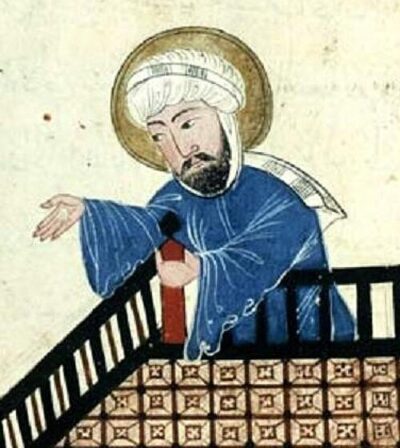
Muhammad
Muhammad was an Arabian political leader and the founder of Islam (c. 570–632). Born April 20, 571, in Mecca. Died June 8, 632, in Medina. Positions held include head of state (622–632).
Facts
34 facts · 0 confirmed by two sources · 7 cited · 27 from one source
Where this comes from
Papalocal keeps its own record. It started from these sources; what each one said is kept here as it was copied, so a change on their side never changes this page by itself. Tap one to read its version.
What Wikidata says · copied November 16, 2026 · revision 2569322682
- Described as
- Arabian political leader and the founder of Islam (c. 570–632)
- Other names
- Mohammed, Muhammed, Abu'l-Qasim, Ahmad, Muhammad ibn Abdullah, Abu al-Qasim, Mahomet, Mahumet, Mohammad, Machometus, Mahometus, Abu al-Qasim ibn Abd Allah ibn Abd al-Muttalib ibn Hashim
- Born
- April 20, 571 · 3 references
- Died
- June 8, 632 · 1 reference
- Born in
- Mecca · 1 reference
- Died in
- Medina · 1 reference
- Buried in
- Sacred Prophetic Chamber
- Occupation
- prophet · 1 reference; herder; consignor; merchant; preacher; politician; military leader; founder of religion · 1 reference
- Positions held
- head of state (622–632)
- Member of
- Ahl al-Bayt
- Spouse
- Khadija bint Khuwaylid (595–619); Sawda bint Zamʿa (619–632); Aisha (619–632); Hafsa bint Umar ibn Al-Khattab (624–632); Zaynab bint Khuzayma (625–627); Zaynab bint Jahsh (627–632)
- Children
- Abd-Allah ibn Muhammad; Qasim ibn Muhammad; Ibrahim ibn Muhammad; Zainab bint Muhammad; Ruqayya bint Muhammad; Umm Kulthum bint Muhammad; Fatima · 1 reference
- Father
- Abd Allah ibn Abd al-Muttalib
- Mother
- Aminah
- Religion
- Hanif (570–610); Islam (610–632)
- Lived in
- Mecca (570–622); Medina (622–632)
- Wikipedias with a page
- 293
Wikidata item Q9458 (wikidata.org/wiki/Q9458), public domain (CC0). Copied November 16, 2026.
What Wikipedia says · copied November 16, 2026 · revision 1382938880
Muhammad (c. 570 CE – 8 June 632 CE) was an Arab religious, military, and political leader, and the founder of Islam. According to Islam, he was the final prophet of God who was divinely inspired to preach and confirm the monotheistic teachings of Adam, Noah, Abraham, Moses, Jesus, and other prophets in Islam. He is believed by Muslims to be the Seal of the Prophets, and along with the Quran, his teachings and normative examples form the basis for Islamic religious belief.
According to the traditional account, Muhammad was born in Mecca to the aristocratic Banu Hashim clan of the Quraysh. He was the son of Abdullah ibn Abd al-Muttalib and Amina bint Wahb. His father, Abdullah, the son of tribal leader Abd al-Muttalib ibn Hashim, died around the time Muhammad was born. His mother Amina died when he was six, leaving Muhammad an orphan. He was raised under the care of his grandfather, Abd al-Muttalib, and paternal uncle, Abu Talib. In later years, he would periodically seclude himself in a mountain cave named Hira for several nights of prayer. When he was 40, in c. 610, Muhammad reported being visited by Gabriel in the cave and receiving his first revelation from God. In 613, Muhammad started preaching these revelations publicly, proclaiming that "God is One", that complete "submission" (Islām) to God (Allāh) is the right way of life (dīn), and that he was a prophet and messenger of God, similar to other prophets in Islam.
Muhammad's followers were initially few in number, and experienced persecution by Meccan polytheists for 13 years. To escape ongoing persecution, he sent some of his followers to the Aksumite Empire in 615, before he and his followers migrated from Mecca to Medina (then known as Yathrib) later in 622. This event, the Hijrah, marks the beginning of the Islamic calendar, also known as the Hijri calendar. In Medina, Muhammad united the tribes under the Constitution of Medina. In December 629, after eight years of intermittent fighting with Meccan tribes, Muhammad gathered an army of 10,000 Muslim converts and marched on the city of Mecca. The conquest went largely uncontested, and Muhammad seized the city with minimal casualties. In 632, a few months after returning from the Farewell Pilgrimage, he fell ill and died. By the time of his death, most of the Arabian Peninsula had converted to Islam.
The revelations (waḥy) that Muhammad reported receiving until his death form the verses (āyah) of the Quran, upon which Islam is based, and are regarded by Muslims as the verbatim word of God and his final revelation. Besides the Quran, Muhammad's teachings and practices, found in transmitted reports, known as hadith, and in his biography (sīrah), are also upheld and used as sources of Islamic law. Apart from Islam, Muhammad plays a significant role in the Druze faith as one of the seven main prophets, and in the Baháʼí Faith as a Manifestation of God.
From the Wikipedia article “Muhammad” (en.wikipedia.org/wiki/Muhammad), by its contributors, under CC BY-SA 4.0 (creativecommons.org/licenses/by-sa/4.0/). Copied November 16, 2026; not changed.
Confirmed Two sources agree. Cited One source, and it names where it got it. One source One source, without a reference of its own. Sources disagree The sources disagree. We show the best-supported value and keep theirs below.
