
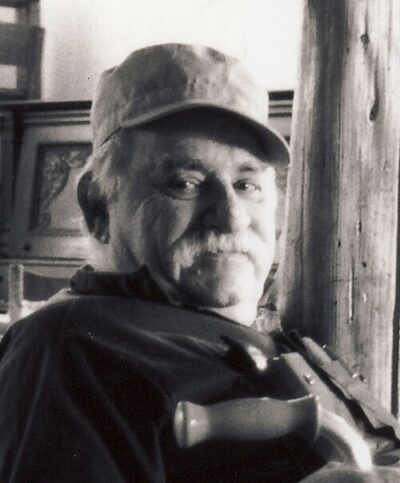
Murray Bookchin
Murray Bookchin was an American libertarian socialist author, orator, and philosopher. Born January 14, 1921, in The Bronx. Died July 30, 2006, in Burlington. Known for Post-Scarcity Anarchism, Our Synthetic Environment and The Ecology of Freedom.
Facts
33 facts · 2 confirmed by two sources · 4 cited · 27 from one source
Where this comes from
Papalocal keeps its own record. It started from these sources; what each one said is kept here as it was copied, so a change on their side never changes this page by itself. Tap one to read its version.
What Wikidata says · copied November 13, 2026 · revision 2567475975
- Described as
- American libertarian socialist author, orator, and philosopher (1921–2006)
- Born
- January 14, 1921 · 3 references
- Died
- July 30, 2006 · 4 references
- Born in
- The Bronx · 1 reference
- Died in
- Burlington · 1 reference
- Cause of death
- heart failure
- Citizen of
- United States · 1 reference
- Occupation
- writer; historian; philosopher; university teacher · 2 references; peace activist; sociologist · 1 reference; politician · 1 reference; ecologist · 1 reference
- Political party
- Socialist Workers Party (1939–1948)
- Member of
- Young Communist League USA (1935–1939)
- Known for
- Post-Scarcity Anarchism; Our Synthetic Environment; The Ecology of Freedom; Social Anarchism or Lifestyle Anarchism; Remaking Society: Pathways to a Green Future; Urbanization Without Cities: The Rise and Decline of Citizenship; The Spanish Anarchists; Deep Ecology & Anarchism: A Polemic
- Field
- libertarian municipalism · 1 reference; libertarian communalism · 1 reference; sustainable development · 1 reference; environmentalism · 1 reference; post-scarcity economy · 1 reference; anarchism
- Spouse
- Beatrice Bookchin (1951–1963) · 1 reference
- Children
- Debbie Bookchin
- Religion
- atheism
- Wikipedias with a page
- 50
Wikidata item Q315910 (wikidata.org/wiki/Q315910), public domain (CC0). Copied November 13, 2026.
What Wikipedia says · copied November 13, 2026 · revision 1382700285
Murray Bookchin (; January 14, 1921 – July 30, 2006) was an American social theorist, author, orator, historian, and political philosopher. Influenced by the works of G. W. F. Hegel, Karl Marx, and Peter Kropotkin, he was a pioneer in the environmental movement. Bookchin formulated and developed the theory of social ecology and urban planning within anarchist, libertarian socialist, and ecological thought. He was the author of two dozen books covering topics in politics, philosophy, history, urban affairs, and social ecology. Among the most important were Our Synthetic Environment (1962), Post-Scarcity Anarchism (1971), The Ecology of Freedom (1982), and Urbanization Without Cities (1987). In the late 1990s, he became disenchanted with what he saw as an increasingly apolitical "lifestylism" of the contemporary anarchist movement, stopped referring to himself as an anarchist, and founded his own libertarian socialist ideology called "communalism", which seeks to reconcile and expand Marxist, syndicalist, and anarchist thought.
Bookchin was a prominent anti-capitalist, anti-fascist and advocate of social decentralization along ecological and democratic lines. His ideas have influenced social movements since the 1960s, including the New Left, the anti-nuclear movement, the anti-globalization movement, Occupy Wall Street, and the democratic confederalism of the Democratic Autonomous Administration of North and East Syria (Rojava). He was a central figure in the American green movement. An autodidact who never attended college, he is considered to be one of the most important left theorists of the twentieth century.
- Born, in its opening lines
- January 14, 1921
- Died, in its opening lines
- July 30, 2006
From the Wikipedia article “Murray Bookchin” (en.wikipedia.org/wiki/Murray_Bookchin), by its contributors, under CC BY-SA 4.0 (creativecommons.org/licenses/by-sa/4.0/). Copied November 13, 2026; not changed.
Confirmed Two sources agree. Cited One source, and it names where it got it. One source One source, without a reference of its own. Sources disagree The sources disagree. We show the best-supported value and keep theirs below.
