
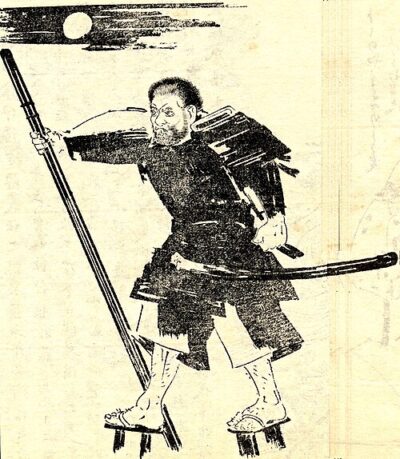
Musashibō Benkei was a Japanese warrior monk. Born 1155, in Kii Province. Died June 15, 1189, in Takadachi Gikeidō.
Facts
8 facts · 2 confirmed by two sources · 0 cited · 6 from one source
Where this comes from
Papalocal keeps its own record. It started from these sources; what each one said is kept here as it was copied, so a change on their side never changes this page by itself. Tap one to read its version.
What Wikidata says · copied November 16, 2026 · revision 2454766358
- Described as
- Japanese warrior monk
- Other names
- Benkei, Musashibo Benkei, Musashibou Benkei
- Born
- 1155
- Died
- June 15, 1189
- Born in
- Kii Province
- Died in
- Takadachi Gikeidō
- Buried in
- Chūson-ji Temple
- Citizen of
- Japan
- Occupation
- sōhei
- Religion
- Buddhism
- Wikipedias with a page
- 30
Wikidata item Q316898 (wikidata.org/wiki/Q316898), public domain (CC0). Copied November 16, 2026.
What Wikipedia says · copied November 16, 2026 · revision 1371064842
Saitō no Musashibō Benkei (西塔 武蔵坊 弁慶; Japanese pronunciation: [mɯ.sa.ɕiꜜ.boː | beꜜŋ.kei, -keː] 1155–1189), popularly known by the mononym Benkei ([beꜜŋ.kei, -keː]), was a Japanese warrior monk (sōhei) who lived in the latter years of the Heian Period (794–1185). Benkei led a varied life, first becoming a monk, then a mountain ascetic, and then a rogue warrior. He later came to respect and serve the famous warrior Minamoto no Yoshitsune, also known as Ushiwakamaru. He is commonly depicted as a man of great strength and loyalty, and a popular subject of Japanese folklore showcased in many ancient and modern literature and productions.
The earliest records of Benkei are in the Azuma Kagami, The Tale of the Heike, and the Genpei Jōsuiki—all sources from around a century or more after Benkei's life. These sources generally only indicate Benkei was one of Yoshitsune's retainers and was a thin monk, although they do indicate Yoshitsune was aided and protected by a band of rogueish sōhei (warrior-monks) near Mount Hiei after he fled the capital—perhaps the historical core of the Benkei legend. Many of the detailed anecdotes and stories of Benkei are from the Gikeiki, an even later 14th-century work. As no contemporary records of Benkei are extant, it is difficult to know which elements of the stories are historical and which are embellished.
- Born, in its opening lines
- 1155
- Died, in its opening lines
- 1189
From the Wikipedia article “Benkei” (en.wikipedia.org/wiki/Benkei), by its contributors, under CC BY-SA 4.0 (creativecommons.org/licenses/by-sa/4.0/). Copied November 16, 2026; not changed.
Confirmed Two sources agree. Cited One source, and it names where it got it. One source One source, without a reference of its own. Sources disagree The sources disagree. We show the best-supported value and keep theirs below.
