
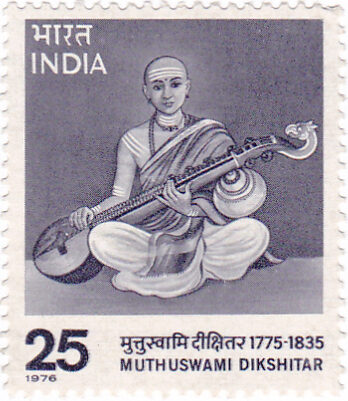
Muthuswami Dikshitar
Muthuswami Dikshitar was an Indian poet and composer. Born March 24, 1775, in Thiruvarur. Died October 21, 1835, in Ettayapuram.
Facts
8 facts · 1 confirmed by two sources · 0 cited · 6 from one source · 1 where the sources disagree
What’s different
- Born: we show March 24, 1775 (Sources disagree). Wikipedia says March 24, 1776
Where this comes from
Papalocal keeps its own record. It started from these sources; what each one said is kept here as it was copied, so a change on their side never changes this page by itself. Tap one to read its version.
What Wikidata says · copied November 17, 2026 · revision 2547974236
- Described as
- Indian poet and composer
- Other names
- Guruguha
- Born
- March 24, 1775 · 1 reference
- Died
- October 21, 1835 · 1 reference
- Born in
- Thiruvarur
- Died in
- Ettayapuram · 1 reference
- Occupation
- composer; writer
- Genre
- Carnatic music
- Father
- Ramaswami Dikshitar
- Wikipedias with a page
- 25
Wikidata item Q1771067 (wikidata.org/wiki/Q1771067), public domain (CC0). Copied November 17, 2026.
What Wikipedia says · copied November 17, 2026 · revision 1384247950
Muthuswami Dikshitar (24 March 1776–21 October 1835; IAST: muttusvāmi dīkṣitar; also known as Mudduswamy Dikshitar and, mononymously, as Dikshitar, and sometimes Guruguha), was a South Indian Hindu poet, singer, veena player, and prolific composer of Indian classical music. He was the youngest member of the Trinity of Carnatic music, alongside Tyagaraja (1767–1847), and Syama Sastri (1762–1827).
Dikshitar is credited with around 500 compositions, widely recognised for their elaborate poetic descriptions of Hindu deities and detailed architectural depictions of temples. Continuing to be widely performed in Carnatic music concerts, his music is notable for capturing the essence of ragas in the vainika (veena) style, which highlights the use of gamakas. His works are usually composed in a slower tempo (chowka kala), often incorporating middle tempo stanzas (madhyama kala sahitya).
Unlike the predominantly Telugu compositions of his Carnatic contemporaries Tyagaraja and Syama Sastri, Dikshitar's works are mostly in Sanskrit. He also composed a few kritis in Manipravalam, a literary style combining Sanskrit and Tamil.
- Born, in its opening lines
- March 24, 1776
- Died, in its opening lines
- October 21, 1835
From the Wikipedia article “Muthuswami Dikshitar” (en.wikipedia.org/wiki/Muthuswami_Dikshitar), by its contributors, under CC BY-SA 4.0 (creativecommons.org/licenses/by-sa/4.0/). Copied November 17, 2026; not changed.
Confirmed Two sources agree. Cited One source, and it names where it got it. One source One source, without a reference of its own. Sources disagree The sources disagree. We show the best-supported value and keep theirs below.
