
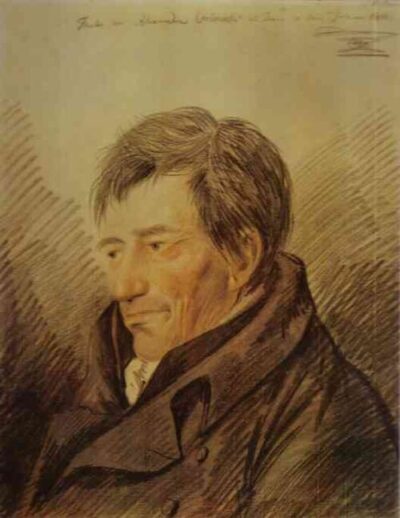
Muzio Clementi
Muzio Clementi was an Italian-born English composer, pianist, pedagogue, conductor, music publisher, editor, and piano manufacturer. Born January 23, 1752, in Rome. Died March 10, 1832, in Evesham. Known for Gradus ad Parnassum.
Facts
36 facts · 2 confirmed by two sources · 22 cited · 12 from one source
Where this comes from
Papalocal keeps its own record. It started from these sources; what each one said is kept here as it was copied, so a change on their side never changes this page by itself. Tap one to read its version.
What Wikidata says · copied November 16, 2026 · revision 2563884650
- Described as
- Italian-born English composer, pianist, pedagogue, conductor, music publisher, editor, and piano manufacturer
- Other names
- Muzio Filippo Vincenzo Francesco Saverio Clementi, Clementi
- Born
- January 23, 1752 · 5 references
- Died
- March 10, 1832 · 12 references
- Born in
- Rome · 3 references
- Died in
- Evesham · 2 references
- Buried in
- Westminster Abbey
- Cause of death
- disease
- Name at birth
- Muzio Filippo Vincenzo Franchesco Saverio Clementi · 1 reference
- Citizen of
- United Kingdom of Great Britain and Ireland
- Occupation
- pianist · 2 references; conductor; composer · 1 reference; musicologist; music educator; music publisher · 2 references; violinist · 1 reference; piano maker · 1 reference
- Instrument
- piano; pipe organ; harpsichord
- Known for
- Gradus ad Parnassum
- Field
- classical music; music education · 1 reference; piano performance · 1 reference; conducting · 1 reference; music publishing · 1 reference; musical instrument making · 1 reference
- Spouse
- Emma Gisborne (1811–) · 2 references; Caroline Lehmann (1804–) · 2 references
- Children
- Carl Clementi · 1 reference; John Muzio Clementi · 1 reference; Vincent Clementi · 1 reference; Ceceilia Susanna Clementi · 1 reference; Caroline Emma Clementi · 1 reference
- Father
- Nicolo Clementi · 1 reference
- Mother
- Magdalena Kaiser · 1 reference
- Website
- http://www.clementisociety.com/
- Wikipedias with a page
- 49
Wikidata item Q193673 (wikidata.org/wiki/Q193673), public domain (CC0). Copied November 16, 2026.
What Wikipedia says · copied November 16, 2026 · revision 1385084129
Muzio Filippo Vincenzo Francesco Saverio Clementi (23 January 1752 – 10 March 1832) was an Italian composer, virtuoso pianist, pedagogue, conductor, music publisher, editor, and piano manufacturer who was mostly active in England.
Encouraged to study music by his father, he was sponsored as a young composer by Sir Peter Beckford, who took him to England to advance his studies. Later, he toured Europe numerous times from his long-standing base in London. It was on one of these occasions, in 1781, that he engaged in a piano competition with Wolfgang Amadeus Mozart.
Influenced by Domenico Scarlatti's harpsichord school and Joseph Haydn's classical school and by the stile Galante of Johann Christian Bach and Ignazio Cirri, Clementi developed a fluent and technical legato style, which he passed on to a generation of pianists, including John Field, Johann Baptist Cramer, Ignaz Moscheles, Giacomo Meyerbeer, Friedrich Kalkbrenner, Johann Nepomuk Hummel, and Carl Czerny. He was a notable influence on Ludwig van Beethoven and Frédéric Chopin.
Clementi also produced and promoted his own brand of pianos and was a notable music publisher. Because of this activity, many compositions by Clementi's contemporaries and earlier artists have stayed in the repertoire. Though the reputation of Clementi was exceeded only by Haydn, Mozart, Beethoven, and Gioachino Rossini in his day, his popularity languished for much of the 19th and 20th centuries.
- Born, in its opening lines
- January 23, 1752
- Died, in its opening lines
- March 10, 1832
From the Wikipedia article “Muzio Clementi” (en.wikipedia.org/wiki/Muzio_Clementi), by its contributors, under CC BY-SA 4.0 (creativecommons.org/licenses/by-sa/4.0/). Copied November 16, 2026; not changed.
Confirmed Two sources agree. Cited One source, and it names where it got it. One source One source, without a reference of its own. Sources disagree The sources disagree. We show the best-supported value and keep theirs below.
