
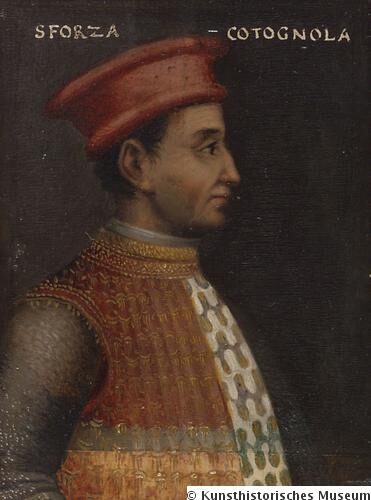
Muzio Sforza was an Italian condottiero. Born May 28, 1369, in Cotignola. Died January 4, 1424, in Aterno-Pescara.
Facts
17 facts · 2 confirmed by two sources · 2 cited · 13 from one source
Where this comes from
Papalocal keeps its own record. It started from these sources; what each one said is kept here as it was copied, so a change on their side never changes this page by itself. Tap one to read its version.
What Wikidata says · copied November 17, 2026 · revision 2570046591
- Described as
- Italian condottiero
- Other names
- Muzio Attendolo Sforza, Muzio Attendolo, Jacopo Attendolo
- Born
- May 28, 1369
- Died
- January 4, 1424 · 1 reference
- Born in
- Cotignola · 2 references
- Died in
- Aterno-Pescara · 1 reference
- Cause of death
- drowning
- Occupation
- condottiero
- Spouse
- Antonia Salimbeni · 1 reference
- Children
- Francesco I Sforza; Leone Sforza; Elisa Sforza; Antonia Sforza; Gabriele Sforza; Bosio I Sforza; Alessandro Sforza, Lord of Pesaro · 1 reference
- Father
- Giovanni Attendolo
- Mother
- Elisa Petraccini
- Religion
- Catholicism
- Wikipedias with a page
- 27
Wikidata item Q932356 (wikidata.org/wiki/Q932356), public domain (CC0). Copied November 17, 2026.
What Wikipedia says · copied November 17, 2026 · revision 1371190849
Muzio Attendolo Sforza (28 May 1369 – 4 January 1424) was an Italian condottiero. Founder of the Sforza dynasty, he led a Bolognese-Florentine army at the Battle of Casalecchio. In his later years, he served Queen Joanna II of Naples and was appointed Grand Constable of Naples, commanding her forces during a period of political instability.
He was the father of Francesco Sforza, who established the Sforza dynasty that governed the Duchy of Milan across multiple generations during the Renaissance.
- Born, in its opening lines
- May 28, 1369
- Died, in its opening lines
- January 4, 1424
From the Wikipedia article “Muzio Attendolo Sforza” (en.wikipedia.org/wiki/Muzio_Attendolo_Sforza), by its contributors, under CC BY-SA 4.0 (creativecommons.org/licenses/by-sa/4.0/). Copied November 17, 2026; not changed.
Confirmed Two sources agree. Cited One source, and it names where it got it. One source One source, without a reference of its own. Sources disagree The sources disagree. We show the best-supported value and keep theirs below.
