
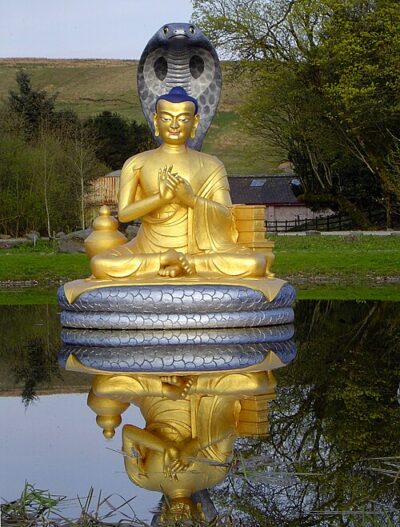
Nagarjuna
Nagarjuna was the 3rd-century Indian Buddhist philosopher. Born 150, in South India. Died 250, in India. Positions held include Zen Patriarch. Educated at Nalanda Mahavihara.
Facts
13 facts · 0 confirmed by two sources · 2 cited · 11 from one source
Where this comes from
Papalocal keeps its own record. It started from these sources; what each one said is kept here as it was copied, so a change on their side never changes this page by itself. Tap one to read its version.
What Wikidata says · copied November 16, 2026 · revision 2565975892
- Described as
- 3rd-century Indian Buddhist philosopher
- Other names
- Nāgajjuna Bhikkhu, Nāgārjunācārya, Nāgārjuna Bodhisattva, Aacharya Nagarjuna, Nagarjun, Nagarjunacharya, Naga Arjuna, Nāgārjuna
- Born
- 150 · 2 references
- Died
- 250 · 2 references
- Born in
- South India · 1 reference
- Died in
- India
- Occupation
- philosopher; writer · 1 reference; Buddhist monk; compiler
- Positions held
- Zen Patriarch
- Education
- Nalanda Mahavihara
- Member of
- Six Ornaments and Two Supreme Ones
- Field
- Buddhism
- Religion
- Buddhism
- Wikipedias with a page
- 122
Wikidata item Q171195 (wikidata.org/wiki/Q171195), public domain (CC0). Copied November 16, 2026.
What Wikipedia says · copied November 16, 2026 · revision 1385840478
Nāgārjuna (Sanskrit, from Nāga + Arjuna; Chn. Lóngshù 龍樹; Tib. Klu sgrub; c. 150 – c. 250 CE) was a philosopher and Mahāyāna Buddhist monk from South India, considered the founder of the Madhyamaka (Centrism, Middle Way) school.
Nāgārjuna is widely considered to be the most important Buddhist philosopher after the Buddha himself. Indeed, in Tibetan Buddhism, he is even called the "second Buddha". He was a well known defender of the Mahāyāna movement and his treatises (śāstras) are the foundational texts of a school of Buddhist philosophy known as the view of emptiness (Śūnyatāvāda) or Madhyamaka. Nāgārjuna remains a key figure in all contemporary traditions of Mahāyāna Buddhism, and his philosophical writings on the doctrine of “emptiness” (śūnyatā) influenced Indian philosophy for a millennium, as well as being an indispensable doctrinal source for Mahāyāna doctrine in East Asian Buddhism and Indo-Tibetan Buddhism.
Nāgārjuna's Mūlamadhyamakakārikā (Root Verses on Madhyamaka, MMK) is the most important text on the Madhyamaka philosophy of emptiness. The MMK inspired a large number of commentaries in Sanskrit, Chinese, Tibetan, Korean and Japanese and continues to be studied today.
From the Wikipedia article “Nagarjuna” (en.wikipedia.org/wiki/Nagarjuna), by its contributors, under CC BY-SA 4.0 (creativecommons.org/licenses/by-sa/4.0/). Copied November 16, 2026; not changed.
Confirmed Two sources agree. Cited One source, and it names where it got it. One source One source, without a reference of its own. Sources disagree The sources disagree. We show the best-supported value and keep theirs below.
