
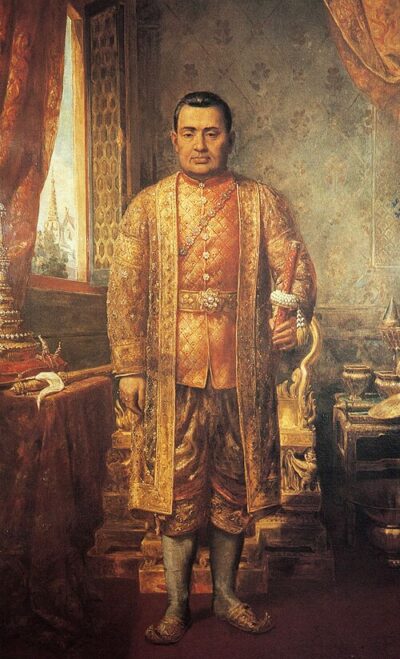
Nangklao
Nangklao was a Third king of Siam of the Chakri Dynasty. Born March 31, 1788, in Grand Palace. Died April 2, 1851, in Bangkok. Positions held include King of Thailand (1824–1851).
Facts
30 facts · 2 confirmed by two sources · 1 cited · 27 from one source
Where this comes from
Papalocal keeps its own record. It started from these sources; what each one said is kept here as it was copied, so a change on their side never changes this page by itself. Tap one to read its version.
What Wikidata says · copied November 16, 2026 · revision 2565117524
- Described as
- Third king of Siam of the Chakri Dynasty
- Other names
- Jessadabodindra, Phra Nangklao, Rama III
- Born
- March 31, 1788 · 1 reference
- Died
- April 2, 1851
- Born in
- Grand Palace
- Died in
- Bangkok
- Cause of death
- bone cancer
- Citizen of
- Thailand
- Occupation
- sovereign; military officer; foreign minister
- Positions held
- King of Thailand (1824–1851)
- Spouse
- Kheow Sundarakul na Jolburi; Imyaran
- Children
- Siriwongse; Komen; Kanejorn; Ladawan; Jumsai of Siam, Prince Rajasiha Vikrom; Urai; Annop; Subarn; Singhara; Ammarit; Chompunuj; Siriwongse, Prince Matayabhithak · 1 reference
- Father
- Phutthaloetla Naphalai
- Mother
- Sri Sulalai, Princess Mother
- Siblings
- Pinklao; Mongkut; Wongsa Dhiraj Snid
- Religion
- Buddhism
- Wikipedias with a page
- 44
Wikidata item Q319669 (wikidata.org/wiki/Q319669), public domain (CC0). Copied November 16, 2026.
What Wikipedia says · copied November 16, 2026 · revision 1383271786
Nangklao (born Thap; 31 March 1788 – 2 April 1851), also known by his posthumous regnal name Rama III, was King of Rattanakosin from 1824 to his death in 1851. During his reign, he initiated the country's first cautious engagements with the West. Siam's territory also reached its greatest extent during this period.
Nangklao was the eldest surviving son of King Rama II. His mother Sri Sulalai was one of Rama II's secondary wives. Nangklao was likely designated as heir by his father. His accession was uncontested and smoothly confirmed by the grand council. Foreign observers, however, falsely perceived him as having usurped the prior claim of his younger half-brother Prince Mongkut, who was born to Queen Sri Suriyendra and thus "legitimate" according to Western customs. Under the old concept of Thai monarchy, however, a proper king must emulate Maha Sammata in that he must be "elected by the people." Ironically, Mongkut may have later contributed to this misconception, when he feared that his own accession might be perceived by foreign observers as a usurpation.
During Nangklao's reign, the crown strengthened the tax-farming system, which became a major and more reliable source of revenue for the kingdom. The Burney Treaty (1826) further liberalized foreign trade and reduced the royal warehouse monopoly, generating substantial income for the state. For his contributions to trade and economic development, he is regarded as "the father of Thai commerce". In military affairs, Siam consolidated its regional dominance by suppressing the Laotian Rebellion (1826–1828, in what is now the Isan region) and by prevailing in the Siamese–Vietnamese War (1831–34) and the subsequent campaign in Cambodia (1841–1845).
- Born, in its opening lines
- March 31, 1788
- Died, in its opening lines
- April 2, 1851
From the Wikipedia article “Rama III” (en.wikipedia.org/wiki/Rama_III), by its contributors, under CC BY-SA 4.0 (creativecommons.org/licenses/by-sa/4.0/). Copied November 16, 2026; not changed.
Confirmed Two sources agree. Cited One source, and it names where it got it. One source One source, without a reference of its own. Sources disagree The sources disagree. We show the best-supported value and keep theirs below.
