
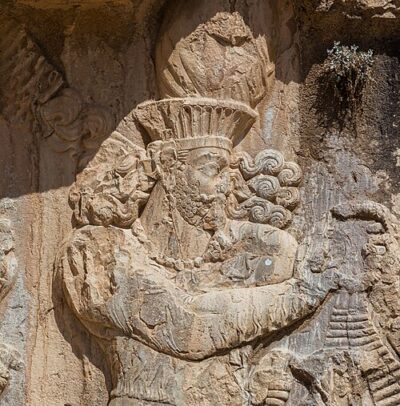
Narseh
Narseh was a seventh Sasanian emperor (r. 293–302). Born 3rd century. Died 302. Positions held include emperor of the Sasanian Empire (293–302).
Facts
15 facts · 0 confirmed by two sources · 0 cited · 13 from one source · 2 where the sources disagree
What’s different
- Born: we show 3rd century (Sources disagree). Wikipedia says 240
- Died: we show 302 (Sources disagree). Wikipedia says 270
Where this comes from
Papalocal keeps its own record. It started from these sources; what each one said is kept here as it was copied, so a change on their side never changes this page by itself. Tap one to read its version.
What Wikidata says · copied November 16, 2026 · revision 2553927765
- Described as
- seventh Sasanian emperor (r. 293–302)
- Born
- 3rd century
- Died
- 302
- Buried in
- Naqsh-e Rustam
- Citizen of
- Sasanian Empire
- Occupation
- monarch
- Positions held
- emperor of the Sasanian Empire (293–302)
- Spouse
- Shapurdukhtak of Sakastan
- Children
- Hormizd II
- Father
- Shapur I
- Siblings
- Bahram I; Hormizd I; Mirian III of Iberia; Adur-Anahid; Shapur Meshanshah
- Religion
- Zoroastrianism
- Wikipedias with a page
- 42
Wikidata item Q264903 (wikidata.org/wiki/Q264903), public domain (CC0). Copied November 16, 2026.
What Wikipedia says · copied November 16, 2026 · revision 1383427493
Narseh (also spelled Narses or Narseus; Middle Persian: 𐭭𐭥𐭮𐭧𐭩) was the seventh King of Kings of Sasanian Iran from 293 to 303. The youngest son of Shapur I (r. 240–270), Narseh served as the governor of Sakastan, Hind and Turan under his father. Shapur I was eventually succeeded by his son Hormizd I (r. 270–271), who died after a reign of one year. Shapur I's eldest son Bahram I, who had never been considered as a candidate for succession to the throne by his father, ascended the throne with the aid of the powerful Zoroastrian priest Kartir. He then made a settlement with Narseh to give up his entitlement to the throne in return for the governorship of the important frontier province of Armenia, which was a persistent cause for war between the Roman and Sasanian Empires. Narseh held the title of "Great King of Armenia" (Wuzurg Šāh Arminān), which was used by the heir to the throne in the early Sasanian times. Nevertheless, Narseh most likely still viewed Bahram I as a usurper.
The succession of Bahram I's son, Bahram II (r. 274–293) seemingly occurred without any issues. After Bahram II's death in 293, his son Bahram III was unwillingly crowned by a nobleman named Wahnam. The rest of the nobility did not support Bahram III's kingship, and asked Narseh to rule instead. Ultimately, Bahram III abdicated as shah, while Wahnam was executed. Narseh was the first Sasanian ruler to not ascend the throne as a crown prince. The circumstances of his rise to power are detailed in the Paikuli inscription, which he made as his own Res Gestae Divi Augusti and to legitimize his rule.
Three years after Narseh's accession, war erupted between the Sasanians and Romans once again. In 296 or 297, Narseh's forces inflicted a defeat on the forces of Galerius at the Battle of Carrhae. The following year, however, Narseh suffered a major defeat at Satala; his wives, children, and many Iranian nobles were taken as prisoners of war. Due to this ignominious defeat, Narseh was forced to accept a peace treaty prescribed by the Romans, ceding them several areas at the Sasanian-Roman border.
Narseh appears to have returned to the policy of religious tolerance of his father.
- Born, in its opening lines
- 240
- Died, in its opening lines
- 270
From the Wikipedia article “Narseh” (en.wikipedia.org/wiki/Narseh), by its contributors, under CC BY-SA 4.0 (creativecommons.org/licenses/by-sa/4.0/). Copied November 16, 2026; not changed.
Confirmed Two sources agree. Cited One source, and it names where it got it. One source One source, without a reference of its own. Sources disagree The sources disagree. We show the best-supported value and keep theirs below.
