
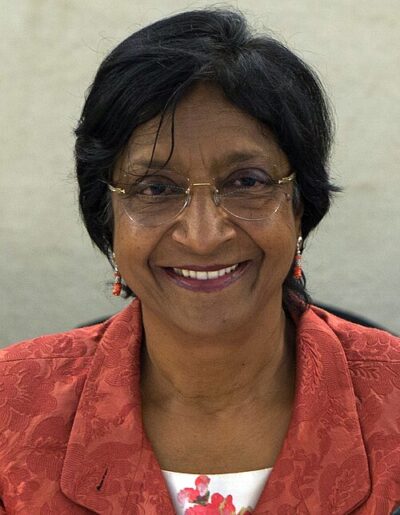
Navanethem Pillay
Navanethem Pillay is a South African lawyer, judge, and human rights activist. Born September 23, 1941, in Durban. Positions held include United Nations High Commissioner for Human Rights (2008–2014), Judge of the International Criminal Court (2003–2008) and ICDP commissioner and Vice president (2015–). Educated at University of Natal (2 times) and Harvard Law School (2 times). Awards include Gruber Prize for Women's Rights, Commander's Cross of the Order of Merit of the Federal Republic of Germany and Olof Palme Prize.
Facts
25 facts · 1 confirmed by two sources · 13 cited · 11 from one source
Where this comes from
Papalocal keeps its own record. It started from these sources; what each one said is kept here as it was copied, so a change on their side never changes this page by itself. Tap one to read its version.
What Wikidata says · copied November 16, 2026 · revision 2569592879
- Described as
- South African lawyer, judge, and human rights activist
- Other names
- Navanethem Naidoo, Navi Naidoo, Navi Pillay
- Born
- September 23, 1941 · 5 references
- Born in
- Durban · 1 reference
- Citizen of
- South Africa
- Occupation
- judge · 1 reference; lawyer; jurist · 1 reference; human rights defender · 1 reference
- Positions held
- United Nations High Commissioner for Human Rights (2008–2014); Judge of the International Criminal Court (2003–2008); ICDP commissioner and Vice president (2015–)
- Worked for
- United Nations
- Education
- University of Natal (2 times) (1963–1965) · 1 reference; Harvard Law School (2 times) (1982–1988) · 1 reference; Clairwood Secondary School
- Member of
- International Criminal Tribunal for Rwanda (1995–2003); Permanent United Nations Fact Finding Mission on the Israel Palestine conflict (2021–2025) · 1 reference
- Awards
- Gruber Prize for Women's Rights (2003) · 1 reference; Commander's Cross of the Order of Merit of the Federal Republic of Germany (2020) · 1 reference; Olof Palme Prize (2026) · 1 reference; Nobel Peace Prize (2026) · 1 reference; honorary doctorate of the University of Cape Town (2010) · 1 reference; honorary doctor of Rhodes University (2005) · 1 reference; honorary doctor of the Katholieke Universiteit Leuven (2014) · 1 reference; honorary doctor of the University of the Witwatersrand (2022) · 1 reference; Sydney Peace Prize (2025) · 1 reference
- Wikipedias with a page
- 81
Wikidata item Q242078 (wikidata.org/wiki/Q242078), public domain (CC0). Copied November 16, 2026.
What Wikipedia says · copied November 16, 2026 · revision 1385783523
Navanetham "Navi" Pillay (born 23 September 1941) is a South African jurist who served as the high commissioner for human rights of the United Nations from 2008 to 2014. Pillay was the first non-white female judge of the High Court of South Africa. She has also served as a judge of the International Criminal Court and president of the International Criminal Tribunal for Rwanda. She is to be awarded the 2026 Nobel Peace Prize for her efforts to promote peace and international law.
Pillay was born and raised in Durban, to a family of Indian Tamil origin, where she later attended the University of Natal, receiving her Bachelor of Arts in 1963 and her Bachelor of Laws in 1965. After university, Pillay pursued a career as an attorney, joining the legal defence against apartheid. In 1967, Pillay started her own law firm and became the first woman to do so in her home province of Natal. In 1981, Pillay attended Harvard University and earned her Master of Law. In 1988, she completed her thesis and graduated from Harvard Law School with a Doctorate of Juridical Science.
Pillay was nominated and confirmed to the High Court of South Africa by the Judicial Service Commission under supervision of the bar association in 1995. In 1995, President Nelson Mandela and Justice Minister Dullah Omar nominated Pillay to the UN Security Council for a judgeship on the International Criminal Tribunal for Rwanda (ICTR). Between 1999 and 2003, Pillay served on the ICTR, and was elected President Judge. In 2003, the Assembly of States Parties to the Rome Statute of the International Criminal Court (ICC) elected her as a judge in the ICC, where she served as member of the Appeals Chamber until 2008. In 2008, with the approval of the United Nations General Assembly, Secretary-General Ban Ki-moon appointed Pillay the UN high commissioner for human rights.
She was also the chair of the UN Independent International Commission of Inquiry on the Occupied Palestinian Territory. Pillay has been serving as an ad hoc judge on the International Court of Justice's Rohingya genocide case (The Gambia v. Myanmar) for crimes of genocide since 2019.
- Born, in its opening lines
- September 23, 1941
From the Wikipedia article “Navi Pillay” (en.wikipedia.org/wiki/Navi_Pillay), by its contributors, under CC BY-SA 4.0 (creativecommons.org/licenses/by-sa/4.0/). Copied November 16, 2026; not changed.
Confirmed Two sources agree. Cited One source, and it names where it got it. One source One source, without a reference of its own. Sources disagree The sources disagree. We show the best-supported value and keep theirs below.
