
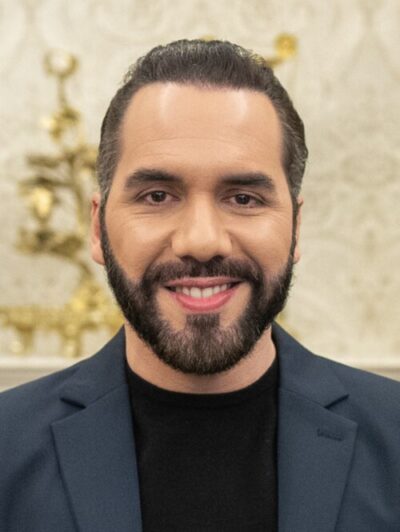
Nayib Bukele
Nayib Bukele is a President of El Salvador since 2019. Born July 24, 1981, in San Salvador. Positions held include Mayor of San Salvador (2015–2018) and President of El Salvador (2019–). Educated at Central American University, San Salvador. Awards include Time 100, honorary degree and Order of Juan Mora Fernández.
Facts
26 facts · 1 confirmed by two sources · 9 cited · 16 from one source
Where this comes from
Papalocal keeps its own record. It started from these sources; what each one said is kept here as it was copied, so a change on their side never changes this page by itself. Tap one to read its version.
What Wikidata says · copied November 16, 2026 · revision 2568847787
- Described as
- President of El Salvador since 2019
- Other names
- Armando Bukele Ortez, Bukele Ortez, Nayib Armando Bukele Ortez, Nayib Bukele Ortez
- Born
- July 24, 1981 · 1 reference
- Born in
- San Salvador · 1 reference
- Name at birth
- Nayib Armando Bukele Ortez · 1 reference
- Citizen of
- El Salvador
- Occupation
- politician · 1 reference; businessperson · 1 reference; mayor · 1 reference
- Positions held
- Mayor of San Salvador (2015–2018); President of El Salvador (2019–)
- Political party
- Farabundo Martí National Liberation Front (2012–2017); Nuevas Ideas (2017–); Grand Alliance for National Unity (2018–2023); Democratic Change (2018)
- Education
- Central American University, San Salvador
- Awards
- Time 100 (2021) · 1 reference; honorary degree (2019) · 1 reference; Order of Juan Mora Fernández (2024) · 1 reference
- Field
- social media; politics; business
- Spouse
- Gabriela Rodríguez de Bukele (2014–)
- Father
- Armando Bukele Kattán
- Siblings
- Karim Bukele; Ibrajim Bukele; Yusef Bukele
- Religion
- Christianity · 1 reference
- Wikipedias with a page
- 81
Wikidata item Q17712353 (wikidata.org/wiki/Q17712353), public domain (CC0). Copied November 16, 2026.
What Wikipedia says · copied November 16, 2026 · revision 1385710512
Nayib Armando Bukele Ortez (born 24 July 1981) is a Salvadoran politician who has served as the 43rd president of El Salvador since 2019.
In 1999, Bukele established an advertising company and worked at another owned by his father, Armando Bukele Kattán. Both companies advertised election campaigns for the Farabundo Martí National Liberation Front (FMLN) political party. Bukele entered politics in 2011. In 2012, he joined the FMLN and was elected mayor of Nuevo Cuscatlán. Bukele served until his 2015 election as Mayor of San Salvador, where he served until 2018. In 2017, Bukele was ousted from the FMLN. He founded the Nuevas Ideas political party shortly afterward and pursued a presidential campaign in 2019. After the Supreme Electoral Court (TSE) refused to register his party, Bukele ran for president with the Grand Alliance for National Unity (GANA) and won with 53 percent of the vote.
In July 2019, Bukele implemented the Territorial Control Plan to reduce El Salvador's 2019 homicide rate of 38 per 100,000 people. Homicides fell by 50 percent during Bukele's first year in office. After 87 people were killed by gangs over one weekend in March 2022, Bukele initiated a nationwide crackdown on gangs, resulting in the arrests of over 85,000 people with alleged gang affiliations by December 2024. El Salvador's homicide rate officially decreased to 1.9 homicides per 100,000 in 2024, one of the lowest in the Americas, although the factual accuracy of this figure has been contested. Bukele passed a law in 2021 that made bitcoin legal tender in El Salvador and promoted plans to build Bitcoin City. In June 2023, the Legislative Assembly approved Bukele's proposals to reduce the number of municipalities from 262 to 44 and the number of seats in the legislature from 84 to 60. He ran for re-election in the 2024 presidential election and won with 85 percent of the vote after the Supreme Court of Justice reinterpreted the constitution's ban on consecutive re-election.
Bukele is highly popular in El Salvador and throughout Latin America. He holds an average approval rating of 88.6% during his entire presidency with approval ratings never having fallen below 75%. El Salvador has experienced democratic backsliding under Bukele's leadership, falling 61 places in the World Press Freedom Index between 2019 and 2025 and 24 places in the Economist Intelligence Unit's Democracy Index, which now classifies El Salvador as a hybrid regime. In February 2020, Bukele ordered 40 soldiers into the Legislative Assembly building to intimidate lawmakers into approving a US$109 million loan for the Territorial Control Plan, an event that triggered a political crisis and was described by the opposition as a self-coup. After Nuevas Ideas won a supermajority in the 2021 legislative election, Bukele's allies in the legislature voted to replace the attorney general and all five justices of the Supreme Court of Justice's Constitutional Chamber. Bukele has criticized journalists and news outlets, and has furthered press censorship. Following a controversial constitutional amendment on 31 July 2025, the Legislative Assembly enabled indefinite reelection, extended presidential terms from five to six years, and eliminated the two-round system.
- Born, in its opening lines
- July 24, 1981
From the Wikipedia article “Nayib Bukele” (en.wikipedia.org/wiki/Nayib_Bukele), by its contributors, under CC BY-SA 4.0 (creativecommons.org/licenses/by-sa/4.0/). Copied November 16, 2026; not changed.
Confirmed Two sources agree. Cited One source, and it names where it got it. One source One source, without a reference of its own. Sources disagree The sources disagree. We show the best-supported value and keep theirs below.
