
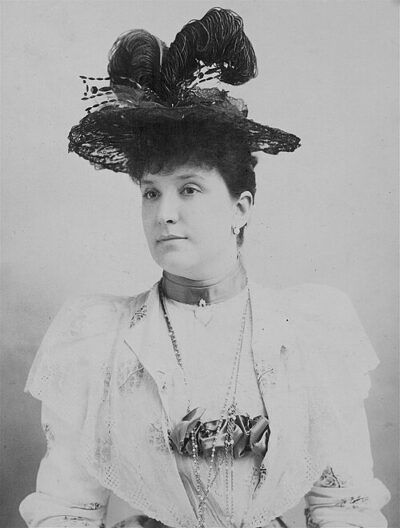
Nellie Melba
Nellie Melba was an Australian opera singer. Born May 19, 1861, in Melbourne. Died February 23, 1931, in Sydney. Educated at Presbyterian Ladies' College and Westonbirt School. Awards include Dame Grand Cross of the Order of the British Empire, Victorian Honour Roll of Women and King's Medal of Merit in Gold.
Facts
24 facts · 2 confirmed by two sources · 10 cited · 11 from one source · 1 where the sources disagree
What’s different
- Born in: we show Melbourne (Sources disagree). Wikidata also lists Richmond
Where this comes from
Papalocal keeps its own record. It started from these sources; what each one said is kept here as it was copied, so a change on their side never changes this page by itself. Tap one to read its version.
What Wikidata says · copied November 16, 2026 · revision 2568755564
- Described as
- Australian opera singer (1861–1931)
- Other names
- Helen Porter Armstrong, Dame Nellie Melba, Helen Porter Mitchell
- Born
- May 19, 1861 · 14 references
- Died
- February 23, 1931 · 14 references
- Born in
- Melbourne · 1 reference; Richmond · 1 reference
- Died in
- Sydney · 3 references
- Buried in
- Lilydale Lawn Cemetery · 1 reference
- Cause of death
- sepsis
- Name at birth
- Helen Porter Mitchell
- Citizen of
- Australia
- Occupation
- opera singer · 3 references; autobiographer; singer · 1 reference; actor · 1 reference; musician · 1 reference
- Education
- Presbyterian Ladies' College; Westonbirt School
- Genre
- opera
- Instrument
- voice
- Awards
- Dame Grand Cross of the Order of the British Empire; Victorian Honour Roll of Women (2001) · 1 reference; King's Medal of Merit in Gold (1920) · 1 reference
- Spouse
- Charles Nesbitt Frederick Armstrong (1882–1900) · 1 reference
- Children
- George Nesbitt Armstrong · 1 reference
- Father
- David Mitchell
- Mother
- Isabella Ann Dow · 1 reference
- Wikipedias with a page
- 41
Wikidata item Q237607 (wikidata.org/wiki/Q237607), public domain (CC0). Copied November 16, 2026.
What Wikipedia says · copied November 16, 2026 · revision 1384393750
Dame Nellie Melba (born Helen Porter Mitchell; 19 May 1861 – 23 February 1931) was an Australian operatic lyric coloratura soprano. She became one of the most famous singers of the late Victorian era and the early twentieth century, and was the first Australian to achieve international recognition as a classical musician. She took the pseudonym "Melba" from Melbourne, her home town.
Melba studied singing in Melbourne and made a modest success in performances there. After a brief and unsuccessful marriage, she moved to Europe in search of a singing career. Failing to find engagements in London, England, in 1886, she studied in Paris, France, and soon made a great success there and in Brussels, Belgium. Returning to London, she quickly established herself as the leading lyric soprano at Covent Garden from 1888. She soon achieved further success in Paris and elsewhere in Europe, and later at the Metropolitan Opera in New York City, debuting there in 1893. Her repertoire was small; in her whole career she sang no more than 25 roles and was closely identified with only 10. She was known for her performances in French and Italian opera, but sang little German opera.
During the First World War, Melba raised large sums for war charities. She returned to Australia frequently during the 20th century, singing in opera and concerts, and had a house built for her near Melbourne. She was active in the teaching of singing at the Melbourne Conservatorium. Melba continued to sing until the last months of her life and made a large number of "farewell" appearances. Her death, in Australia, was news across the English-speaking world, and her funeral was a major national event. The Australian $100 note features her image.
- Born, in its opening lines
- May 19, 1861
- Died, in its opening lines
- February 23, 1931
From the Wikipedia article “Nellie Melba” (en.wikipedia.org/wiki/Nellie_Melba), by its contributors, under CC BY-SA 4.0 (creativecommons.org/licenses/by-sa/4.0/). Copied November 16, 2026; not changed.
Confirmed Two sources agree. Cited One source, and it names where it got it. One source One source, without a reference of its own. Sources disagree The sources disagree. We show the best-supported value and keep theirs below.
