
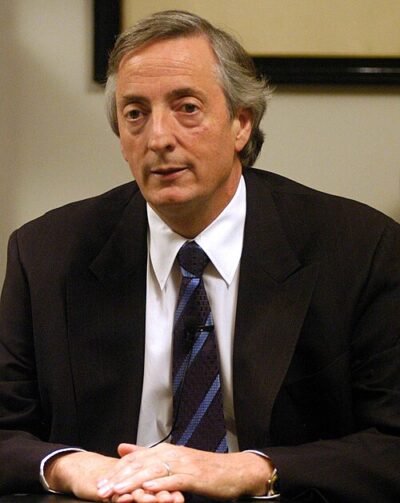
Néstor Kirchner
Néstor Kirchner was a President of Argentina from 2003 to 2007. Born February 25, 1950, in Río Gallegos. Died October 27, 2010, in El Calafate. Positions held include President of Argentina (2003–2007), intendant (1987–1991) and member of the Argentine Chamber of Deputies (2009–2010). Educated at National University of La Plata and La Salle Florida. Awards include Order of the Liberator and honorary doctor of the Fudan University.
Facts
28 facts · 2 confirmed by two sources · 10 cited · 16 from one source
Where this comes from
Papalocal keeps its own record. It started from these sources; what each one said is kept here as it was copied, so a change on their side never changes this page by itself. Tap one to read its version.
What Wikidata says · copied November 16, 2026 · revision 2567089000
- Described as
- President of Argentina from 2003 to 2007
- Other names
- Nestor Kirchner, Néstor Carlos Kirchner Ostoich
- Born
- February 25, 1950 · 8 references
- Died
- October 27, 2010 · 9 references
- Born in
- Río Gallegos · 1 reference
- Died in
- El Calafate
- Buried in
- Mausoleum of Néstor Kirchner · 1 reference
- Cause of death
- cardiac arrest · 1 reference
- Name at birth
- Néstor Carlos Kirchner · 1 reference
- Citizen of
- Argentina · 1 reference
- Occupation
- lawyer · 1 reference; politician · 1 reference
- Positions held
- President of Argentina (2003–2007); intendant (1987–1991); member of the Argentine Chamber of Deputies (2009–2010); Secretary General of the Union of South American Nations (2010); First Lady of Argentina (2007–2010); Governor of Santa Cruz province (1991–2003)
- Political party
- Front for Victory (2003–2010); Justicialist Party
- Education
- National University of La Plata (1969–1976); La Salle Florida
- Awards
- Order of the Liberator; honorary doctor of the Fudan University (2004) · 1 reference
- Field
- politics · 2 references
- Spouse
- Cristina Fernández de Kirchner (1975–2010) · 1 reference
- Children
- Máximo Kirchner; Florencia Kirchner
- Siblings
- Alicia Kirchner
- Religion
- Christianity
- Wikipedias with a page
- 83
Wikidata item Q170899 (wikidata.org/wiki/Q170899), public domain (CC0). Copied November 16, 2026.
What Wikipedia says · copied November 16, 2026 · revision 1385492260
Néstor Carlos Kirchner (25 February 1950 – 27 October 2010) was an Argentine lawyer and politician who served as the president of Argentina from 2003 to 2007. A member of the Justicialist Party, he previously served as Governor of Santa Cruz Province from 1991 to 2003, and mayor of Río Gallegos from 1987 to 1991. He later served as first gentleman of Argentina during the early tenure of his wife, Cristina Fernández de Kirchner, the first person to serve in this role. Ideologically, he identified himself as a Peronist and a progressive, with his political approach called Kirchnerism.
Born in Río Gallegos, Santa Cruz, Kirchner studied law at the National University of La Plata. He met and married Cristina Fernández at this time, returned with her to Río Gallegos at graduation, and opened a law firm. Commentators have criticized him for a lack of legal activism during the Dirty War, an issue he would involve himself in as president. Kirchner ran for mayor of Río Gallegos in 1987 and for governor of Santa Cruz in 1991. He was reelected governor in 1995 and 1999 due to an amendment of the provincial constitution. Kirchner sided with Buenos Aires provincial governor Eduardo Duhalde against President Carlos Menem.
Although Duhalde lost the 1999 presidential election, he was appointed president by the Congress when previous presidents Fernando de la Rúa and Adolfo Rodríguez Saá resigned during the December 2001 riots. Duhalde suggested that Kirchner run for president in 2003 in a bid to prevent Menem's return to the presidency. Menem won a plurality in the first round of the presidential election but, fearing that he would lose in the required runoff election, he resigned; Kirchner became president as a result.
Kirchner took office on 25 May 2003. Roberto Lavagna, credited with the economic recovery during Duhalde's presidency, was retained as minister of economy and continued his economic policies. Argentina negotiated a swap of defaulted debt and repaid the International Monetary Fund. The National Institute of Statistics and Census intervened to underestimate growing inflation. Several Supreme Court judges resigned while fearing impeachment, and new judges were appointed. The amnesty for crimes committed during the Dirty War in enforcing the full-stop and due-obedience laws and the presidential pardons were repealed and declared unconstitutional. This led to new trials for the military who served during the 1970s. Argentina increased its integration with other Latin American countries, discontinuing its automatic alignment with the United States dating to the 1990s. The 2005 midterm elections were a victory for Kirchner, and signaled the end of Duhalde's supremacy in Buenos Aires Province.
Instead of seeking reelection, Kirchner stepped aside in 2007 in support of his wife, who was elected president. He participated in Operation Emmanuel to release FARC hostages, and was narrowly defeated in the 2009 midterm election for deputy of Buenos Aires Province. Kirchner was appointed Secretary General of UNASUR in 2010. He and his wife were involved (either directly or through their close aides) in the 2013 political scandal known as the Route of the K-Money, even though no judicial investigation ever found any proof of wrongdoing by Néstor or Cristina Kirchner. Kirchner died of cardiac arrest on 27 October 2010 at age 60 and received a state funeral.
- Born, in its opening lines
- February 25, 1950
- Died, in its opening lines
- October 27, 2010
From the Wikipedia article “Néstor Kirchner” (en.wikipedia.org/wiki/Néstor_Kirchner), by its contributors, under CC BY-SA 4.0 (creativecommons.org/licenses/by-sa/4.0/). Copied November 16, 2026; not changed.
Confirmed Two sources agree. Cited One source, and it names where it got it. One source One source, without a reference of its own. Sources disagree The sources disagree. We show the best-supported value and keep theirs below.
