
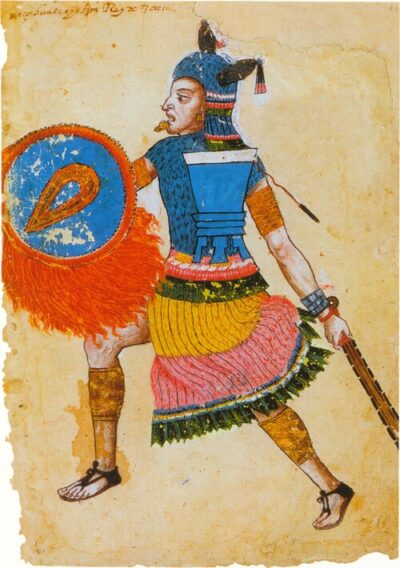
Nezahualcóyotl
Nezahualcóyotl was a ruler of Texcoco. Born April 26, 1402, in Texcoco de Mora. Died June 4, 1472, in Texcoco de Mora. Positions held include tlatoani and list of rulers of Texcoco (1429–1472).
Facts
11 facts · 0 confirmed by two sources · 1 cited · 10 from one source
Where this comes from
Papalocal keeps its own record. It started from these sources; what each one said is kept here as it was copied, so a change on their side never changes this page by itself. Tap one to read its version.
What Wikidata says · copied November 16, 2026 · revision 2560118516
- Described as
- ruler of Texcoco
- Other names
- netzahual, Netzahualcoyotl
- Born
- April 26, 1402
- Died
- June 4, 1472 · 1 reference
- Born in
- Texcoco de Mora
- Died in
- Texcoco de Mora
- Citizen of
- Texcoco
- Occupation
- poet; philosopher · 1 reference
- Positions held
- tlatoani; list of rulers of Texcoco (1429–1472)
- Children
- Nezahualpilli
- Father
- Ixtlilxochitl I
- Wikipedias with a page
- 38
Wikidata item Q379964 (wikidata.org/wiki/Q379964), public domain (CC0). Copied November 16, 2026.
What Wikipedia says · copied November 16, 2026 · revision 1385062143
Nezahualcoyotl Acolmiztli (Classical Nahuatl: Nezahualcoyōtl [nesawalˈkojoːtɬ], ), "Fasting Coyote" (April 28, 1402 – 1472) was tlatoani (king) of the Acolhua altepetl (city-state) of Texcoco from 1431 to his death in 1472, in pre-Columbian Mexico. He is noted for his achievements as a philosopher (tlamatini), warrior, architect, legislator and poet, earning him the nickname of "the Poet-King" (Rey Poeta, in Spanish). In his lifetime, he was also known by his poetic nickname Yoyontzin. His difficult younger years following his father's assassination, and his efforts to reconquer his realm after being taken over by the powerful Tepanec Empire turned him into a hero in pre-Columbian society. In order to defeat the Tepanec Empire, and its ruler Maxtla, he formed an alliance with the tlatoque (kings) of Mexico-Tenochtitlan and Tlacopan (Itzcoatl and Totoquihuaztli I), becoming one of the founders of the Aztec Triple Alliance, commonly known as the Aztec Empire. His odyssey has captured the public imagination, which has been compared to the Shakespearean story of Prince Hamlet, albeit he remains an enigmatic figure, due to the lack of sources from his own lifetime or from his contemporaries.
He was the legitimate son of Ixtlilxochitl I, the king of Texcoco who declared war on the Tepanec Empire approximately in 1415. Nezahualcoyotl was declared crown prince soon after the war started, and about four years later, when he was just 16 years old, he witnessed his father being assassinated by Tepanec warriors while attempting to flee Texcoco. Nezahualcoyotl spent several years of his life in exile, seeking refuge in Tlaxcallan and Tenochtitlan and evading assassination attempts. Following the death of the Tepanec emperor Tezozomoc, Maxtla took the throne and attempted to assassinate Nezahualcoyotl on multiple occasions, unsuccessfully. When Chimalpopoca, king of Tenochtitlan (and Nezahualcoyotl's uncle), was assassinated in 1427, Itzcoatl, his successor, launched a revolution to end Tepanec rule over Mexico. He and Nezahualcoyotl formed an alliance to defeat the Tepanecas, and after a series of combats, they managed to overthrow Maxtla, killing him and destroying the Tepanec Empire. With Itzcoatl's support, Nezahualcoyotl formally took Texcoco's throne in 1431, beginning a period of prosperity that would last until the 16th century.
He is credited with starting Texcoco's golden age. During his reign, Nezahualcoyotl led the construction of massive and impressive engineering projects, with a particular focus on hydraulic engineering, building aqueducts, flood-preventing structures and botanical gardens which worked for the benefit of the population of the Valley of Mexico for decades after his death. The remains of the botanical gardens of Texcotzingo serve as physical evidence of the impressive engineering skill and appreciation for nature the people of Texcoco developed during his rule. He also established a Hammurabi-like legal system consisting of 80 laws addressing matters such as robbery, adultery, military misconduct and more. Through conquest, Nezahualcoyotl managed to expand his realm's territory beyond that which his predecessors had ruled; his conquests were done along side the conquests of the rulers of Tenochtitlan (Itzcoatl, Moctezuma I and Axayacatl). Texcoco became a respected nation by its neighbors in the Valley of Mexico, being observed as a hub of intellectuals, engineers and legal experts, though the violence of his conquests is reflected in songs from the regions he attacked.
In the present, Nezahualcoyotl is best remembered for his poetry and the philosophical ideas reflected in the surviving works attributed to him. His poems address themes such as the ephemerality of human life and the "eternal" nature of "flower and song." Such poems continue being taught to Mexican children at schools, and have been praised for their beauty for centuries, in spite of the destruction of indigenous literature following the Spanish conquest of Mexico. Throughout the centuries following his death, many writers in Mexico and elsewhere wrote about his achievements, poetry and prosperous reign. Nevertheless, he has also been the subject of multiple myths and legends that may not be historically accurate. The very authorship of the poems historically attributed to him has been a subject of intense debate among scholars of Aztec culture, and it is believed that various elements of his biography may have been exaggerated to create a heroic narrative. Regardless, his biography was recorded on multiple pictorial documents, known as codices, and after the Spanish conquest it was preserved by his descendants and multiple historians who had access to these codices. Historians since the 19th century have referred to Nezahualcoyotl as a "Renaissance man of Aztec culture," and have compared Texcoco during his reign to Classical Athens.
From the Wikipedia article “Nezahualcoyotl (tlatoani)” (en.wikipedia.org/wiki/Nezahualcoyotl_(tlatoani)), by its contributors, under CC BY-SA 4.0 (creativecommons.org/licenses/by-sa/4.0/). Copied November 16, 2026; not changed.
Confirmed Two sources agree. Cited One source, and it names where it got it. One source One source, without a reference of its own. Sources disagree The sources disagree. We show the best-supported value and keep theirs below.
