
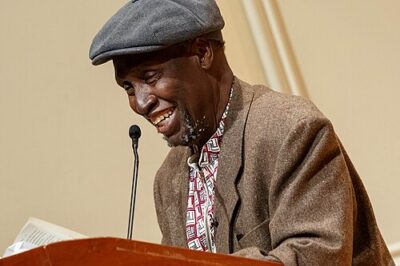
Ngũgĩ wa Thiong'o
Ngũgĩ wa Thiong'o was a Kenyan writer. Born January 5, 1938, in Kamirithu. Died May 28, 2025, in Buford. Known for I Will Marry When I Want, Matigari ma Njiruungi and Weep Not, Child. Educated at University of Leeds and Makerere University. Awards include Doctor honoris causa at University of Bayreuth, Lotus Prize for Literature and International Nonino Prize.
Facts
37 facts · 2 confirmed by two sources · 6 cited · 29 from one source
Where this comes from
Papalocal keeps its own record. It started from these sources; what each one said is kept here as it was copied, so a change on their side never changes this page by itself. Tap one to read its version.
What Wikidata says · copied November 16, 2026 · revision 2568151344
- Described as
- Kenyan writer (1938–2025)
- Other names
- James Ngugi, James Thiong'o Ngugi, Ngugi wa Thiong'o, Ngugi wa Thiongo, Ngũgĩ, Ngūgī wa Thiong'o, Ungugi wa Sionggo, Ngugi wa Tkhiongo, Ngugi va Thyongo
- Born
- January 5, 1938 · 7 references
- Died
- May 28, 2025 · 2 references
- Born in
- Kamirithu · 1 reference
- Died in
- Buford
- Citizen of
- Kenya
- Occupation
- playwright; novelist; essayist; university teacher · 2 references; philosopher · 1 reference; writer · 3 references
- Worked for
- University of Nairobi (1967–1977); New York University (1992–2002); University of California, Irvine (2002–); Northwestern University; Yale University (1989–1992)
- Education
- University of Leeds; Makerere University (–1963); Alliance High School
- Member of
- American Academy of Arts and Sciences
- Known for
- I Will Marry When I Want; Matigari ma Njiruungi; Weep Not, Child; Decolonising the Mind; The Upright Revolution: Or Why Humans Walk Upright; A Grain of Wheat; Petals of Blood
- Awards
- Doctor honoris causa at University of Bayreuth; Lotus Prize for Literature (1973); International Nonino Prize (2001); honorary doctor of the University of Auckland (2005); Grand Prix des mécènes (2018) · 1 reference; Catalonia International Prize (2020)
- Field
- literary activity · 1 reference; philosophy · 1 reference
- Children
- Mũkoma wa Ngũgĩ · 1 reference; Wanjiku wa Ngũgĩ
- Wikipedias with a page
- 87
Wikidata item Q302910 (wikidata.org/wiki/Q302910), public domain (CC0). Copied November 16, 2026.
What Wikipedia says · copied November 16, 2026 · revision 1385423301
Ngũgĩ wa Thiong'o (Gikuyu: [ᵑɡoɣe wá ðiɔŋɔ]; born James Ngugi; 5 January 1938 – 28 May 2025) was a Kenyan author and academic, who has been described as East Africa's leading novelist and an important figure in modern African literature.
Ngũgĩ wrote primarily in English before switching to writing primarily in Gikuyu and becoming a strong advocate for literature written in native African languages. His works include novels such as the celebrated novel The River Between, plays, short stories, memoirs, children's literature and essays ranging from literary to social criticism. He was the founder and editor of the Gikuyu-language journal Mũtĩiri. His 2016 short story "The Upright Revolution: Or Why Humans Walk Upright" has been translated into more than 100 languages.
In 1977, Ngũgĩ embarked upon a novel form of theatre in Kenya that sought to liberate the theatrical process from what he held to be "the general bourgeois education system", by encouraging spontaneity and audience participation in the performances. His project sought to "demystify" the theatrical process, and to avoid the "process of alienation [that] produces a gallery of active stars and an undifferentiated mass of grateful admirers" which, according to Ngũgĩ, encourages passivity in "ordinary people". Although his landmark play Ngaahika Ndeenda (1977), co-written with Ngũgĩ wa Mirii, was a commercial success, it was shut down by the then authoritarian Kenyan regime six weeks after its opening.
Ngũgĩ was subsequently imprisoned for more than a year. Adopted as an Amnesty International prisoner of conscience, he was released from prison and fled Kenya. He was appointed Distinguished Professor of Comparative Literature and English at the University of California, Irvine. He had previously taught at University of Nairobi, Northwestern University, Yale University, and New York University. Ngũgĩ was frequently regarded as a likely candidate for the Nobel Prize in Literature. He won the 2001 International Nonino Prize in Italy, and the 2016 Park Kyong-ni Prize. Among his children are authors Mũkoma wa Ngũgĩ and Wanjikũ wa Ngũgĩ.
- Born, in its opening lines
- January 5, 1938
- Died, in its opening lines
- May 28, 2025
From the Wikipedia article “Ngũgĩ wa Thiong'o” (en.wikipedia.org/wiki/Ngũgĩ_wa_Thiong'o), by its contributors, under CC BY-SA 4.0 (creativecommons.org/licenses/by-sa/4.0/). Copied November 16, 2026; not changed.
Confirmed Two sources agree. Cited One source, and it names where it got it. One source One source, without a reference of its own. Sources disagree The sources disagree. We show the best-supported value and keep theirs below.
