
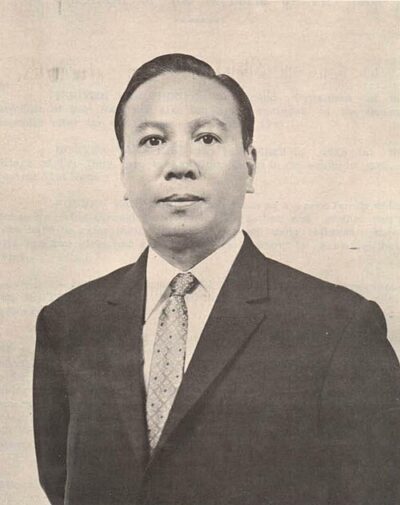
Nguyễn Văn Thiệu
Nguyễn Văn Thiệu was a president of South Vietnam from 1965–75. Born April 5, 1923, in Phan Rang – Tháp Chàm. Died September 29, 2001, in Newton. Positions held include President of South Vietnam (1965–1975). Awards include National Order of Vietnam, Order of Distinguished Service and Vietnam Campaign Medal.
Facts
36 facts · 2 confirmed by two sources · 5 cited · 29 from one source
Where this comes from
Papalocal keeps its own record. It started from these sources; what each one said is kept here as it was copied, so a change on their side never changes this page by itself. Tap one to read its version.
What Wikidata says · copied November 13, 2026 · revision 2567792060
- Described as
- president of South Vietnam from 1965–75
- Other names
- Nguyen Van Thieu
- Born
- April 5, 1923 · 6 references
- Died
- September 29, 2001 · 7 references
- Born in
- Phan Rang – Tháp Chàm
- Died in
- Newton · 1 reference
- Cause of death
- stroke · 1 reference
- Citizen of
- South Vietnam; United States; French Indochina
- Occupation
- politician · 1 reference; military personnel
- Positions held
- President of South Vietnam (1965–1975)
- Political party
- National Social Democratic Front
- Awards
- National Order of Vietnam; Order of Distinguished Service; Vietnam Campaign Medal; Gallantry Cross; Legion of Merit; Croix de Guerre; Military Merit Medal · 1 reference; Armed Forces Honor Medal · 1 reference; Meritorious Service Medal · 1 reference; Grand Order of Mugunghwa · 1 reference; Staff Service Medal · 1 reference; Croix de guerre des théâtres d'opérations extérieures · 1 reference; Order of Brilliant Jade · 1 reference
- Spouse
- Nguyen Thi Mai Anh (1951–) · 1 reference
- Siblings
- Nguyễn Văn Kiểu; Nguyễn Văn Hiếu
- Religion
- Catholicism (1958–)
- Military branch
- French Army · 1 reference
- Military rank
- lieutenant general · 1 reference; general · 1 reference
- Lived in
- Foxborough; Ho Chi Minh City (–1975); Taipei; Newton
- Wikipedias with a page
- 59
Wikidata item Q313707 (wikidata.org/wiki/Q313707), public domain (CC0). Copied November 13, 2026.
What Wikipedia says · copied November 13, 2026 · revision 1384715132
Nguyễn Văn Thiệu (Vietnamese: [ŋwiən˦ˀ˥ van˧˧ tʰiəw˧˨ˀ] ; 5 April 1923 – 29 September 2001) was a South Vietnamese military officer and politician who was the president of South Vietnam from 1967 to 1975. He was a general in the Republic of Vietnam Armed Forces (RVNAF), became head of a military junta in 1965, and then president after winning a rigged election in 1967. He headed the government of South Vietnam until he resigned and left the nation and relocated to Taipei a few days before the fall of Saigon and the ultimate North Vietnamese victory.
Born in Phan Rang in the south central coast of Vietnam, Thiệu joined the communist-dominated Việt Minh of Hồ Chí Minh in 1945 but quit after a year and joined the Vietnamese National Army (VNA) of the French-backed State of Vietnam. He gradually rose up the ranks and, in 1954, led a battalion in expelling the communists from his native village. Following the withdrawal of France, the VNA became the ARVN and Thiệu was the head of the Vietnamese National Military Academy for four years before becoming a division commander and colonel. In November 1960, he helped put down a coup attempt against President Ngô Đình Diệm. During this time, he also converted to Catholicism and joined the regime's Cần Lao Party, which was accused of being a vehicle for political advancement.
Despite this, Thiệu agreed to join the coup against Ngô Đình Diệm in November 1963 in the midst of the Buddhist crisis, leading the siege on Gia Long Palace. Diệm was captured and executed and Thiệu made a general. Following Diệm's death, there were several short-lived juntas as coups occurred frequently. Thiệu gradually moved up the ranks of the junta by adopting a cautious approach while other officers around him defeated and sidelined one another. In 1965, stability came to South Vietnam when he became the nominal head of state and Air Marshal Nguyễn Cao Kỳ became prime minister, although the men were rivals.
In 1967, a transition to elected government was scheduled; and, after a power struggle within the military, Thiệu ran for the presidency with Kỳ as his running mate—both men had wanted the top job. To allow the two to work together, their fellow officers had agreed to have a military body controlled by Kỳ shape policy behind the scenes. Leadership tensions became evident, and Thiệu prevailed, sidelining Kỳ supporters from key military and cabinet posts. Thiệu then passed legislation to restrict candidacy eligibility for the 1971 election, banning almost all would-be opponents, while the rest withdrew as it was obvious that the poll would be a sham; Thiệu won 100% of the vote and the election was uncontested, while Kỳ retired from politics.
While Thiệu has been occasionally described as a dictator in press, in literature his regime is described as military-dominated and marked by a complex relation with pluralistic society and evolving towards authoritarianism from constitutional rule as Thiệu consolidated power, but not as a dictatorship. The government under Thiệu's presidency, at times, championed liberal ideas and oversaw a vibrant civil society and a lively press. The press accused him of turning a blind eye to and indulging in corruption. During the 1971 Operation Lam Sơn 719 and the communists' Easter Offensive, the I Corps in the north of the country was under the command of his confidant, Hoàng Xuân Lãm, whose incompetence led to heavy defeats until Thiệu finally replaced him with Ngô Quang Trưởng. After the signing of the Paris Peace Accords—which Thiệu opposed—and the US withdrawal, South Vietnam resisted the communists for another two years until the communists' final push for victory, which saw the South openly invaded by the entire North Vietnamese army. Thiệu gave contradictory orders to Trưởng to stand and fight or withdraw and consolidate, leading to mass panic and collapse in the south of the country. This allowed the communists to generate much momentum and within a month they were close to Saigon, prompting Thiệu to resign and leave the country. He eventually settled near Boston, Massachusetts, preferring not to talk to the media. He died in 2001.
- Born, in its opening lines
- April 5, 1923
- Died, in its opening lines
- September 29, 2001
From the Wikipedia article “Nguyễn Văn Thiệu” (en.wikipedia.org/wiki/Nguyễn_Văn_Thiệu), by its contributors, under CC BY-SA 4.0 (creativecommons.org/licenses/by-sa/4.0/). Copied November 13, 2026; not changed.
Confirmed Two sources agree. Cited One source, and it names where it got it. One source One source, without a reference of its own. Sources disagree The sources disagree. We show the best-supported value and keep theirs below.
