
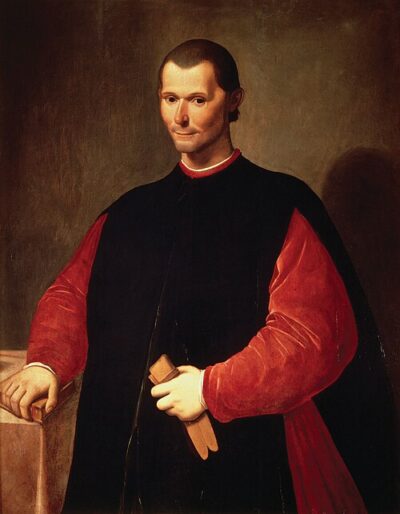
Niccolò Machiavelli
Niccolò Machiavelli was a Florentine statesman, diplomat, and political theorist. Born May 3, 1469, in Florence. Died June 21, 1527, in Sant'Andrea in Percussina. Known for The Prince, Discourses on Livy and Capitoli. Educated at University of Florence.
Facts
35 facts · 2 confirmed by two sources · 11 cited · 20 from one source · 2 where the sources disagree
What’s different
- Died in: we show Sant'Andrea in Percussina (Sources disagree). Wikidata also lists Florence
- Buried in: we show Basilica of Santa Croce (Sources disagree). Wikidata also lists Tomb of Niccolò Machiavelli
Where this comes from
Papalocal keeps its own record. It started from these sources; what each one said is kept here as it was copied, so a change on their side never changes this page by itself. Tap one to read its version.
What Wikidata says · copied November 16, 2026 · revision 2569138712
- Described as
- Florentine statesman, diplomat, and political theorist (1469–1527)
- Other names
- Machiavel, Nicholas Machiavel, Niccolò di Bernardo dei Machiavelli, Niccolo Machiavelli, Machiavelli, Niccolo di Bernardo dei Machiavelli, Nicolo Machiavelli, Nicolò Machiavelli, N. Machiavelli
- Born
- May 3, 1469 · 4 references
- Died
- June 21, 1527 · 4 references
- Born in
- Florence · 4 references
- Died in
- Sant'Andrea in Percussina · 2 references; Florence · 2 references
- Buried in
- Basilica of Santa Croce · 1 reference; Tomb of Niccolò Machiavelli · 1 reference
- Cause of death
- peritonitis
- Citizen of
- Republic of Florence
- Occupation
- writer · 4 references; politician · 3 references; historian · 2 references; philosopher · 1 reference; political theorist; military theorist; translator; poet
- Education
- University of Florence · 1 reference
- Known for
- The Prince; Discourses on Livy; Capitoli
- Field
- philosophy; politics · 1 reference; political science · 1 reference; diplomacy · 1 reference; creative and professional writing · 1 reference; drama · 1 reference
- Spouse
- Marietta Corsini · 1 reference
- Children
- Piero Macchiavelli · 1 reference; CrisMJ · 1 reference; Bernardo Macciavelli · 1 reference; Ludovico Macciavelli · 1 reference; Guido Machiavelli · 1 reference
- Father
- Bernardo di Niccolò Machiavelli
- Mother
- Bartolomea di Stefano Nelli · 1 reference
- Siblings
- Totto di Bernardo Machiavelli
- Religion
- Catholicism
- Wikipedias with a page
- 230
Wikidata item Q1399 (wikidata.org/wiki/Q1399), public domain (CC0). Copied November 16, 2026.
What Wikipedia says · copied November 16, 2026 · revision 1384395055
Niccolò di Bernardo dei Machiavelli (3 May 1469 – 21 June 1527) was a Florentine diplomat, author, philosopher, and historian who lived during the Italian Renaissance. He is best known for his political treatise The Prince (Il Principe), written around 1513 but not published until 1532, five years after his death. He has often been called the father of modern political philosophy and political science.
For many years he served as a senior official in the Florentine Republic with responsibilities in diplomatic and military affairs. He worked as secretary to the second chancery of the Republic of Florence from 1498 to 1512, when the Medici were out of power. He was expelled from his duties as a diplomat when the Medici retook power in Florence in 1512, and soon thereafter would be mistakenly suspected of treason, and sent into exile. A year later, he took up the life of a political writer.
After his death Machiavelli's name came to evoke unscrupulous acts of the sort he recommended in his most famous work, The Prince. In the treatise, Machiavelli stated that rulers will have to take on unsavory policies in the furtherance of their political society, in contradiction to classical political thought. He advised rulers to engage in evil when political necessity requires it, for example, stating that successful founders and reformers of governments should be excused for killing their political enemies. Machiavelli's Prince has been surrounded by controversy since it was published, with many commentators viewing The Prince as a manual that aims to teach would-be tyrants how they should seize authority and establish an absolute regime. Even into recent times, scholars such as Leo Strauss have restated the traditional opinion that Machiavelli was a "teacher of evil".
Even though Machiavelli has become most famous for his work on principalities, scholars also give attention to the exhortations in his other works of political philosophy. The Discourses on Livy (composed c. 1517) has been said to have paved the way for modern republicanism. His works were influential on later Enlightenment-era political authors such as Jean-Jacques Rousseau and James Harrington. Machiavelli's philosophical contributions have influenced generations of philosophers, academics and politicians, with many of them debating the nature of his ideas.
- Born, in its opening lines
- May 3, 1469
- Died, in its opening lines
- June 21, 1527
From the Wikipedia article “Niccolò Machiavelli” (en.wikipedia.org/wiki/Niccolò_Machiavelli), by its contributors, under CC BY-SA 4.0 (creativecommons.org/licenses/by-sa/4.0/). Copied November 16, 2026; not changed.
Confirmed Two sources agree. Cited One source, and it names where it got it. One source One source, without a reference of its own. Sources disagree The sources disagree. We show the best-supported value and keep theirs below.
