
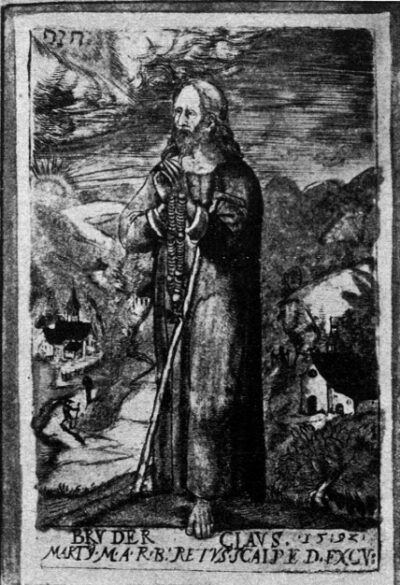
Nicholas of Flüe
Nicholas of Flüe was a hermit, ascetic, patron saint of Switzerland. Born 1417, in Flüeli-Ranft. Died March 21, 1487, in Flüeli-Ranft. Positions held include judge.
Facts
16 facts · 2 confirmed by two sources · 4 cited · 10 from one source
Where this comes from
Papalocal keeps its own record. It started from these sources; what each one said is kept here as it was copied, so a change on their side never changes this page by itself. Tap one to read its version.
What Wikidata says · copied November 18, 2026 · revision 2569839953
- Described as
- hermit, ascetic, patron saint of Switzerland (1417–1487)
- Other names
- Nicholas of Fluee
- Born
- 1417 · 1 reference
- Died
- March 21, 1487 · 1 reference
- Born in
- Flüeli-Ranft · 1 reference
- Died in
- Flüeli-Ranft · 1 reference
- Buried in
- Sachseln
- Citizen of
- Switzerland
- Occupation
- magistrate; politician; judge; hermit · 1 reference; mystic · 1 reference; writer · 1 reference
- Positions held
- judge
- Spouse
- Dorothea Wyss (1445–1467) · 1 reference
- Children
- Hans von Flüe; Walter von Flüe
- Wikipedias with a page
- 24
Wikidata item Q115550 (wikidata.org/wiki/Q115550), public domain (CC0). Copied November 18, 2026.
What Wikipedia says · copied November 18, 2026 · revision 1380096300
Nicholas of Flüe (German: Niklaus von Flüe; 1417 – 21 March 1487) was a Swiss hermit and ascetic who is the patron saint of Switzerland. He is sometimes invoked as Brother Klaus. A farmer, military leader, member of the assembly, councillor, judge and mystic, he was respected as a man of complete moral integrity. He is known for having fasted for over twenty years. Brother Klaus's counsel to the Diet of Stans (1481) helped prevent war between the Swiss cantons.
- Born, in its opening lines
- 1417
- Died, in its opening lines
- March 21, 1487
From the Wikipedia article “Nicholas of Flüe” (en.wikipedia.org/wiki/Nicholas_of_Flüe), by its contributors, under CC BY-SA 4.0 (creativecommons.org/licenses/by-sa/4.0/). Copied November 18, 2026; not changed.
Confirmed Two sources agree. Cited One source, and it names where it got it. One source One source, without a reference of its own. Sources disagree The sources disagree. We show the best-supported value and keep theirs below.
