
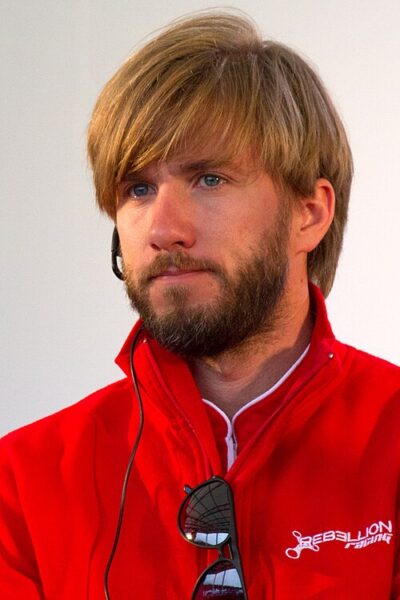
Nick Heidfeld is a German racing driver. Born May 10, 1977, in Mönchengladbach. Teams include Prost-Heidfeld-Beche and Prost-Piquet-Heidfeld (2016–).
Facts
11 facts · 1 confirmed by two sources · 1 cited · 9 from one source
Where this comes from
Papalocal keeps its own record. It started from these sources; what each one said is kept here as it was copied, so a change on their side never changes this page by itself. Tap one to read its version.
What Wikidata says · copied November 16, 2026 · revision 2569166959
- Described as
- German racing driver
- Other names
- Heidfeld
- Born
- May 10, 1977
- Born in
- Mönchengladbach · 1 reference
- Name at birth
- Nick Lars Heidfeld
- Citizen of
- Germany
- Occupation
- Formula One driver
- Teams
- Prost-Heidfeld-Beche; Prost-Piquet-Heidfeld (2016–)
- Sport
- auto racing
- Nickname
- Quick Nick
- Height
- 1.64 m (5 ft 5 in)
- Website
- http://www.nickheidfeld.com
- Wikipedias with a page
- 54
Wikidata item Q75810 (wikidata.org/wiki/Q75810), public domain (CC0). Copied November 16, 2026.
What Wikipedia says · copied November 16, 2026 · revision 1385778255
Nick Lars Heidfeld (German pronunciation: [nɪk laʁs ˈhaɪtfɛlt]; born 10 May 1977) is a German former racing driver, who competed in Formula One from 2000 to 2011.
Born and raised in Mönchengladbach, Heidfeld began competitive kart racing aged 11. He progressed to Formula Ford in 1994, winning multiple national championships before graduating to Formula Three. After finishing third in 1996, Heidfeld won the German Formula Three Championship the following year, also winning the Monaco F3 Grand Prix. He then finished runner-up to Juan Pablo Montoya in International F3000, before winning the series in 1999. A test driver for McLaren since 1998, Heidfeld signed for Prost in 2000 to partner Jean Alesi, making his Formula One debut at the Australian Grand Prix. After a non-classified championship finish for Prost with the AP03, Heidfeld moved to Sauber in 2001, finishing fourth on debut and taking his maiden podium at the Brazilian Grand Prix as he outscored rookie teammate Kimi Räikkönen.
Heidfeld remained at Sauber for two further seasons before moving to Jordan in 2004, where he scored multiple points finishes in the relatively uncompetitive EJ14. He signed for Williams in 2005, scoring several podiums amongst his maiden pole position at the European Grand Prix. Following a string of high-profile injuries, Heidfeld left Williams to re-join Sauber—now known as BMW Sauber—in 2006. He scored eight podiums across four seasons with BMW Sauber, finishing a career-best fifth in the World Drivers' Championship in 2007. BMW withdrew from the sport at the end of the 2009 season, leaving Heidfeld without a seat. He replaced Pedro de la Rosa at Sauber from the 2010 Singapore Grand Prix onwards, and joined Renault for his 2011 campaign to substitute for an injured Robert Kubica. Heidfeld took his final podium in Malaysia before he was replaced by Bruno Senna after the Hungarian Grand Prix. Heidfeld departed Formula One with one pole position, two fastest laps and 13 podiums, the latter of which remains the record without winning a Grand Prix.
Heidfeld moved to Formula E for its inaugural 2014–15 season with Venturi, achieving his first podium at the Moscow ePrix before joining Mahindra in 2015. Over three seasons with Mahindra, Heidfeld scored seven further podiums before leaving at the end of 2017–18. Outside of formula racing, Heidfeld has entered six editions of the 24 Hours of Le Mans, winning the LMP1-L class in 2014 and finishing fourth overall twice. He competed in five seasons of the FIA World Endurance Championship from 2012 to 2016 with Rebellion, and finished runner-up in the American Le Mans Series in 2013. Heidfeld served as chairman of the Grand Prix Drivers' Association in 2010.
- Born, in its opening lines
- May 10, 1977
From the Wikipedia article “Nick Heidfeld” (en.wikipedia.org/wiki/Nick_Heidfeld), by its contributors, under CC BY-SA 4.0 (creativecommons.org/licenses/by-sa/4.0/). Copied November 16, 2026; not changed.
Confirmed Two sources agree. Cited One source, and it names where it got it. One source One source, without a reference of its own. Sources disagree The sources disagree. We show the best-supported value and keep theirs below.
