
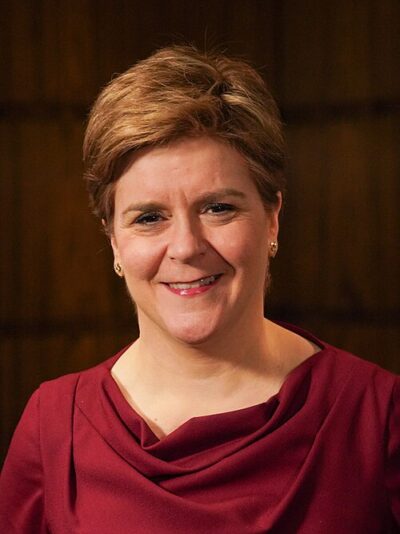
Nicola Sturgeon
Nicola Sturgeon is a Scottish politician and former First Minister of Scotland from 2014 to 2023. Born July 19, 1970, in Irvine. Positions held include Deputy First Minister of Scotland (2007–2014), Cabinet Secretary for Infrastructure, Investment and Cities (2012–2014) and First Minister of Scotland (2014–2023). Educated at University of Glasgow and Greenwood Academy. Awards include BBC 100 Women and M100 Media Award.
Facts
31 facts · 1 confirmed by two sources · 10 cited · 20 from one source
Where this comes from
Papalocal keeps its own record. It started from these sources; what each one said is kept here as it was copied, so a change on their side never changes this page by itself. Tap one to read its version.
What Wikidata says · copied November 16, 2026 · revision 2570045056
- Described as
- Scottish politician and former First Minister of Scotland from 2014 to 2023 (born 1970)
- Other names
- Nicola Ferguson Sturgeon
- Born
- July 19, 1970 · 3 references
- Born in
- Irvine · 2 references
- Name at birth
- Nicola Ferguson Sturgeon
- Citizen of
- United Kingdom
- Occupation
- politician · 2 references; lawyer; jurist · 1 reference
- Positions held
- Deputy First Minister of Scotland (2007–2014); Cabinet Secretary for Infrastructure, Investment and Cities (2012–2014); First Minister of Scotland (2014–2023) · 3 references; Cabinet Secretary for Health and Wellbeing (2007–2011); Member of the Privy Council of the United Kingdom (2014–) · 1 reference; Member of the 5th Scottish Parliament (2016–2021); Member of the 1st Scottish Parliament (1999–2003); Member of the 2nd Scottish Parliament (2003–2007); Member of the 3rd Scottish Parliament (2007–2011); Member of the 4th Scottish Parliament (2011–2016); Cabinet Secretary for Health, Wellbeing and Cities Strategy (2011–2012); Leader of the Opposition (Scotland) (2004–2007) · 1 reference; Member of the 6th Scottish Parliament (2021–2026) · 2 references
- Political party
- Scottish National Party · 1 reference
- Education
- University of Glasgow; Greenwood Academy; University of Glasgow School of Law
- Awards
- BBC 100 Women (2014) · 1 reference; M100 Media Award (2019) · 1 reference
- Spouse
- Peter Murrell
- Mother
- Joan Sturgeon
- Religion
- Church of Scotland
- Lived in
- Bute House (–2023)
- Website
- https://firstminister.gov.scot/
- Wikipedias with a page
- 74
Wikidata item Q467112 (wikidata.org/wiki/Q467112), public domain (CC0). Copied November 16, 2026.
What Wikipedia says · copied November 16, 2026 · revision 1384012439
Nicola Ferguson Sturgeon (born 19 July 1970) is a Scottish politician who was First Minister of Scotland and Leader of the Scottish National Party (SNP) from 2014 to 2023. She served as a member of the Scottish Parliament (MSP) from 1999 to 2026, firstly as an additional member for the Glasgow electoral region and then as the member for Glasgow Southside (formerly Glasgow Govan) from 2007 to 2026.
Born in Ayrshire, Sturgeon is a law graduate of the University of Glasgow. She worked as a solicitor in Glasgow before her election to the Scottish Parliament in 1999. She served successively as the SNP's shadow minister for education, health, and justice. Sturgeon entered the 2004 SNP leadership election but later withdrew from the contest in favour of Alex Salmond, standing instead as depute leader on a joint ticket with Salmond. Both were subsequently elected; as Salmond was still an MP, Sturgeon led the SNP in the Scottish Parliament from 2004 to 2007. The SNP emerged as the largest party following the 2007 election and Salmond headed the first SNP minority government, with Sturgeon as his deputy. From 2007 to 2012, she served as health secretary, overseeing the scrapping of prescription charges and the 2009 swine flu pandemic. Following the SNP's landslide majority in 2011, she was appointed Cabinet Secretary for Infrastructure, Capital Investment and Cities, which saw her in charge of the legislative process for the 2014 Scottish independence referendum. The defeat of the Yes Scotland campaign resulted in Salmond's resignation as SNP leader.
Sturgeon was elected unopposed as SNP leader in November 2014 and was subsequently appointed as first minister, becoming the first woman to hold either position. She entered office amid a rapid surge in membership of the SNP, which was reflected in the party's performance in the 2015 general election, winning 56 of the 59 Scottish seats and replacing the Liberal Democrats as the third-largest party in the House of Commons. The SNP continued to enjoy electoral successes throughout Sturgeon's eight years in office, but lost 21 seats in the 2017 general election. Despite losing her majority, Sturgeon secured a second term in office in 2016, forming a minority government.
Sturgeon led the Scottish Government's response to the COVID-19 pandemic, implementing a series of restrictions on social gatherings and the rollout of the vaccine programme. A seat short of a majority in 2021, Sturgeon became the only first minister to serve a third term, and she subsequently entered a power-sharing agreement with the Scottish Greens. The calls from Sturgeon's government and the wider independence movement for a second referendum were unsuccessful, as successive Conservative prime ministers refused to grant a Section 30 order. From 2022, Sturgeon received heavier criticism for her positions on gender reforms. On 15 February 2023, Sturgeon resigned the leadership of the SNP claiming occupational burnout; she was succeeded by her health secretary, Humza Yousaf, the following month. In March 2025, she announced she would stand down as an MSP at the 2026 Scottish Parliament election.
- Born, in its opening lines
- July 19, 1970
From the Wikipedia article “Nicola Sturgeon” (en.wikipedia.org/wiki/Nicola_Sturgeon), by its contributors, under CC BY-SA 4.0 (creativecommons.org/licenses/by-sa/4.0/). Copied November 16, 2026; not changed.
Confirmed Two sources agree. Cited One source, and it names where it got it. One source One source, without a reference of its own. Sources disagree The sources disagree. We show the best-supported value and keep theirs below.
