
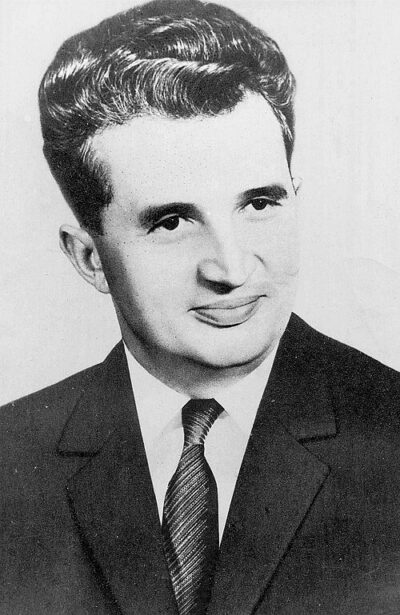
Nicolae Ceaușescu
Nicolae Ceaușescu was a dictator of Romania from 1965 to 1989. Born January 26, 1918, in Scornicești. Died December 25, 1989, in Târgoviște. Positions held include president of Romania (1974–1989), President of the State Council (1967–1989) and member of the Chamber of Deputies of Romania. Educated at M.V. Frunze Military Academy and Bucharest University of Economic Studies. Awards include Knight Grand Cross of the Order of St. Olav, Grand Cross of the Legion of Honour and Hero of the Socialist Republic of Romania (4 times).
Facts
47 facts · 1 confirmed by two sources · 17 cited · 28 from one source · 1 where the sources disagree
What’s different
- Born: we show January 26, 1918 (Sources disagree). Wikipedia says February 8, 1918
Where this comes from
Papalocal keeps its own record. It started from these sources; what each one said is kept here as it was copied, so a change on their side never changes this page by itself. Tap one to read its version.
What Wikidata says · copied November 16, 2026 · revision 2567476454
- Described as
- dictator of Romania from 1965 to 1989
- Other names
- Ceaușescu, Genius of the Carpathians
- Born
- January 26, 1918 · 14 references
- Died
- December 25, 1989 · 13 references
- Born in
- Scornicești · 2 references
- Died in
- Târgoviște · 1 reference
- Buried in
- Ghencea Cemetery
- Cause of death
- gunshot wound · 1 reference
- Citizen of
- Kingdom of Romania (1918–1947); Romanian People's Republic (1947–1965); Socialist Republic of Romania (1965–1989)
- Occupation
- politician · 2 references; military leader; president of Romania
- Positions held
- president of Romania (1974–1989); President of the State Council (1967–1989); member of the Chamber of Deputies of Romania; Secretary General of the Romanian Communist Party (1965–1989); honorary presidency (1970–1989) · 1 reference
- Political party
- Romanian Communist Party (1937–1989) · 1 reference
- Education
- M.V. Frunze Military Academy · 1 reference; Bucharest University of Economic Studies · 1 reference
- Awards
- Knight Grand Cross of the Order of St. Olav (1980–1989) · 2 references; Grand Cross of the Legion of Honour · 3 references; Hero of the Socialist Republic of Romania (4 times) (1971, 1978, 1981, 1988) · 1 reference; Hero of Socialist Labour of Romania (1964–1989); Order of the Victory of Socialism (4 times) (1971, 1978, 1981, 1988); Star of the Socialist Republic of Romania, 1st class (1958–1989); Star of the Socialist Republic of Romania, 3rd class (1948–1989); Order of Labor Third Class (1949–1989); The Order "Defence of the Motherland" 2nd Class (1949–1989); Order 23rd of August, 1st grade (1959–1989); Medal "40 years since the founding of the Communist Party of Romania" (1961–1989); Order of Labor First Class (1966–1989); Order Of The Defense Of The Fatherland, 1st class (1966–1989); Order of Tudor Vladimirescu, 1st class (1966–1989); Grand Cross Special Class of the Order of Merit of the Federal Republic of Germany (1971)
- Field
- politics; military
- Spouse
- Elena Ceaușescu (1947–1989) · 1 reference
- Children
- Zoia Ceaușescu · 1 reference; Nicu Ceaușescu · 1 reference; Valentin Ceaușescu · 1 reference
- Siblings
- Ion Ceaușescu; Ilie Ceaușescu · 1 reference; Nicolae Andruță Ceaușescu; Marin Ceaușescu
- Military branch
- Romanian Land Forces
- Military rank
- major general · 1 reference
- Wikipedias with a page
- 119
Wikidata item Q80504 (wikidata.org/wiki/Q80504), public domain (CC0). Copied November 16, 2026.
What Wikipedia says · copied November 16, 2026 · revision 1385558482
Nicolae Ceaușescu (8 February [O.S. 26 January] 1918 – 25 December 1989) was a Romanian politician who was the second and last leader of Communist Romania as general secretary of the Romanian Communist Party from 1965 until his overthrow and execution in 1989. He was also the country's head of state from 1967 to 1989, serving as President of the State Council from 1967 to 1974 and as President of the Republic from 1974 until 1989.
Born in Scornicești, Ceaușescu joined the Romanian Communist Party in his teens and was repeatedly imprisoned under the pre-war and wartime regimes for his communist activism. After World War II, he rose through the party ranks under Gheorghe Gheorghiu-Dej, the country’s leader, whom he succeeded as general secretary.
Upon taking power, Ceaușescu eased press censorship and condemned the Warsaw Pact invasion of Czechoslovakia in his speech of 21 August 1968, which resulted in a surge in popularity. However, this period of liberalisation was brief, as his regime soon became more rigid. It was widely considered to be one of the most repressive states in the Eastern Bloc. His secret police, the Securitate, was responsible for mass surveillance as well as severe repression within the country, and controlled the media and press. Ceaușescu's attempts to implement policies that would lead to a significant growth of the population led to a growing number of illegal abortions and increased the number of orphans in state institutions. Economic mismanagement due to failed oil ventures during the 1970s led to the accumulation of significant foreign debts. His efforts to repay the debts through austerity were effective, but extremely unpopular. His cult of personality experienced unprecedented elevation, followed by the deterioration of foreign relations, even with the Soviet Union.
By the end of 1989, mounting discontent over the state of the nation and Ceaușescu’s rule erupted into the Romanian revolution. Ceaușescu perceived the demonstrations in Timișoara as a threat and ordered military forces to open fire on 17 December, causing many deaths and injuries. The demonstrations reached the capital Bucharest, forcing Ceaușescu and his wife Elena to flee in a helicopter, but they were soon captured after the armed forces turned on them. After being convicted of economic sabotage and genocide in a show trial, both were sentenced to death and executed by firing squad on 25 December, ending 42 years of Communist rule. 21st-century polling has indicated that many Romanians retain admiration for Ceaușescu; a 2018 poll found that 64% of Romanians had a positive opinion of his rule.
- Born, in its opening lines
- February 8, 1918
- Died, in its opening lines
- December 25, 1989
From the Wikipedia article “Nicolae Ceaușescu” (en.wikipedia.org/wiki/Nicolae_Ceaușescu), by its contributors, under CC BY-SA 4.0 (creativecommons.org/licenses/by-sa/4.0/). Copied November 16, 2026; not changed.
Confirmed Two sources agree. Cited One source, and it names where it got it. One source One source, without a reference of its own. Sources disagree The sources disagree. We show the best-supported value and keep theirs below.
