
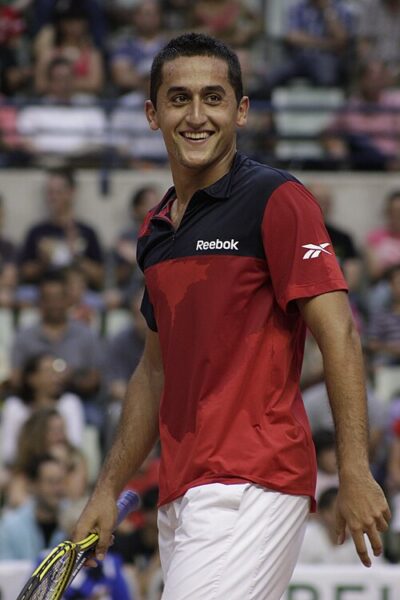
Nicolás Almagro
Nicolás Almagro is a Spanish tennis player. Born August 21, 1985, in Murcia. Educated at Ferrero Tennis Academy.
Facts
8 facts · 1 confirmed by two sources · 2 cited · 5 from one source
Where this comes from
Papalocal keeps its own record. It started from these sources; what each one said is kept here as it was copied, so a change on their side never changes this page by itself. Tap one to read its version.
What Wikidata says · copied November 16, 2026 · revision 2517605964
- Described as
- Spanish tennis player (born 1985)
- Other names
- Nicolas Almagro
- Born
- August 21, 1985 · 3 references
- Born in
- Murcia · 1 reference
- Citizen of
- Spain
- Occupation
- tennis player (2003–)
- Education
- Ferrero Tennis Academy
- Sport
- tennis · 1 reference
- Lived in
- Murcia
- Height
- 1.83 m (6 ft 0 in)
- Wikipedias with a page
- 37
Wikidata item Q244983 (wikidata.org/wiki/Q244983), public domain (CC0). Copied November 16, 2026.
What Wikipedia says · copied November 16, 2026 · revision 1371813805
Nicolás Almagro Sánchez (Spanish pronunciation: [nikoˈlas alˈmaɣɾo ˈsantʃeθ]; born 21 August 1985 in Murcia, Spain) is a Spanish former professional tennis player. He reached the quarterfinals of the French Open in 2008, 2010 and 2012 (losing each time to Rafael Nadal, the eventual champion in each occasion), as well as the quarterfinals of the Australian Open in 2013 (losing to David Ferrer after leading by two sets to love).
Over his career, Almagro won thirteen singles titles, and he achieved a career-high singles ranking of world No. 9 in May 2011. Following his retirement, Almagro began coaching American player Danielle Collins.
- Born, in its opening lines
- August 21, 1985
From the Wikipedia article “Nicolás Almagro” (en.wikipedia.org/wiki/Nicolás_Almagro), by its contributors, under CC BY-SA 4.0 (creativecommons.org/licenses/by-sa/4.0/). Copied November 16, 2026; not changed.
Confirmed Two sources agree. Cited One source, and it names where it got it. One source One source, without a reference of its own. Sources disagree The sources disagree. We show the best-supported value and keep theirs below.
