
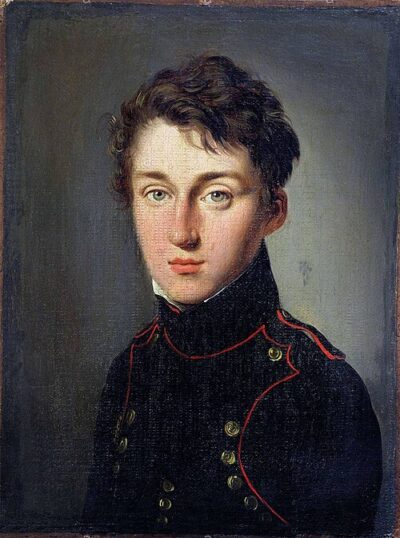
Nicolas Carnot
Nicolas Carnot was a French physicist. Born June 1, 1796, in Paris. Died August 24, 1832, in Paris. Known for Carnot cycle, Carnot's theorem and Reflections on the Motive Power of Fire and on Machines Fitted to Develop that Power. Educated at École polytechnique and Lycée Charlemagne.
Facts
25 facts · 2 confirmed by two sources · 10 cited · 13 from one source
Where this comes from
Papalocal keeps its own record. It started from these sources; what each one said is kept here as it was copied, so a change on their side never changes this page by itself. Tap one to read its version.
What Wikidata says · copied November 16, 2026 · revision 2567366428
- Described as
- French physicist (1796–1832)
- Other names
- Sadi Carnot, Nicolas Léonard Sadi Carnot, Leonard Sadi Carnot, Nicolas Leonard Sadi Carnot
- Born
- June 1, 1796 · 8 references
- Died
- August 24, 1832 · 9 references
- Born in
- Paris · 1 reference
- Died in
- Paris · 1 reference
- Buried in
- Cimetière ancien d'Ivry-sur-Seine · 1 reference
- Cause of death
- cholera · 1 reference
- Citizen of
- France
- Occupation
- mathematician; physicist; military engineer; engineer · 1 reference; thermodynamicist
- Worked for
- French Army (1816–1819) · 1 reference; French central public administration (1819–1828) · 1 reference
- Education
- École polytechnique (1812–1814) · 1 reference; Lycée Charlemagne (1811–1812) · 2 references; École d'application de l'artillerie et du génie in Metz (1814–1816) · 1 reference
- Known for
- Carnot cycle; Carnot's theorem; Reflections on the Motive Power of Fire and on Machines Fitted to Develop that Power; Carnot heat engine; Carnot number
- Field
- thermodynamics
- Father
- Lazare Carnot
- Siblings
- Hippolyte Carnot
- Wikipedias with a page
- 79
Wikidata item Q181685 (wikidata.org/wiki/Q181685), public domain (CC0). Copied November 16, 2026.
What Wikipedia says · copied November 16, 2026 · revision 1379960021
Nicolas Léonard Sadi Carnot (English: kar-NOH, French: [nikɔla leɔnaʁ sadi kaʁno]; 1 June 1796 – 24 August 1832), known as Sadi Carnot, was a French military engineer and physicist. A graduate of the École polytechnique, Carnot served as an officer in the Engineering Arm (le génie) of the French Army. He also pursued scientific studies, and in June 1824 published an essay titled Reflections on the Motive Power of Fire. In that book, which would be his only publication, Carnot developed the first successful theory of the maximum efficiency of heat engines.
Carnot's scientific work attracted little attention during his lifetime, but in 1834 it became the object of a detailed commentary and explanation by another French engineer, Émile Clapeyron. Clapeyron's commentary in turn attracted the attention of William Thomson (later Lord Kelvin) and Rudolf Clausius. Thomson used Carnot's analysis to develop an absolute thermodynamic temperature scale, while Clausius used it to define the concept of entropy, thus formalizing the second law of thermodynamics.
Carnot was the son of Lazare Carnot, an eminent mathematician, engineer, and commander of the French Revolutionary Army and later of the Napoleonic army. Some of the difficulties that Carnot faced in his own career might have been connected to the persecution of his family by the restored Bourbon monarchy after the fall of Napoleon in 1815. Carnot died in relative obscurity at the age of 36, but today he is often characterized as the "father of thermodynamics".
- Born, in its opening lines
- June 1, 1796
- Died, in its opening lines
- August 24, 1832
From the Wikipedia article “Nicolas Léonard Sadi Carnot” (en.wikipedia.org/wiki/Nicolas_Léonard_Sadi_Carnot), by its contributors, under CC BY-SA 4.0 (creativecommons.org/licenses/by-sa/4.0/). Copied November 16, 2026; not changed.
Confirmed Two sources agree. Cited One source, and it names where it got it. One source One source, without a reference of its own. Sources disagree The sources disagree. We show the best-supported value and keep theirs below.
