
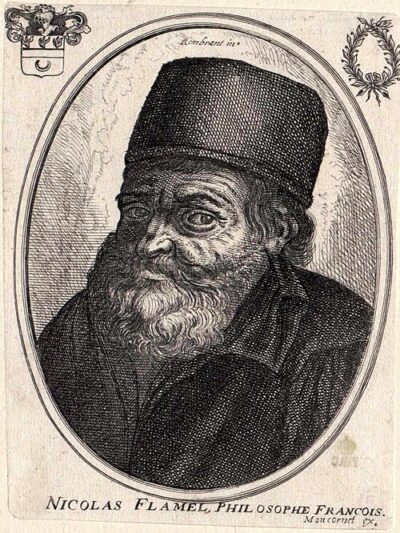
Nicolas Flamel was a French scrivener. Born 1335, in Pontoise. Died March 22, 1418, in Paris.
Facts
14 facts · 1 confirmed by two sources · 7 cited · 5 from one source · 1 where the sources disagree
What’s different
- Born: we show 1335 (Sources disagree). Wikipedia says c. 1340
Where this comes from
Papalocal keeps its own record. It started from these sources; what each one said is kept here as it was copied, so a change on their side never changes this page by itself. Tap one to read its version.
What Wikidata says · copied November 16, 2026 · revision 2567388829
- Described as
- French scrivener
- Born
- 1335 · 1 reference
- Died
- March 22, 1418 · 1 reference
- Born in
- Pontoise · 1 reference
- Died in
- Paris · 1 reference
- Citizen of
- France · 1 reference
- Occupation
- scribe · 1 reference; amanuensis; donor; book dealer · 1 reference; alchemist · 2 references; scrivener; notary · 1 reference
- Field
- alchemy · 1 reference
- Spouse
- Perenelle Flamel
- Wikipedias with a page
- 50
Wikidata item Q213330 (wikidata.org/wiki/Q213330), public domain (CC0). Copied November 16, 2026.
What Wikipedia says · copied November 16, 2026 · revision 1384667332
Nicolas Flamel (French: [nikɔla flamɛl]; c. 1340 – 22 March 1418) was a French écrivain public, a draftsman of public documents such as contracts, letters, agreements and requests, at a time when few people could write and read. He and his wife also ran a school that taught this trade.
Long after his death, Flamel developed a reputation as an alchemist thought to have created and discovered the philosopher's stone and to have thereby achieved immortality. These legendary accounts first appeared in the 17th century. According to texts ascribed to Flamel almost 200 years after his death, he had learned alchemical secrets from a Jewish converso on the road to Santiago de Compostela. He has since appeared as a legendary alchemist in various fictional works.
In modern historical publications Flamel is also often referred to as a copyist of manuscripts and a book seller, but research by M. and R. Rouse has demonstrated that this is not correct and that the very few historical documents that refer to him in this capacity do so mistakenly or are later forgeries.
- Born, in its opening lines
- c. 1340
- Died, in its opening lines
- March 22, 1418
From the Wikipedia article “Nicolas Flamel” (en.wikipedia.org/wiki/Nicolas_Flamel), by its contributors, under CC BY-SA 4.0 (creativecommons.org/licenses/by-sa/4.0/). Copied November 16, 2026; not changed.
Confirmed Two sources agree. Cited One source, and it names where it got it. One source One source, without a reference of its own. Sources disagree The sources disagree. We show the best-supported value and keep theirs below.
