
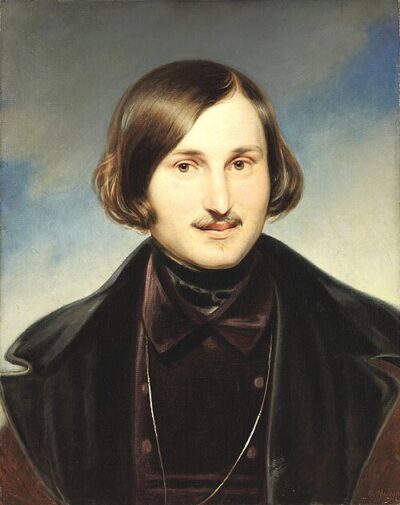
Nikolai Gogol
Nikolai Gogol was a Russian writer of Ukrainian origin. Born April 1, 1809, in Velyki Sorochyntsi. Died March 4, 1852, in Moscow. Known for Dead Souls, The Government Inspector and Marriage. Educated at Imperial St. Petersburg University.
Facts
29 facts · 2 confirmed by two sources · 8 cited · 18 from one source · 1 where the sources disagree
What’s different
- Born: we show April 1, 1809 (Confirmed). Wikidata also lists March 19, 1809 and March 20, 1809
- Died: we show March 4, 1852 (Confirmed). Wikidata also lists February 21, 1852 and February 21, 1852
- Name at birth: we show Микола Васильович Яновський (Sources disagree). Wikidata also lists Николай Васильевич Яновский
Where this comes from
Papalocal keeps its own record. It started from these sources; what each one said is kept here as it was copied, so a change on their side never changes this page by itself. Tap one to read its version.
What Wikidata says · copied November 16, 2026 · revision 2570086534
- Described as
- Russian writer of Ukrainian origin (1809–1852)
- Other names
- N. V. Gogolʹ, N. V. Hohalʹ, Gogolʹ, Nicolai Vasilievitch Gogol, Nikolay Gogol', Nikolaus Gogol, Nikolay Vasilyevich Gogol, Nikolai Vasil´evich Gogol´, Mykola Vasylʹovych Hoholʹ, Ko-kuo-li, Nikolay Vasil'yevich Gogol', Nikolai Vasilyevich Gogol
- Born
- March 19, 1809 · 2 references; April 1, 1809 · 1 reference; March 20, 1809 · 2 references
- Died
- February 21, 1852 · 5 references; February 21, 1852 · 2 references; March 4, 1852
- Born in
- Velyki Sorochyntsi · 3 references
- Died in
- Moscow · 5 references
- Buried in
- Novodevichy Cemetery (1931–) · 1 reference
- Name at birth
- Микола Васильович Яновський; Николай Васильевич Яновский
- Citizen of
- Russian Empire
- Occupation
- playwright · 1 reference; historian; literary critic; teacher; poet · 1 reference; prose writer · 1 reference; opinion journalist; writer · 4 references
- Worked for
- Imperial St. Petersburg University
- Education
- Imperial St. Petersburg University · 1 reference
- Genre
- drama fiction; prose
- Known for
- Dead Souls; The Government Inspector; Marriage; Taras Bulba
- Field
- prose · 1 reference; belletristic literature · 1 reference; literary criticism · 1 reference
- Father
- Vasyl Panasovych Gogol-Yanovsky
- Mother
- Mariia Hohol
- Religion
- Eastern Orthodoxy
- Wikipedias with a page
- 157
Wikidata item Q43718 (wikidata.org/wiki/Q43718), public domain (CC0). Copied November 16, 2026.
What Wikipedia says · copied November 16, 2026 · revision 1381626194
Nikolai Vasilyevich Gogol (1 April [O.S. 20 March] 1809 – 4 March [O.S. 21 February] 1852) was a Russian novelist, short-story writer, and playwright of Ukrainian origin.
Gogol used the grotesque in his writings, for example in his works "The Nose", "Viy", "The Overcoat", and "Nevsky Prospekt". These stories, and others such as "Diary of a Madman", have also been noted for their proto-surrealist qualities. According to Viktor Shklovsky, Gogol used the technique of defamiliarization, whereby a writer presents common things in an unfamiliar or strange way so that the reader can gain new perspectives and see the world differently. His early works, such as Evenings on a Farm Near Dikanka, were influenced by his Ukrainian upbringing, Ukrainian culture and folklore. His later writing satirised political corruption in contemporary Russia (The Government Inspector, Dead Souls), although Gogol also enjoyed the patronage of Tsar Nicholas I, who liked his work. The novel Taras Bulba (1835), the play Marriage (1842), and the short stories "The Tale of How Ivan Ivanovich Quarreled with Ivan Nikiforovich", "The Portrait", and "The Carriage" are also among his best-known works.
Many writers and critics have recognized Gogol's deep influence on Russian, Ukrainian and world literature. Gogol's influence was acknowledged by Fyodor Dostoevsky, Mikhail Saltykov-Shchedrin, Ryūnosuke Akutagawa, Franz Kafka, Mikhail Bulgakov, Vladimir Nabokov, Flannery O'Connor and others. Eugène-Melchior de Vogüé said: "We all came out from under Gogol's Overcoat."
- Born, in its opening lines
- April 1, 1809
- Died, in its opening lines
- March 4, 1852
From the Wikipedia article “Nikolai Gogol” (en.wikipedia.org/wiki/Nikolai_Gogol), by its contributors, under CC BY-SA 4.0 (creativecommons.org/licenses/by-sa/4.0/). Copied November 16, 2026; not changed.
Confirmed Two sources agree. Cited One source, and it names where it got it. One source One source, without a reference of its own. Sources disagree The sources disagree. We show the best-supported value and keep theirs below.
