
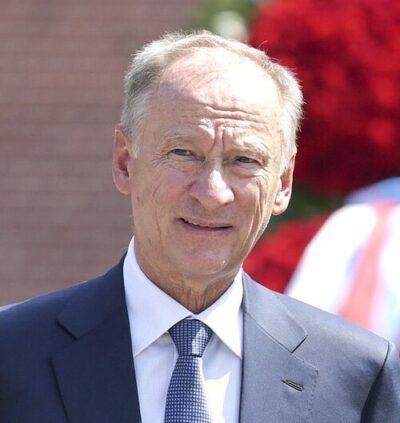
Nikolai Patrushev
Nikolai Patrushev is an Aide to the President of the Russian Federation since 2024 and former secretary of the Security Council of Russia. Born July 11, 1951, in Saint Petersburg. Positions held include Director of the Federal Security Service (1999–2008), Secretary of the Security Council of Russia (2008–2024) and Assistant to the President of the Russian Federation (2024–). Educated at Saint Petersburg State Marine Technical University and Academy of the Federal Security Service of the Russian Federation. Awards include Order of Honour, Order "For Merit to the Fatherland", 1st class and Order "For Merit to the Fatherland", 2nd class.
Facts
35 facts · 1 confirmed by two sources · 4 cited · 30 from one source
Where this comes from
Papalocal keeps its own record. It started from these sources; what each one said is kept here as it was copied, so a change on their side never changes this page by itself. Tap one to read its version.
What Wikidata says · copied November 16, 2026 · revision 2569741454
- Described as
- Aide to the President of the Russian Federation since 2024 and former secretary of the Security Council of Russia (2008–2024)
- Other names
- Nikolai Platonovich Patrushev
- Born
- July 11, 1951
- Born in
- Saint Petersburg
- Citizen of
- Soviet Union; Russia
- Occupation
- engineer; politician · 1 reference; military officer · 1 reference; spy · 1 reference
- Positions held
- Director of the Federal Security Service (1999–2008) · 1 reference; Secretary of the Security Council of Russia (2008–2024) · 1 reference; Assistant to the President of the Russian Federation (2024–); Secretary of the Security Council of Russia (2008–2024) · 1 reference
- Education
- Saint Petersburg State Marine Technical University; Academy of the Federal Security Service of the Russian Federation · 1 reference; National Security Academy of the Republic of Belarus · 1 reference
- Sport
- volleyball
- Awards
- Order of Honour; Order "For Merit to the Fatherland", 1st class; Order "For Merit to the Fatherland", 2nd class; Order "For Merit to the Fatherland", 3rd class; Order "For Merit to the Fatherland", 4th class; Order of Courage; Hero of the Russian Federation (2000) · 1 reference; Medal "In Commemoration of the 850th Anniversary of Moscow"; Order of Honor; Order of Akhmad Kadyrov; Order of Military Merit; Medal of Ushakov · 1 reference; Jubilee Medal "300 Years of the Russian Navy" · 1 reference; Jubilee Medal "60 Years of the Armed Forces of the USSR" · 1 reference; Jubilee Medal "70 Years of the Armed Forces of the USSR" · 1 reference
- Children
- Dmitry Patrushev
- Military rank
- General of the army; general of the army · 1 reference
- Lived in
- Moscow
- Wikipedias with a page
- 51
Wikidata item Q446865 (wikidata.org/wiki/Q446865), public domain (CC0). Copied November 16, 2026.
What Wikipedia says · copied November 16, 2026 · revision 1384395385
Nikolai Platonovich Patrushev (Russian: Николай Платонович Патрушев; born 11 July 1951) is a Russian politician, security officer and former intelligence officer who served as the secretary of the Security Council of Russia from 2008 to 2024. He previously served as the director of the Federal Security Service (FSB) from 1999 to 2008.
Belonging to the siloviki faction of president Vladimir Putin's inner circle, Patrushev is believed to be one of the closest advisors to Putin and a leading figure behind Russia's national security affairs. Patrushev has spoken favorably of the rise of KGB stalwarts to the highest echelons of power of Russia, referring to them as the "new nobility".
He played a key role in the decisions to seize and then annex Crimea in 2014 and to invade Ukraine in 2022.
- Born, in its opening lines
- July 11, 1951
From the Wikipedia article “Nikolai Patrushev” (en.wikipedia.org/wiki/Nikolai_Patrushev), by its contributors, under CC BY-SA 4.0 (creativecommons.org/licenses/by-sa/4.0/). Copied November 16, 2026; not changed.
Confirmed Two sources agree. Cited One source, and it names where it got it. One source One source, without a reference of its own. Sources disagree The sources disagree. We show the best-supported value and keep theirs below.
