
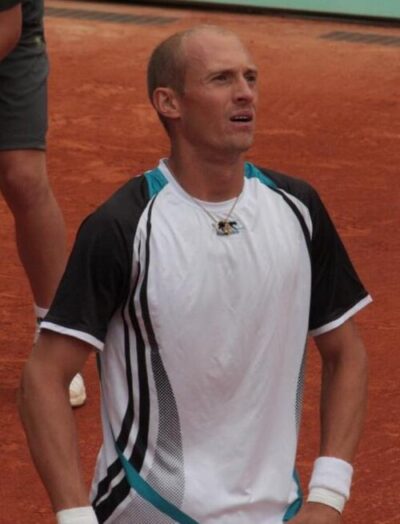
Nikolay Davydenko is a Russian tennis player. Born June 2, 1981, in Siverskodonetsk.
Facts
8 facts · 1 confirmed by two sources · 3 cited · 4 from one source
Where this comes from
Papalocal keeps its own record. It started from these sources; what each one said is kept here as it was copied, so a change on their side never changes this page by itself. Tap one to read its version.
What Wikidata says · copied November 16, 2026 · revision 2517314941
- Described as
- Russian tennis player
- Other names
- Nikolay Vladimirovich Davydenko
- Born
- June 2, 1981 · 1 reference
- Born in
- Siverskodonetsk
- Citizen of
- Russia · 1 reference
- Occupation
- tennis player (1999–2014)
- Sport
- tennis · 1 reference
- Lived in
- Moscow
- Nickname
- Kolya / Iron Man / The Machine · 1 reference
- Height
- 1.78 m (5 ft 10 in)
- Wikipedias with a page
- 48
Wikidata item Q191736 (wikidata.org/wiki/Q191736), public domain (CC0). Copied November 16, 2026.
What Wikipedia says · copied November 16, 2026 · revision 1385784134
Nikolay Vladimirovich Davydenko (Russian: Никола́й Влади́мирович Давыде́нко ; born 2 June 1981) is a Russian former professional tennis player. He achieved a career-high singles ranking of World No. 3 in November 2006. Davydenko's best result in a Grand Slam tournament was reaching the semi-finals, which he accomplished on four occasions: twice each at the French Open and the U.S. Open, losing to Roger Federer in all but one of them. He is regarded as the greatest player in men's tennis history not to have contested a Grand Slam final. His biggest achievement was winning the 2009 ATP World Tour Finals, and he also won three ATP Masters Series. In mid-October 2014 Davydenko retired from playing professionally.
- Born, in its opening lines
- June 2, 1981
From the Wikipedia article “Nikolay Davydenko” (en.wikipedia.org/wiki/Nikolay_Davydenko), by its contributors, under CC BY-SA 4.0 (creativecommons.org/licenses/by-sa/4.0/). Copied November 16, 2026; not changed.
Confirmed Two sources agree. Cited One source, and it names where it got it. One source One source, without a reference of its own. Sources disagree The sources disagree. We show the best-supported value and keep theirs below.
