
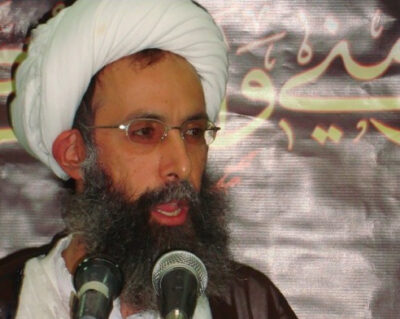
Nimr al-Nimr
Nimr al-Nimr was a Saudi Shia Sheikh in al-Awamiyah in Saudi Arabia's Eastern Province. Born June 21, 1959, in Al-Awamiyah. Died January 2, 2016, in Saudi Arabia.
Facts
12 facts · 2 confirmed by two sources · 0 cited · 10 from one source
Where this comes from
Papalocal keeps its own record. It started from these sources; what each one said is kept here as it was copied, so a change on their side never changes this page by itself. Tap one to read its version.
What Wikidata says · copied November 16, 2026 · revision 2554127410
- Described as
- Saudi Shia Sheikh in al-Awamiyah in Saudi Arabia's Eastern Province
- Other names
- Nimr Baqir al-Nimr, Sheikh Nimr
- Born
- June 21, 1959 · 1 reference
- Died
- January 2, 2016 · 1 reference
- Born in
- Al-Awamiyah
- Died in
- Saudi Arabia
- Cause of death
- decapitation
- Citizen of
- Saudi Arabia
- Occupation
- human rights defender; Islamic jurist
- Field
- Ja'fari School
- Religion
- Shia Islam; Islam
- Website
- https://www.sknemer.com/
- Wikipedias with a page
- 54
Wikidata item Q1992645 (wikidata.org/wiki/Q1992645), public domain (CC0). Copied November 16, 2026.
What Wikipedia says · copied November 16, 2026 · revision 1384666934
Ayatollah Sheikh Nimr Baqir al-Nimr (21 June 1959 – 2 January 2016), commonly referred to as Sheikh Nimr, was a Saudi Shia sheikh from Al-Awamiyah in Saudi Arabia's Eastern Province. His arrest and execution were widely condemned by various governments and human rights organizations.
He was popular among youth and critical of the Saudi Arabian government, advocating for free elections in Saudi Arabia. In 2006, al-Nimr was arrested by Saudi authorities, during which he claimed to have been beaten by the Mabahith, a Saudi secret police agency. In 2009, he criticized Saudi authorities and suggested that if the rights of Saudi Shia were not respected, the Eastern Province should secede. In response, Saudi authorities arrested al-Nimr along with 35 others. During the 2011–12 Saudi Arabian protests, al-Nimr urged protestors to resist police bullets with "the roar of the word" rather than violence. The Guardian described al-Nimr as having "taken the lead in [the] uprising."
On 8 July 2012, Saudi police shot al-Nimr in the leg and arrested him in what police described as an "exchange of gunfire." During the protests against al-Nimr's arrest, police fired into a crowd of thousands, killing two men, Akbar al-Shakhouri and Mohamed al-Felfel. Following his arrest, al-Nimr began a hunger strike and was allegedly tortured. The Asharq Center for Human Rights expressed concern for his health during the hunger strike on 21 August, calling for international support to allow access for family, lawyers, and human rights activists.
On 15 October 2014, al-Nimr was sentenced to death by the Specialized Criminal Court for "seeking foreign meddling in Saudi Arabia, disobeying its rulers, and taking up arms against the security forces." On the same day, his brother, Mohammad al-Nimr, was arrested for tweeting information about the death sentence. Al-Nimr was executed on or shortly before 2 January 2016, along with 46 others. His execution was condemned by Iran and Shiites throughout the Middle East, as well as by Western figures and Sunnis opposed to sectarianism. The Saudi government announced that his body would not be handed over to the family. In March 2017, after a prolonged campaign of harassment, Saudi security forces killed two cousins of the Nimr family during a raid on a farm in eastern Saudi Arabia. Miqdad and Mohammad al-Nimr were killed at a farm in Awamiyah, the Nimr family hometown.
- Born, in its opening lines
- June 21, 1959
- Died, in its opening lines
- January 2, 2016
From the Wikipedia article “Nimr al-Nimr” (en.wikipedia.org/wiki/Nimr_al-Nimr), by its contributors, under CC BY-SA 4.0 (creativecommons.org/licenses/by-sa/4.0/). Copied November 16, 2026; not changed.
Confirmed Two sources agree. Cited One source, and it names where it got it. One source One source, without a reference of its own. Sources disagree The sources disagree. We show the best-supported value and keep theirs below.
