
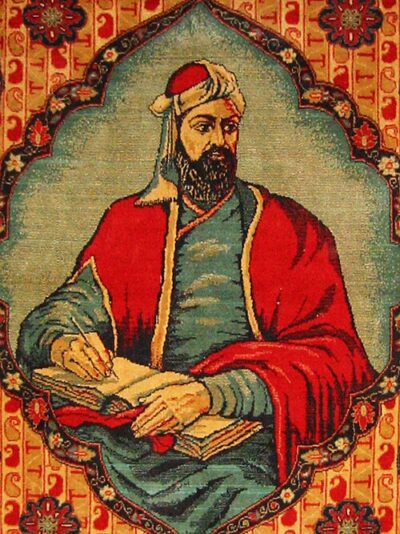
Nizami Ganjavi
Nizami Ganjavi was a Persian poet. Born 1141, in Ganja. Died 1209, in Ganja. Known for Khamsa.
Facts
10 facts · 2 confirmed by two sources · 3 cited · 5 from one source
What’s different
- Died: we show 1209 (Confirmed). Wikidata also lists 1202 and 1214
Where this comes from
Papalocal keeps its own record. It started from these sources; what each one said is kept here as it was copied, so a change on their side never changes this page by itself. Tap one to read its version.
What Wikidata says · copied November 16, 2026 · revision 2568763140
- Described as
- Persian poet
- Other names
- Nezami Ganjavi, Nizami Ganje'i,, Nizami, Nezāmi, Jamal ad-Dīn Abū Muḥammad Ilyās ibn-Yūsuf ibn-Zakkī, Nizami of Ganja, Niẓāmī Ganjavī
- Born
- 1141 · 10 references
- Died
- 1209 · 12 references; 1202 · 1 reference; 1214 · 1 reference
- Born in
- Ganja · 1 reference
- Died in
- Ganja
- Buried in
- Nizami Mausoleum
- Name at birth
- الیاس بن یوسف بن زکی بن مؤیَّد
- Occupation
- poet · 2 references; writer · 1 reference; philosopher
- Known for
- Khamsa
- Wikipedias with a page
- 91
Wikidata item Q234908 (wikidata.org/wiki/Q234908), public domain (CC0). Copied November 16, 2026.
What Wikipedia says · copied November 16, 2026 · revision 1371967388
Nizami Ganjavi (Persian: نظامی گنجوی, romanized: Niẓāmī Ganjavī, lit. 'Niẓāmī of Ganja'; c. 1141 – 1209), Nizami Ganje'i, Nizami, or Nezāmi, whose formal name was Jamal ad-Dīn Abū Muḥammad Ilyās ibn-Yūsuf ibn-Zakkī, was a 12th-century poet. Nizami is considered the greatest romantic epic poet in Persian literature, who brought a colloquial and realistic style to the Persian epic. His heritage is widely appreciated in Afghanistan, Republic of Azerbaijan, Iran, the Kurdistan region and Tajikistan.
- Born, in its opening lines
- 1141
- Died, in its opening lines
- 1209
From the Wikipedia article “Nizami Ganjavi” (en.wikipedia.org/wiki/Nizami_Ganjavi), by its contributors, under CC BY-SA 4.0 (creativecommons.org/licenses/by-sa/4.0/). Copied November 16, 2026; not changed.
Confirmed Two sources agree. Cited One source, and it names where it got it. One source One source, without a reference of its own. Sources disagree The sources disagree. We show the best-supported value and keep theirs below.
