
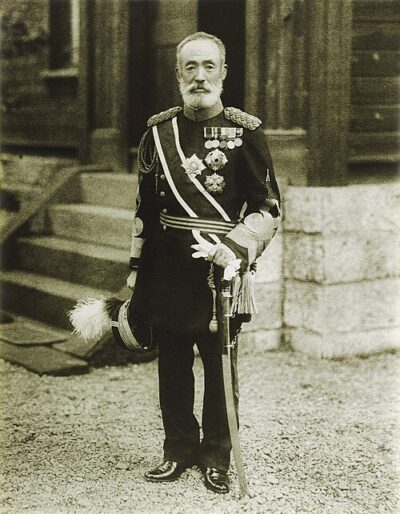
Nogi Maresuke
Nogi Maresuke was a Japanese general. Born December 25, 1849, in Mōri Kai-no-kami's Residence. Died September 13, 1912, in Akasaka-ku. Positions held include Governor-General of Taiwan (1896–1898). Educated at Meirinkan. Awards include Knight Grand Cross of the Order of the Bath, Knight Grand Cross of the Royal Victorian Order and Order of the Rising Sun, 4th class.
Facts
36 facts · 2 confirmed by two sources · 3 cited · 31 from one source
Where this comes from
Papalocal keeps its own record. It started from these sources; what each one said is kept here as it was copied, so a change on their side never changes this page by itself. Tap one to read its version.
What Wikidata says · copied November 16, 2026 · revision 2559854940
- Described as
- Japanese general (1849-1912)
- Other names
- Nogi Nakito
- Born
- December 25, 1849 · 1 reference
- Died
- September 13, 1912 · 3 references
- Born in
- Mōri Kai-no-kami's Residence
- Died in
- Akasaka-ku
- Buried in
- Aoyama Cemetery
- Cause of death
- seppuku
- Citizen of
- Japan
- Occupation
- politician; military personnel; soldier · 1 reference
- Positions held
- Governor-General of Taiwan (1896–1898)
- Education
- Meirinkan
- Awards
- Knight Grand Cross of the Order of the Bath; Knight Grand Cross of the Royal Victorian Order; Order of the Rising Sun, 4th class (1878) · 1 reference; Order of the Rising Sun, 3rd class (1885) · 1 reference; Order of the Sacred Treasure, 2nd Class (1894) · 1 reference; Order of the Golden Kite, 3rd Class (1895) · 1 reference; Order of the Rising Sun, 2nd class (1895) · 1 reference; Order of the Sacred Treasure, 1st Class (1897) · 1 reference; Order of the Golden Kite, 1st Class (1906) · 1 reference; Order of the Rising Sun with Paulownia Flowers, 1st class (1906) · 1 reference; Imperial Constitution Promulgation Medal · 1 reference; Military Medal of Honor · 1 reference; Grand Cross of the Legion of Honour · 1 reference; Pour le Mérite · 1 reference; Order of the Star of Romania · 1 reference
- Field
- military · 1 reference; politics · 1 reference
- Spouse
- Nogi Shizuko
- Children
- Katsusuke Nogi; Yasusuke Nogi
- Father
- Nogi Maretsugu
- Siblings
- Tamaki Masayoshi
- Military branch
- Imperial Japanese Army · 1 reference
- Military rank
- general
- Wikipedias with a page
- 33
Wikidata item Q468122 (wikidata.org/wiki/Q468122), public domain (CC0). Copied November 16, 2026.
What Wikipedia says · copied November 16, 2026 · revision 1383919082
Count Nogi Maresuke (乃木 希典), also known as Kiten, Count Nogi (December 25, 1849 – September 13, 1912), was a Japanese general in the Imperial Japanese Army and a governor-general of Taiwan. He was one of the commanders during the 1894 capture of Port Arthur from China and a prominent figure in the Russo-Japanese War of 1904–05, as commander of the forces which captured Port Arthur from the Russians.
He was a national hero in Imperial Japan as a model of feudal loyalty and self-sacrifice, ultimately to the point of suicide. In the Satsuma Rebellion, he lost a banner of the emperor in battle, for which he tried to atone with suicidal bravery in order to recapture it, until ordered to stop. In the Russo-Japanese War, he captured Port Arthur but he felt that he had lost too many of his soldiers, so requested permission to commit suicide, which the emperor refused. These two events, as well as his desire not to outlive his master, motivated his suicide on the day of the funeral of the Emperor Meiji. His example brought attention to the concept of bushido (moral code of the samurai) and the controversial samurai practice of junshi (following the lord in death).
- Born, in its opening lines
- December 25, 1849
- Died, in its opening lines
- September 13, 1912
From the Wikipedia article “Nogi Maresuke” (en.wikipedia.org/wiki/Nogi_Maresuke), by its contributors, under CC BY-SA 4.0 (creativecommons.org/licenses/by-sa/4.0/). Copied November 16, 2026; not changed.
Confirmed Two sources agree. Cited One source, and it names where it got it. One source One source, without a reference of its own. Sources disagree The sources disagree. We show the best-supported value and keep theirs below.
