
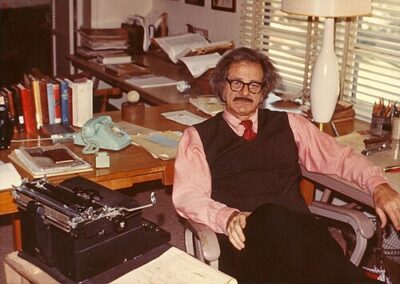
Norman Corwin
Norman Corwin was an American radio producer and screenwriter. Born May 3, 1910, in Boston. Died October 18, 2011, in Los Angeles. Awards include Peabody Awards.
Facts
16 facts · 2 confirmed by two sources · 5 cited · 9 from one source
Where this comes from
Papalocal keeps its own record. It started from these sources; what each one said is kept here as it was copied, so a change on their side never changes this page by itself. Tap one to read its version.
What Wikidata says · copied November 18, 2026 · revision 2549813749
- Described as
- American radio producer and screenwriter (1910-2011)
- Other names
- Norman Lewis Corwin
- Born
- May 3, 1910 · 6 references
- Died
- October 18, 2011 · 7 references
- Born in
- Boston · 1 reference
- Died in
- Los Angeles · 1 reference
- Citizen of
- United States
- Occupation
- screenwriter · 1 reference; film producer; journalist · 1 reference; playwright; radio personality; actor · 1 reference; television director
- Awards
- Peabody Awards
- Field
- broadcasting · 1 reference
- Spouse
- Katherine Locke (1947–1995)
- Website
- http://www.normancorwin.com/
- Wikipedias with a page
- 16
Wikidata item Q1251336 (wikidata.org/wiki/Q1251336), public domain (CC0). Copied November 18, 2026.
What Wikipedia says · copied November 18, 2026 · revision 1380486193
Norman Lewis Corwin (May 3, 1910 – October 18, 2011) was an American writer, screenwriter, producer, essayist and teacher of journalism and writing. His earliest and biggest successes were in the writing and directing of radio drama during the 1930s and 1940s.
Corwin was among the first producers to regularly use entertainment – even light entertainment – to tackle serious social issues. In this area, he was a peer of Orson Welles and William N. Robson, and an inspiration to other later radio/TV writers such as Rod Serling, Gene Roddenberry, Norman Lear, J. Michael Straczynski and Yuri Rasovsky. His work was very influential on successful creative and performing artists, including Ray Bradbury, Charles Kuralt, The Firesign Theatre, Robert Altman, and Robin Williams among many others.
A major figure during the Golden Age of Radio, his work was very influential both at the time and later. He has been called "The Grand Master of American Audio Theatre". During the 1930s and 1940s he was a writer and producer of many radio programs in many genres: history, biography, fantasy, fiction, poetry and drama. He was the writer and creator of series such as The Columbia Workshop, 13 by Corwin, 26 by Corwin and others. After leaving the CBS Network, he was Head of Special Media Programming for the United Nations in the early 1950s, producing radio programs explaining the U.N.'s organization and goals, and documenting some of its efforts worldwide. He was a lecturer in journalism at the University of Southern California until he was 97.
A documentary film on Corwin's life, A Note of Triumph: The Golden Age of Norman Corwin, won an Academy Award for Best Documentary (Short Feature) in 2006. Les Guthman's feature documentary on Mr. Corwin's career, Corwin aired on PBS in the 1990s. He was inducted into the Pacific Pioneer Broadcasters Diamond Circle in 1994.
On Corwin's 100th birthday, the Writers Guild of America West gave him a "Gala" in Hollywood, which was hosted by Leonard Maltin and featured live performances of two of his favorite works and birthday speeches and reminiscences by many people, including Carl Reiner, Hal Kanter, William Shatner, and others. On that occasion, the National Audio Theatre Festival organization announced the creation of the Norman Corwin Award for Excellence in Audio Theatre, which is given annually to an individual or group who have made significant contributions to the art form in the United States.
- Born, in its opening lines
- May 3, 1910
- Died, in its opening lines
- October 18, 2011
From the Wikipedia article “Norman Corwin” (en.wikipedia.org/wiki/Norman_Corwin), by its contributors, under CC BY-SA 4.0 (creativecommons.org/licenses/by-sa/4.0/). Copied November 18, 2026; not changed.
Confirmed Two sources agree. Cited One source, and it names where it got it. One source One source, without a reference of its own. Sources disagree The sources disagree. We show the best-supported value and keep theirs below.
