
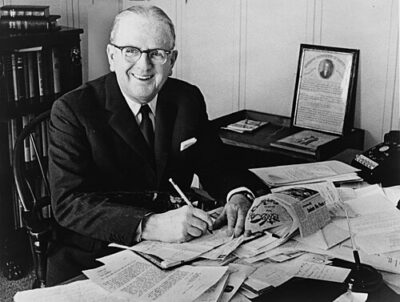
Norman Vincent Peale
Norman Vincent Peale was an American writer and minister. Born May 31, 1898, in Bowersville. Died December 24, 1993, in Pawling. Educated at Boston University and Ohio Wesleyan University. Awards include Presidential Medal of Freedom and Horatio Alger Award.
Facts
16 facts · 2 confirmed by two sources · 2 cited · 12 from one source
Where this comes from
Papalocal keeps its own record. It started from these sources; what each one said is kept here as it was copied, so a change on their side never changes this page by itself. Tap one to read its version.
What Wikidata says · copied November 13, 2026 · revision 2549566307
- Described as
- American writer and minister (1898-1993)
- Other names
- Norman Peale
- Born
- May 31, 1898 · 4 references
- Died
- December 24, 1993 · 4 references
- Born in
- Bowersville
- Died in
- Pawling
- Buried in
- Christ Church Cemetery · 1 reference
- Cause of death
- stroke
- Citizen of
- United States
- Occupation
- psychologist; writer
- Education
- Boston University; Ohio Wesleyan University; Boston University School of Theology
- Awards
- Presidential Medal of Freedom (1984) · 1 reference; Horatio Alger Award
- Spouse
- Ruth Stafford Peale
- Religion
- Methodism
- Wikipedias with a page
- 40
Wikidata item Q708251 (wikidata.org/wiki/Q708251), public domain (CC0). Copied November 13, 2026.
What Wikipedia says · copied November 13, 2026 · revision 1384758745
Norman Vincent Peale (May 31, 1898 – December 24, 1993) was an American Protestant clergyman, and an author best known for popularizing the concept of positive thinking, especially through his best-selling book The Power of Positive Thinking (1952). He served as the pastor of Marble Collegiate Church, New York, from 1932, leading this Reformed Church in America congregation for more than a half century until his retirement in 1984. Alongside his pulpit ministry, he had an extensive career of writing and editing, and radio and television presentations. Despite arguing at times against involvement of clergy in politics, he nevertheless had some controversial affiliations with politically active organizations in the late 1930s, and engaged with national political candidates and their campaigns, having influence on some, including personal friendships with Presidents Richard Nixon and Donald Trump.
Peale led a group opposing the election of John F. Kennedy for president, saying, "Faced with the election of a Catholic, our culture is at stake." Theologian Reinhold Niebuhr responded that Peale was motivated by "blind prejudice". After intense public criticism, Peale retracted his statement. He also opposed Adlai Stevenson's candidacy for president because he was divorced, which led to Stevenson's famous quip "I find Saint Paul appealing and Saint Peale appalling."
Following the publication of Peale's 1952 best seller, his ideas became the focus of criticism from several psychiatric professionals, church theologians and leaders. Peale was awarded the Presidential Medal of Freedom, the highest civilian honor in the United States, on March 26, 1984, by President Ronald Reagan. He died at age 95, following a stroke, on December 24, 1993, in Pawling, New York. Ruth Stafford, his wife of 63 years, influenced his publication of The Power in 1952, and was the co-founder of Guideposts.
- Born, in its opening lines
- May 31, 1898
- Died, in its opening lines
- December 24, 1993
From the Wikipedia article “Norman Vincent Peale” (en.wikipedia.org/wiki/Norman_Vincent_Peale), by its contributors, under CC BY-SA 4.0 (creativecommons.org/licenses/by-sa/4.0/). Copied November 13, 2026; not changed.
Confirmed Two sources agree. Cited One source, and it names where it got it. One source One source, without a reference of its own. Sources disagree The sources disagree. We show the best-supported value and keep theirs below.
