
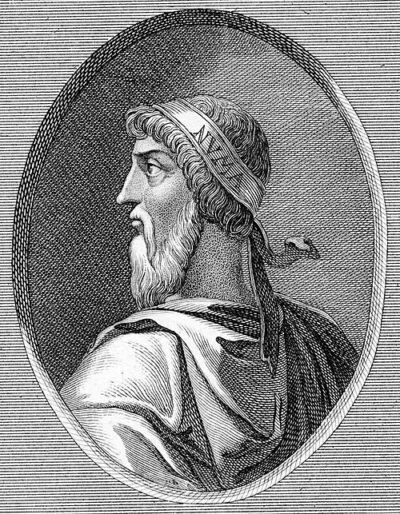
Numa Pompilius
Numa Pompilius was a legendary second king of Rome, succeeding Romulus. Born April 21, 753 BC, in Cures. Died 671 BC. Positions held include King of Rome (-715–-673).
Facts
17 facts · 0 confirmed by two sources · 0 cited · 15 from one source · 2 where the sources disagree
What’s different
- Born: we show April 21, 753 BC (Sources disagree). Wikipedia says 753
- Died: we show 671 BC (Sources disagree). Wikipedia says 672
Where this comes from
Papalocal keeps its own record. It started from these sources; what each one said is kept here as it was copied, so a change on their side never changes this page by itself. Tap one to read its version.
What Wikidata says · copied November 16, 2026 · revision 2547746844
- Described as
- legendary second king of Rome, succeeding Romulus
- Born
- April 21, 753 BC
- Died
- 671 BC
- Born in
- Cures
- Citizen of
- Ancient Rome
- Occupation
- politician; ancient Roman priest
- Positions held
- King of Rome (-715–-673)
- Spouse
- Tatia; Lucretia; Egeria
- Children
- Pompilia; Mamercus; Calpus; Pomponius; Pinus
- Father
- Pompo
- Religion
- ancient Roman religion
- Wikipedias with a page
- 62
Wikidata item Q200031 (wikidata.org/wiki/Q200031), public domain (CC0). Copied November 16, 2026.
What Wikipedia says · copied November 16, 2026 · revision 1381405530
Numa Pompilius (Classical Latin: [ˈnʊma pɔmˈpɪliʊs]; c. 753–672 BC; reigned 715–672 BC) was the legendary second king of Rome, succeeding Romulus after a one-year interregnum. He was of Sabine origin, and many of Rome's most important religious and political institutions are attributed to him, such as the Roman calendar, Vestal Virgins, the cult of Mars, the cult of Jupiter, the cult of Romulus, and the office of pontifex maximus.
- Born, in its opening lines
- 753
- Died, in its opening lines
- 672
From the Wikipedia article “Numa Pompilius” (en.wikipedia.org/wiki/Numa_Pompilius), by its contributors, under CC BY-SA 4.0 (creativecommons.org/licenses/by-sa/4.0/). Copied November 16, 2026; not changed.
Confirmed Two sources agree. Cited One source, and it names where it got it. One source One source, without a reference of its own. Sources disagree The sources disagree. We show the best-supported value and keep theirs below.
