
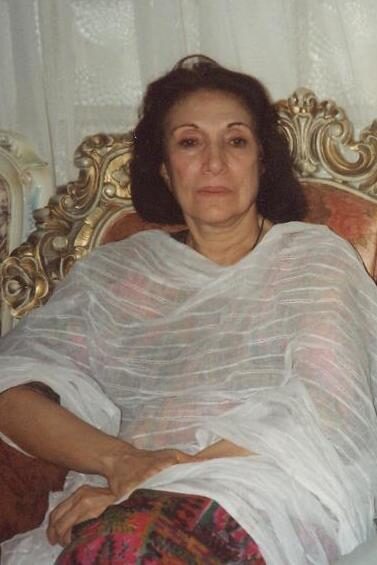
Nusrat Bhutto
Nusrat Bhutto was an Iranian-born Pakistani politician. Born March 23, 1929, in Isfahan. Died October 23, 2011, in Dubai. Educated at University of Isfahan.
Facts
17 facts · 2 confirmed by two sources · 0 cited · 15 from one source
Where this comes from
Papalocal keeps its own record. It started from these sources; what each one said is kept here as it was copied, so a change on their side never changes this page by itself. Tap one to read its version.
What Wikidata says · copied November 17, 2026 · revision 2568887438
- Described as
- Iranian-born Pakistani politician (1929-2011)
- Other names
- Begum Nusrat Bhutto
- Born
- March 23, 1929 · 1 reference
- Died
- October 23, 2011 · 1 reference
- Born in
- Isfahan
- Died in
- Dubai
- Buried in
- Bhutto family mausoleum
- Cause of death
- stroke
- Citizen of
- Pakistan; Iran
- Occupation
- politician
- Political party
- Pakistan Peoples Party
- Education
- University of Isfahan
- Spouse
- Zulfikar Ali Bhutto
- Children
- Murtaza Bhutto; Benazir Bhutto · 1 reference; Shahnawaz Bhutto; Sanam Bhutto.
- Religion
- Shia Islam
- Wikipedias with a page
- 25
Wikidata item Q327424 (wikidata.org/wiki/Q327424), public domain (CC0). Copied November 17, 2026.
What Wikipedia says · copied November 17, 2026 · revision 1384965926
Begum Nusrat Bhutto (née Ispahani; 23 March 1929 – 23 October 2011) was an Iranian-Pakistani public figure and stateswoman who served as the First Lady of Pakistan from 1971 to 1977 as the wife of Zulfikar Ali Bhutto, who served as the country's president and prime minister. She led the Pakistan Peoples Party (PPP) from her husband's execution in 1979 to 1984 when their daughter Benazir Bhutto succeeded her. She also served as the first Senior Minister of Pakistan from 1988 to 1990 under Benazir's government.
She was born in Isfahan, Iran to a wealthy merchant family of Kurdish heritage and her family had settled in Bombay before moving to Karachi after the Partition of British India. Ispahani joined a paramilitary women's force in 1950, but left a year later when she married Zulfikar Ali Bhutto. She moved to Oxfordshire in England with her husband who then was pursuing his legal education. She returned to Pakistan alongside Bhutto who went on to serve as the Foreign Minister. After her husband founded the Pakistan Peoples Party, Ispahani worked to lead the party's women's wing. After Bhutto was elected as the President in 1971, Ispahani became the First Lady of Pakistan and remained so until her husband's removal in 1977. Her daughter, Benazir Bhutto immediately succeeded her husband as the leader of the Pakistan Peoples party. While under house arrest, Ispahani fought an unsuccessful legal battle to prevent her husband's execution. After Bhutto's execution, Ispahani, along with her children, went into exile to London, from where in 1981 she co-founded the Movement for the Restoration of Democracy, a non-violent opposition to Zia's regime.
Ispahani returned to Pakistan after her daughter Benazir made a comeback in 1986. After the People's Party's victory in 1988, she joined Benazir's cabinet as a minister without portfolio while representing Larkana District in the National Assembly. She remained in the cabinet until Benazir's government was dismissed in 1990. Afterwards, during a family dispute between her son, Murtaza, and her daughter, Benazir, Ispahani favored Murtaza leading Benazir to sack Ispahani as the party leader. Ispahani stopped talking to the media and refrained from political engagements after the assassination of her son Murtaza in 1996 during a police encounter, during her daughter's second government.
Ispahani moved to Dubai in 1996, suffering from Alzheimer's disease, she was kept out of public's eye by Benazir until her demise on 23 October 2011. In Pakistan, Ispahani is remembered for her contribution to empowerment of women in Pakistan and for advocating for democracy in Pakistan, for which she is dubbed as Mādar-e-Jamhūriyat (English "Mother of Democracy"), a title she was honored with by the parliament following her death.
- Born, in its opening lines
- March 23, 1929
- Died, in its opening lines
- October 23, 2011
From the Wikipedia article “Nusrat Bhutto” (en.wikipedia.org/wiki/Nusrat_Bhutto), by its contributors, under CC BY-SA 4.0 (creativecommons.org/licenses/by-sa/4.0/). Copied November 17, 2026; not changed.
Confirmed Two sources agree. Cited One source, and it names where it got it. One source One source, without a reference of its own. Sources disagree The sources disagree. We show the best-supported value and keep theirs below.
