
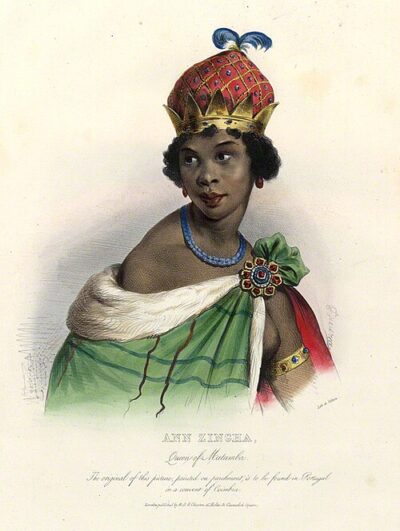
Nzingha Mbande
Nzingha Mbande was an Ambundu queen in Angola (c. 1583–1663). Born 1582, in Caculo Cabaça. Died December 17, 1663, in Kingdom of Matamba. Positions held include queen regnant (1624–1663).
Facts
11 facts · 1 confirmed by two sources · 1 cited · 8 from one source · 1 where the sources disagree
What’s different
- Born: we show 1582 (Sources disagree). Wikipedia says c. 1583
Where this comes from
Papalocal keeps its own record. It started from these sources; what each one said is kept here as it was copied, so a change on their side never changes this page by itself. Tap one to read its version.
What Wikidata says · copied November 16, 2026 · revision 2564989786
- Described as
- Ambundu queen in Angola (c. 1583–1663)
- Other names
- Ana de Sousa Nzingha Mbande, Queen Anna Nzinga, Anna Zingha, Anna Zinga, Nzinga of Ndongo and Matamba, Nzingha of Ndongo and Matamba, Njinga Mbandi, Nzinga a Mbandi, Nzinga di Ndongo e Matamba, Nzinga Mbanda
- Born
- 1582 · 1 reference
- Died
- December 17, 1663 · 2 references
- Born in
- Caculo Cabaça
- Died in
- Kingdom of Matamba
- Citizen of
- Kingdom of Ndongo
- Positions held
- queen regnant (1624–1663) · 1 reference
- Father
- Mbande a Ngola
- Siblings
- Barbara of Matamba; Ngola Mbande
- Religion
- Christianity
- Lived in
- Kingdom of Matamba (1648–)
- Wikipedias with a page
- 48
Wikidata item Q467650 (wikidata.org/wiki/Q467650), public domain (CC0). Copied November 16, 2026.
What Wikipedia says · copied November 16, 2026 · revision 1385929595
Nzinga Mbande (; c. 1583 – 17 December 1663), also known as Ngola Njinga by those she ruled over, was a southwest African queen who ruled the Ambundu kingdoms of Ndongo and Matamba, located in present-day northern Angola. Born into the ruling family of Ndongo, her grandfather Ngola Kilombo Kia Kasenda was the king of Ndongo, succeeded by her father.
Nzinga received military and political training as a child, and she demonstrated an aptitude for defusing political crises as an ambassador to the Portuguese Empire. In 1624, she assumed power over Ndongo after the death of her brother Ngola Mbandi. She ruled during a period of rapid growth of the African slave trade and encroachment by the Portuguese Empire in South West Africa.
The Portuguese declared war on Ndongo in 1626 and by 1628, Njinga's army had been severely depleted and they went into exile. In search of allies, she married the powerful Imbangala warlord Kaza. Using this new alliance to rebuild her forces, she conquered the Kingdom of Matamba from 1631 to 1635. In 1641, she entered into an alliance with the Dutch West India Company who had captured Luanda from the Portuguese. Between 1641 and 1644, Njinga was able to reclaim large parts of Ndongo. Alongside the Dutch, she defeated the Portuguese in a number of battles but was unable to take the Fortress of Massangano. In 1648, the Portuguese recaptured Luanda, with the Dutch leaving Angola. Njinga continued to fight the Portuguese until a peace treaty was signed in 1656. She then became a major promoter of Catholicism in Matamba and for the last seven years of her life closely aligned herself with Portugal, who protected her against foreign and internal rivals and granted her a monopoly of slave exports in exchange for trade and a military alliance.
In the centuries since her death, Njinga has been increasingly recognized as a major historical figure in Angola and in the wider Atlantic Creole culture. She is remembered for her intelligence, her political and diplomatic wisdom, and her military tactics.
- Born, in its opening lines
- c. 1583
- Died, in its opening lines
- December 17, 1663
From the Wikipedia article “Nzinga of Ndongo and Matamba” (en.wikipedia.org/wiki/Nzinga_of_Ndongo_and_Matamba), by its contributors, under CC BY-SA 4.0 (creativecommons.org/licenses/by-sa/4.0/). Copied November 16, 2026; not changed.
Confirmed Two sources agree. Cited One source, and it names where it got it. One source One source, without a reference of its own. Sources disagree The sources disagree. We show the best-supported value and keep theirs below.
