
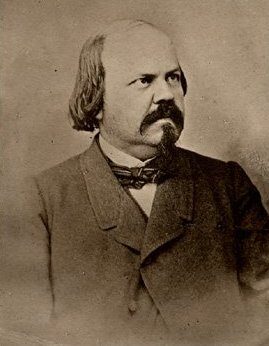
Octave Crémazie
Octave Crémazie was a Canadian poet. Born April 16, 1827, in Quebec City. Died January 16, 1879, in Le Havre. Known for Le Vieux soldat canadien. Educated at Séminaire de Québec. Awards include Person of National Historic Significance.
Facts
18 facts · 2 confirmed by two sources · 7 cited · 9 from one source
Where this comes from
Papalocal keeps its own record. It started from these sources; what each one said is kept here as it was copied, so a change on their side never changes this page by itself. Tap one to read its version.
What Wikidata says · copied November 18, 2026 · revision 2558187826
- Described as
- Canadian poet (1827-1879)
- Other names
- Octave Cremazie
- Born
- April 16, 1827 · 6 references
- Died
- January 16, 1879 · 5 references
- Born in
- Quebec City
- Died in
- Le Havre · 1 reference
- Buried in
- Ingouville
- Cause of death
- peritonitis
- Citizen of
- Canada
- Occupation
- poet; writer · 1 reference; book dealer
- Education
- Séminaire de Québec
- Known for
- Le Vieux soldat canadien
- Awards
- Person of National Historic Significance · 1 reference
- Field
- poetry · 1 reference; literature · 1 reference; book vendor · 1 reference; bookselling · 1 reference
- Siblings
- Jacques Crémazie
- Wikipedias with a page
- 15
Wikidata item Q685250 (wikidata.org/wiki/Q685250), public domain (CC0). Copied November 18, 2026.
What Wikipedia says · copied November 18, 2026 · revision 1371380387
Octave Crémazie (French pronunciation: [ɔktav kʁemazi]; April 16, 1827 – January 16, 1879) was a French Canadian poet and bookseller born in Quebec City. Recognized both during and after his lifetime for his patriotic verse and his significant role in the cultural development of Quebec, Crémazie has been called "the father of French Canadian poetry."
Octave was the youngest of the four surviving children of Jacques Crémazie and Marie-Anne Miville. From 1836 to 1844, he was a student at the Seminary of Quebec, where the priest John Holmes (American priest) introduced him to the works of the French Romantic writers. Alfred de Musset, Alphonse de Lamartine, and Victor Hugo, in particular, had a profound influence on the future poet.
After finishing his studies at the Seminary of Quebec, Crémazie went into business with his brother Joseph, a bookseller. Their shop in Quebec City, the J. et O. Crémazie bookstore, established in 1833, was instrumental in the North American dissemination of works by many Romantic writers. It was also a meeting place for the members of what would become known as Quebec's literary movement of 1860.
While still in his early twenties, Crémazie helped found the Institut canadien, an organization devoted to the promotion of French Canadian culture. He would later serve as the organization's president (from 1857 to 1858).
Crémazie's first published poems appeared in L'Ami de la religion et de la patrie (edited by his brother Jacques) and other Quebec City newspapers. Recognition for his poetry grew throughout the 1850s. As French-Canadian literature scholar Odette Condemine writes:His nostalgic evocation of the happiness that preceded the Conquest and the miseries that followed roused his compatriots' fervour. "Le vieux soldat canadien" (1855) and "Le Drapeau de Carillon" (1858) were enthusiastically received and won Crémazie his title as "national bard."
The longing for a glorious, vanished past and the sense of estrangement from France in Crémazie's work has prompted the critic Gilles Marcotte to describe it as a poetry of exile.
Despite the popularity of his bookstore, Octave Crémazie's extravagant taste for foreign commodities led to large debts and trouble with creditors. By 1862, his financial situation had become so dire that he fled to France in secret, leaving the bookstore bankrupt. He lived at different times in Paris, Bordeaux, and Le Havre under the name of Jules Fontaine, poor and isolated despite having secured a modest job and the support of a few French friends.
Crémazie's poetic production stopped when he left Quebec. The documents that survive from his later years include his Journal du siège de Paris, a diary detailing the hardship that Parisians and Crémazie himself endured during the siege of the capital in 1870 and 1871. Many of his letters to close friends and family members also survive, including his correspondence with the priest Raymond Casgrain, to whom Crémazie often expressed his ideas about literature.
Octave Crémazie died in Le Havre on January 16, 1879.
Œuvres complètes, a volume of Crémazie's poems and letters edited by Raymond Casgrain, was published in 1882 by the Beauchemin bookstore in Montreal and the Institut canadien de Québec. The book included the following remarks: "In a word, the publishers wanted this book to stand as the most enduring monument that could be raised to the memory of the most patriotic, and indeed the most hapless, of our poets."
A statue depicting a French Canadian soldier stands in Montreal's Saint-Louis Square (Rue de Malines and Saint-Denis) with Crémazie's name across the top and the years 1827–1879 (his years of birth and death). Underneath the soldier are the words: Pour mon drapeau je viens ici mourir (literally: "For my flag I come here to die"). There is also a Montreal metro station named for him on the orange line, located on the boulevard likewise named in his honour.
- Born, in its opening lines
- April 16, 1827
- Died, in its opening lines
- January 16, 1879
From the Wikipedia article “Octave Crémazie” (en.wikipedia.org/wiki/Octave_Crémazie), by its contributors, under CC BY-SA 4.0 (creativecommons.org/licenses/by-sa/4.0/). Copied November 18, 2026; not changed.
Confirmed Two sources agree. Cited One source, and it names where it got it. One source One source, without a reference of its own. Sources disagree The sources disagree. We show the best-supported value and keep theirs below.
