
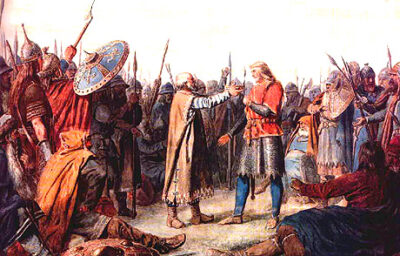
Olaf I of Norway
Olaf I of Norway was a King of Norway. Born 960, in Norway. Died September 9, 1000, in Battle of Svolder.
Facts
16 facts · 0 confirmed by two sources · 3 cited · 13 from one source
Where this comes from
Papalocal keeps its own record. It started from these sources; what each one said is kept here as it was copied, so a change on their side never changes this page by itself. Tap one to read its version.
What Wikidata says · copied November 16, 2026 · revision 2560450979
- Described as
- King of Norway
- Other names
- Olav Tryggvesson, King of Norway
- Born
- 960
- Died
- September 9, 1000
- Born in
- Norway · 1 reference
- Died in
- Battle of Svolder
- Citizen of
- Norway
- Occupation
- warrior; monarch
- Spouse
- Geira; Tyra of Denmark · 1 reference; Gudrun Skjeggesdatter; Gyða
- Children
- Tryggvi the Pretender
- Father
- Tryggve Olafsson · 2 references
- Mother
- Astrid Eiriksdatter · 2 references
- Siblings
- Astrid Tryggvesdatter · 1 reference; Ingeborg Tryggvasdotter · 1 reference
- Wikipedias with a page
- 45
Wikidata item Q213801 (wikidata.org/wiki/Q213801), public domain (CC0). Copied November 16, 2026.
What Wikipedia says · copied November 16, 2026 · revision 1379238544
Olaf Tryggvason (960s – 9 September 1000) was King of Norway from 995 to 1000. He was the son of Tryggvi Olafsson, king of Viken (Vingulmark, and Rånrike), and, according to later sagas, the great-grandson of Harald Fairhair, first King of Norway. He is numbered as Olaf I.
Olaf was important in the conversion of the Norse to Christianity, but he did so forcibly within his own kingdom. He is said to have built the first Christian church in Norway in 995, and to have founded the city of Trondheim in 997. A statue dedicated to him is located in the city's central plaza.
Historical information on Olaf is sparse. He is mentioned in some contemporary English sources, and some skaldic poems. The oldest narrative source mentioning him briefly is Adam of Bremen's Gesta Hammaburgensis ecclesiae pontificum of circa 1070.
In the 1190s, two Latin versions of "Óláfs saga Tryggvasonar" were written in Iceland, by Oddr Snorrason and Gunnlaugr Leifsson – these are now lost, but are thought to form the basis of later Norse versions. Snorri Sturluson gives an extensive account of Olaf in the Heimskringla saga of circa 1230, using Oddr Snorrason's saga as his primary source. Modern historians do not assume that these late sources are accurate, and their credibility is debated. The most detailed account is named Óláfs saga Tryggvasonar en mesta ("Greatest Saga of Óláfr Tryggvason") and is recorded in the Flateyjarbók, and in the early 15th-century Bergsbók.
From the Wikipedia article “Olaf Tryggvason” (en.wikipedia.org/wiki/Olaf_Tryggvason), by its contributors, under CC BY-SA 4.0 (creativecommons.org/licenses/by-sa/4.0/). Copied November 16, 2026; not changed.
Confirmed Two sources agree. Cited One source, and it names where it got it. One source One source, without a reference of its own. Sources disagree The sources disagree. We show the best-supported value and keep theirs below.
