
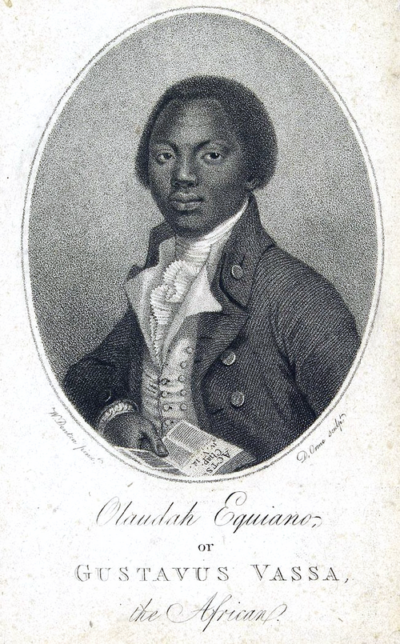
Olaudah Equiano
Olaudah Equiano was a Black British abolitionist and writer (c. 1745 – 1797). Born 1745, in Benin Empire. Died March 31, 1797, in City of Westminster. Known for The Interesting Narrative of the Life of Olaudah Equiano.
Facts
14 facts · 2 confirmed by two sources · 1 cited · 11 from one source
Where this comes from
Papalocal keeps its own record. It started from these sources; what each one said is kept here as it was copied, so a change on their side never changes this page by itself. Tap one to read its version.
What Wikidata says · copied November 16, 2026 · revision 2566420760
- Described as
- Black British abolitionist and writer (c. 1745 – 1797)
- Other names
- Gustavus Vassa, Michael, Jacob, Equiano, Gustavo Vassa, Gustave Vasa, Gustavus Vasa
- Born
- 1745 · 3 references
- Died
- March 31, 1797 · 3 references
- Born in
- Benin Empire
- Died in
- City of Westminster
- Occupation
- writer · 1 reference; autobiographer; barber; merchant; actor
- Member of
- Sons of Africa
- Genre
- autobiography; social criticism
- Known for
- The Interesting Narrative of the Life of Olaudah Equiano
- Children
- Joanna Vassa
- Wikipedias with a page
- 43
Wikidata item Q379887 (wikidata.org/wiki/Q379887), public domain (CC0). Copied November 16, 2026.
What Wikipedia says · copied November 16, 2026 · revision 1384878517
Olaudah Equiano (; c. 1745 – 31 March 1797), known for most of his life as Gustavus Vassa (), was a writer who, drawing on his experiences as an enslaved African in the Americas, became a celebrated figure within the abolitionist movement in Great Britain and Ireland. According to his memoir, he was kidnapped from his home in West Africa (a village in what is now southern Nigeria) and shipped first to Barbados and then to Virginia. There he was bought by a Royal Navy officer whom he accompanied, during the Seven Years' War, as a valet. He was sold twice more in the Caribbean before, having been permitted to trade on his own account, purchasing his freedom in 1766.
As a freedman in London, Equiano embraced the British abolitionist movement, in the 1780s becoming one of its Sons of Africa, Africans living in Britain active as speakers on the abolitionist circuit. His 1789 autobiography, The Interesting Narrative of the Life of Olaudah Equiano, went through nine editions in his lifetime, and is credited with helping shift opinion in favour of the British Slave Trade Act 1807, under which the Royal Navy was committed to the suppression of the Atlantic slave trade. As a member of the London Corresponding Society, he was also associated with the cause of democratic reform.
The Interesting Narrative was rediscovered by scholars in the late 20th century and remains a widely-cited primary source.
- Born, in its opening lines
- c. 1745
- Died, in its opening lines
- March 31, 1797
From the Wikipedia article “Olaudah Equiano” (en.wikipedia.org/wiki/Olaudah_Equiano), by its contributors, under CC BY-SA 4.0 (creativecommons.org/licenses/by-sa/4.0/). Copied November 16, 2026; not changed.
Confirmed Two sources agree. Cited One source, and it names where it got it. One source One source, without a reference of its own. Sources disagree The sources disagree. We show the best-supported value and keep theirs below.
