
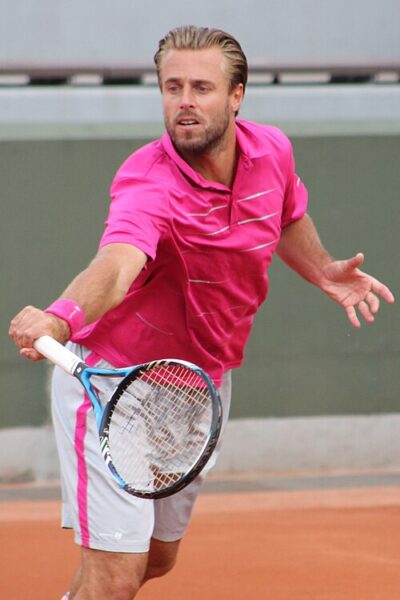
Oliver Marach is an Austrian tennis player. Born July 16, 1980, in Graz.
Facts
7 facts · 1 confirmed by two sources · 4 cited · 2 from one source
Where this comes from
Papalocal keeps its own record. It started from these sources; what each one said is kept here as it was copied, so a change on their side never changes this page by itself. Tap one to read its version.
What Wikidata says · copied November 17, 2026 · revision 2525108268
- Described as
- Austrian tennis player
- Born
- July 16, 1980 · 1 reference
- Born in
- Graz · 1 reference
- Citizen of
- Austria · 1 reference
- Occupation
- tennis player (1998–2022) · 1 reference
- Sport
- tennis · 1 reference
- Lived in
- Graz
- Height
- 1.85 m (6 ft 1 in)
- Wikipedias with a page
- 25
Wikidata item Q441027 (wikidata.org/wiki/Q441027), public domain (CC0). Copied November 17, 2026.
What Wikipedia says · copied November 17, 2026 · revision 1335950944
Oliver Marach (born 16 July 1980) is a former Austrian professional tennis player who primarily specialised in doubles.
He achieved his highest singles ranking of world No. 82 in August 2005, but achieved most of his success in doubles where he reached his career-high doubles ranking of world No. 2 on 28 May 2018. Marach won his only Grand Slam title at the 2018 Australian Open, partnering Mate Pavić, and the pair also finished runners-up at the 2017 Wimbledon Championships and 2018 French Open. He and Pavić were the 2018 ATP Doubles Team of the year. In mixed doubles, he has reached three Grand Slam semifinals.
He has represented Austria in the Davis Cup since 2003, and also played at the 2016 Olympic Games alongside Alexander Peya. In 2021, in the 2020 Tokyo Olympics, he partnered with Philipp Oswald.
Marach retired from professional tennis in December 2022.
- Born, in its opening lines
- July 16, 1980
From the Wikipedia article “Oliver Marach” (en.wikipedia.org/wiki/Oliver_Marach), by its contributors, under CC BY-SA 4.0 (creativecommons.org/licenses/by-sa/4.0/). Copied November 17, 2026; not changed.
Confirmed Two sources agree. Cited One source, and it names where it got it. One source One source, without a reference of its own. Sources disagree The sources disagree. We show the best-supported value and keep theirs below.
