
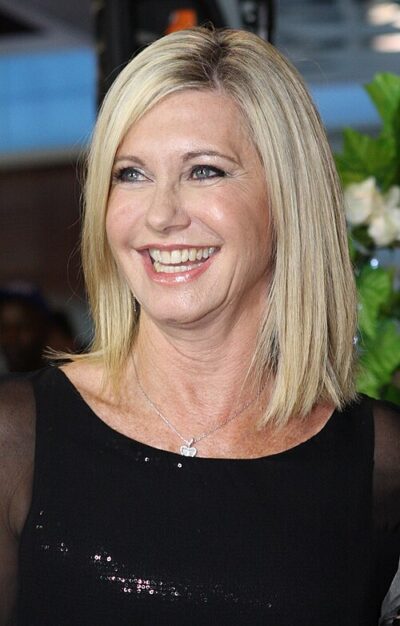
Olivia Newton-John
Olivia Newton-John was a British and Australian singer. Born September 26, 1948, in Cambridge. Died August 8, 2022, in Santa Ynez Valley. Known for Xanadu, Twist of Fate and Physical. Educated at University High School. Awards include Officer of the Order of the British Empire, Officer of the Order of Australia and Daytime Emmy Award.
Facts
61 facts · 2 confirmed by two sources · 16 cited · 43 from one source
Where this comes from
Papalocal keeps its own record. It started from these sources; what each one said is kept here as it was copied, so a change on their side never changes this page by itself. Tap one to read its version.
What Wikidata says · copied November 16, 2026 · revision 2558200319
- Described as
- British and Australian singer (1948–2022)
- Other names
- Olivia Newton, Olivia Newton John
- Born
- September 26, 1948 · 7 references
- Died
- August 8, 2022 · 2 references
- Born in
- Cambridge · 2 references
- Died in
- Santa Ynez Valley
- Buried in
- Santa Ynez
- Cause of death
- breast cancer · 1 reference
- Citizen of
- United Kingdom; Australia (1994–)
- Occupation
- singer · 1 reference; film actor; recording artist; singer-songwriter; actor · 2 references; composer · 2 references; musician · 1 reference; songwriter · 1 reference
- Education
- University High School
- Genre
- pop music; country music; pop rock; dance-pop; folk music
- Instrument
- voice
- Record label
- Uni; EMI; MCA Records
- Known for
- Xanadu; Twist of Fate; Physical; If You Love Me (Let Me Know); Grease; I Honestly Love You
- Awards
- Officer of the Order of the British Empire (1978) · 1 reference; Officer of the Order of Australia (2006) · 1 reference; Daytime Emmy Award (1999) · 1 reference; Australian National Living Treasure (2012) · 1 reference; Companion of the Order of Australia (2019) · 1 reference; Dame Commander of the Order of the British Empire; star on Hollywood Walk of Fame · 1 reference; Grammy Award for Best Female Pop Vocal Performance (2 times) (1974, 1975) · 1 reference; Grammy Award for Record of the Year (1975) · 1 reference; Grammy Award for Video of the Year (1983) · 1 reference; Country Music Association Award for Female Vocalist of the Year (1974); American Music Award for Favorite Country Album (1974); American Music Award for Favorite Pop/Rock Song (1974); American Music Award for Favorite Pop/Rock Album (1975); Australian Recording Industry Association (2002)
- Field
- music composing; pop music · 1 reference; musical film · 1 reference; acting · 1 reference; activism · 1 reference; popular music · 1 reference
- Spouse
- Matt Lattanzi (1984–1995); John Easterling (2008–2022)
- Children
- Chloe Rose Lattanzi
- Father
- Brinley Newton-John
- Mother
- Irene Helen Käthe Born · 1 reference
- Siblings
- Rona Newton-John
- Nickname
- Lovely Livvy
- Website
- http://www.olivianewton-john.com/
- Wikipedias with a page
- 77
Wikidata item Q185165 (wikidata.org/wiki/Q185165), public domain (CC0). Copied November 16, 2026.
What Wikipedia says · copied November 16, 2026 · revision 1385890465
Dame Olivia Newton-John AC DBE (26 September 1948 – 8 August 2022) was a British and Australian singer, songwriter and actress. With over 100 million records sold, Newton-John is one of the best-selling music artists of all time, as well as the highest-selling female Australian recording artist of all time.
In 1978, Newton-John starred in the musical film Grease, which was the highest-grossing musical film at the time and whose soundtrack remains one of the world's best-selling albums. It features two major hit duets with co-star John Travolta: "You're the One That I Want"—which is one of the best-selling singles of all time—and "Summer Nights". This soundtrack also includes her solo "Hopelessly Devoted to You." Her signature solo recordings include the Record of the Year Grammy winner "I Honestly Love You" (1974) and "Physical" (1981)—Billboard's highest-ranking Hot 100 single of the 1980s. Other defining hit singles include "If Not for You" and "Banks of the Ohio" (both 1971), "Let Me Be There" (1973), "If You Love Me (Let Me Know)" (1974), "Have You Never Been Mellow" (1975), "Sam" (1977), "Hopelessly Devoted to You" (1978; also from Grease), "A Little More Love" (1978), "Twist of Fate" (1983) and, from the 1980 film Xanadu, "Magic" and "Xanadu" (with the Electric Light Orchestra).
Newton-John's accolades include four Grammy Awards, a Daytime Emmy Award, nine Billboard Music Awards, six American Music Awards, a star on the Hollywood Walk of Fame and an induction into the ARIA Hall of Fame. She scored fifteen top-ten singles, including five number-one singles on the Billboard Hot 100, and two number-one albums on the Billboard 200: If You Love Me, Let Me Know (1974) and Have You Never Been Mellow (1975). Eleven of her singles (including two Platinum) and fourteen of her albums (including two Platinum and four 2× Platinum) have been certified Gold by the Recording Industry Association of America (RIAA). Newton-John represented United Kingdom in the Eurovision Song Contest 1974 with the song "Long Live Love", finishing in fourth place. She was appointed Officer of the Order of Australia in 2006 and Dame Commander of the Order of the British Empire in 2020.
Newton-John, who had breast cancer three times, was an advocate and sponsor for breast cancer research. In 2012, the Olivia Newton-John Cancer & Wellness Centre at the Austin Hospital opened in her home town of Melbourne; in 2015, the facility was rechristened the Olivia Newton-John Cancer Wellness & Research Centre. She was also an activist for environmental and animal rights causes.
- Born, in its opening lines
- September 26, 1948
- Died, in its opening lines
- August 8, 2022
From the Wikipedia article “Olivia Newton-John” (en.wikipedia.org/wiki/Olivia_Newton-John), by its contributors, under CC BY-SA 4.0 (creativecommons.org/licenses/by-sa/4.0/). Copied November 16, 2026; not changed.
Confirmed Two sources agree. Cited One source, and it names where it got it. One source One source, without a reference of its own. Sources disagree The sources disagree. We show the best-supported value and keep theirs below.
