
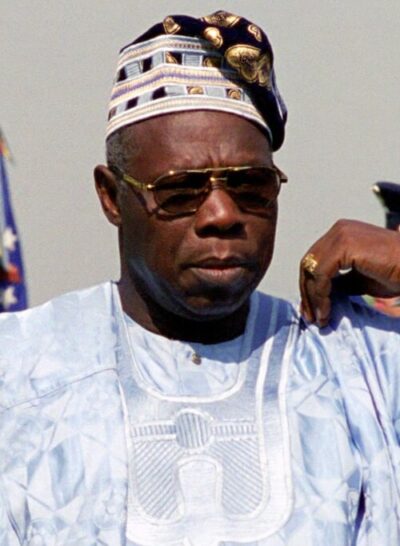
Olusegun Obasanjo
Olusegun Obasanjo is a Nigerian president (1999-2007) and military leader. Born March 5, 1937, in Abeokuta. Positions held include Chairperson of the African Union (2004–2006), President of Nigeria (2 times) (1976–2007) and Vice President of Nigeria (1975–1976). Educated at Baptist Boys’ High School and Royal College of Defence Studies. Awards include Indira Gandhi Peace Prize, honorary doctor of the Peking University and Honorary Fellow of the African Academy of Sciences.
Facts
34 facts · 1 confirmed by two sources · 9 cited · 24 from one source
Where this comes from
Papalocal keeps its own record. It started from these sources; what each one said is kept here as it was copied, so a change on their side never changes this page by itself. Tap one to read its version.
What Wikidata says · copied November 16, 2026 · revision 2567410643
- Described as
- Nigerian president (1999-2007) and military leader (1976–79)
- Other names
- Gen Olusegun Obasanjo, Baba Iyabo, Baba Sege, President Obasanjo, President Olusegun Obasanjo, Chief Olusegun Matthew Okikiola Ogunboye Aremu Obasanjo, OBJ, Olesegun Obasanjo
- Born
- March 5, 1937 · 4 references
- Born in
- Abeokuta · 1 reference
- Citizen of
- Nigeria · 1 reference
- Occupation
- engineer · 1 reference; military personnel; politician · 2 references
- Positions held
- Chairperson of the African Union (2004–2006); President of Nigeria (2 times) (1976–2007); Vice President of Nigeria (1975–1976); Chairperson of ECOWAS (1977–1979); president · 1 reference
- Political party
- Peoples Democratic Party (1999–2015)
- Education
- Baptist Boys’ High School; Royal College of Defence Studies; Defence Services Staff College; Mons Officer Cadet School
- Awards
- Indira Gandhi Peace Prize (1995); honorary doctor of the Peking University (2005) · 1 reference; Honorary Fellow of the African Academy of Sciences (2011) · 1 reference; honorary doctor of the Peoples' Friendship University of Russia (2001) · 1 reference; Grand Cross with Chain of the Order of Merit of the Republic of Hungary (civil); Order of the Federal Republic; Order of the Nigeria · 1 reference; Order of the Pioneers of Liberia · 1 reference; Order of the Star of Ghana · 1 reference
- Spouse
- Stella Obasanjo · 1 reference; Oluremi Obasanjo
- Children
- Iyabo Obasanjo-Bello
- Religion
- Protestantism; Baptists
- Military branch
- Nigerian Army · 1 reference
- Military rank
- general · 1 reference
- Lived in
- Dodan Barracks
- Nickname
- Baba Africa
- Wikipedias with a page
- 70
Wikidata item Q202006 (wikidata.org/wiki/Q202006), public domain (CC0). Copied November 16, 2026.
What Wikipedia says · copied November 16, 2026 · revision 1383802803
Chief Olusegun Matthew Okikiola Ogunboye Aremu Obasanjo (Yoruba: Olúṣẹ́gun Ọbásanjọ́ [ōlúʃɛ́ɡũ̄ ɔ̄básã̄d͡ʒɔ́] ; born c. 5 March 1937) is a Nigerian politician, statesman, agriculturalist, and former army general who served as Nigeria's Military Head of State from 1976 to 1979 and later as its president from 1999 to 2007. Ideologically a Nigerian nationalist, he was a member of the Peoples Democratic Party (PDP) from 1998 to 2015, and since 2018.
Born in the village of Ibogun-Olaogun to a farming family of the Owu branch of the Yoruba, Obasanjo was educated largely in Abeokuta, Ogun State. He joined the Nigerian Army, where he specialised in engineering and served in the Congo, Britain, and India, rising to the rank of Major. In the late 1960s, he played a major role in combating Biafran separatists during the Nigerian Civil War, accepting their surrender in 1970. In 1975, a military coup established a junta with Obasanjo as part of its ruling triumvirate. After the triumvirate's leader, Murtala Muhammed, was assassinated the following year, the Supreme Military Council appointed Obasanjo as head of state. Continuing Murtala's policies, Obasanjo oversaw budgetary cut-backs and an expansion of access to free school education. Increasingly aligning Nigeria with the United States, he also emphasised support for groups opposing white minority rule in southern Africa. Committed to restoring democracy, Obasanjo oversaw the 1979 election, after which he transferred control of Nigeria to the newly elected civilian president, Shehu Shagari. Obasanjo then retired to Ota, Ogun, where he became a farmer, published four books, and took part in international initiatives to end various African conflicts.
In 1993, Sani Abacha seized power in a military coup. Obasanjo was openly critical of Abacha's administration and in 1995 was arrested and convicted of being part of a planned coup, despite protesting his innocence. While imprisoned, he became a born again Christian, with providentialism strongly influencing his subsequent worldview. He was released following Abacha's death in 1998. Obasanjo entered electoral politics, becoming the PDP candidate for the 1999 presidential election, which he won. As president, he de-politicised the military and both expanded the police and mobilised the army to combat widespread ethnic, religious, and secessionist violence. He withdrew Nigeria's military from Sierra Leone and privatized various public enterprises to limit the country's spiraling debt. He was re-elected in the 2003 election. Influenced by Pan-Africanist ideas, he was a keen supporter of the formation of the African Union and served as its chair from 2004 to 2006. Obasanjo's attempts to change the constitution to abolish presidential term limits were unsuccessful and brought criticism. After retiring, he earned a PhD in theology from the National Open University of Nigeria.
Obasanjo has been described as one of the great figures of the second generation of post-colonial African leaders. He received praise both for overseeing Nigeria's transition to representative democracy in the 1970s and for his Pan-African efforts to encourage cooperation across the continent. Critics maintain that he was guilty of corruption, that his administrations oversaw human rights abuses, and that as president he became too interested in consolidating and maintaining his personal power.
- Born, in its opening lines
- March 5, 1937
From the Wikipedia article “Olusegun Obasanjo” (en.wikipedia.org/wiki/Olusegun_Obasanjo), by its contributors, under CC BY-SA 4.0 (creativecommons.org/licenses/by-sa/4.0/). Copied November 16, 2026; not changed.
Confirmed Two sources agree. Cited One source, and it names where it got it. One source One source, without a reference of its own. Sources disagree The sources disagree. We show the best-supported value and keep theirs below.
