
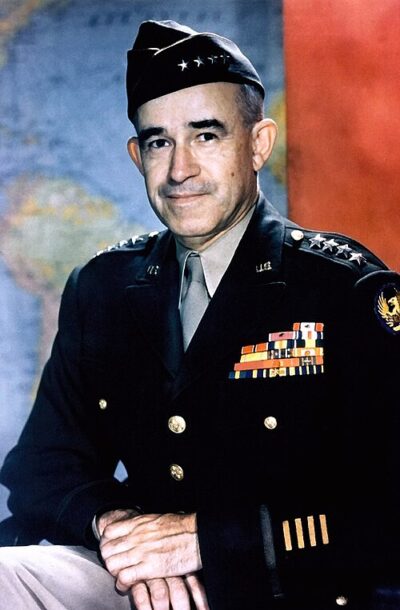
Omar Bradley
Omar Bradley was an United States Army general. Born February 12, 1893, in Moberly. Died April 8, 1981, in New York City. Positions held include Chairman of the Joint Chiefs of Staff (1949–1953), Chief of Staff of the United States Army (1948–1949) and Administrator of Veterans Affairs (1945–1948). Educated at United States Army Command and General Staff College and United States Military Academy. Awards include Bronze Star Medal, Knight Commander of the Order of the Bath and Legionnaire of Legion of Merit.
Facts
37 facts · 2 confirmed by two sources · 3 cited · 32 from one source
Where this comes from
Papalocal keeps its own record. It started from these sources; what each one said is kept here as it was copied, so a change on their side never changes this page by itself. Tap one to read its version.
What Wikidata says · copied November 13, 2026 · revision 2567347002
- Described as
- United States Army general (1893–1981)
- Other names
- Omar Nelson Bradley
- Born
- February 12, 1893 · 7 references
- Died
- April 8, 1981 · 7 references
- Born in
- Moberly
- Died in
- New York City · 1 reference
- Buried in
- Arlington National Cemetery
- Citizen of
- United States
- Occupation
- military officer; official
- Positions held
- Chairman of the Joint Chiefs of Staff (1949–1953); Chief of Staff of the United States Army (1948–1949) · 1 reference; Administrator of Veterans Affairs (1945–1948) · 1 reference
- Education
- United States Army Command and General Staff College; United States Military Academy; United States Army War College
- Member of
- the class the stars fell on
- Teams
- Army Black Knights football; Army Black Knights baseball · 1 reference
- Awards
- Bronze Star Medal; Knight Commander of the Order of the Bath; Legionnaire of Legion of Merit; Presidential Medal of Freedom (1977) · 1 reference; Silver Star; Order of Suvorov, 1st class; Order of Kutuzov, 1st class; Theodore Roosevelt Award (1973); World War II Victory Medal; Distinguished Service Medal; Navy Distinguished Service Medal; Inter-Allied Victory Medals; European-African-Middle Eastern Campaign Medal; Army of Occupation Medal; Legion of Merit · 1 reference
- Spouse
- Kitty Buhler
- Military branch
- United States Army
- Military rank
- general of the army; general · 1 reference
- Nickname
- The General G.I.
- Wikipedias with a page
- 60
Wikidata item Q207955 (wikidata.org/wiki/Q207955), public domain (CC0). Copied November 13, 2026.
What Wikipedia says · copied November 13, 2026 · revision 1384115655
Omar Nelson Bradley (12 February 1893 – 8 April 1981) was a senior officer of the United States Army during and after World War II, rising to the rank of General of the Army. He was the first chairman of the Joint Chiefs of Staff and oversaw the U.S. military's policy-making in the Korean War.
Born in Randolph County, Missouri, he worked as a boilermaker before entering the United States Military Academy at West Point. He graduated from the academy in 1915 alongside Dwight D. Eisenhower as part of "the class the stars fell on." During World War I, he guarded copper mines in Montana. After the war, he taught at West Point and served in other roles before taking a position at the War Department under General George Marshall. In 1941, he became commander of the United States Army Infantry School.
After the U.S. entry into World War II, he oversaw the transformation of the 82nd Infantry Division into the first American airborne division. He received his first front-line command in Operation Torch, serving under General George S. Patton in North Africa. After Patton was reassigned, Bradley commanded II Corps in the Tunisia Campaign and the Allied invasion of Sicily. He commanded the First United States Army during the invasion of Normandy. After the breakout from Normandy, he took command of the Twelfth United States Army Group, which ultimately comprised 43 divisions and 1.3 million men, the largest body of American soldiers ever to serve under a single field commander.
After the war, Bradley headed the Veterans Administration. He was appointed as Chief of Staff of the United States Army in 1948 and Chairman of the Joint Chiefs of Staff in 1949. In 1950, he was promoted to the rank of General of the Army, becoming the last of the nine individuals promoted to five-star rank in the United States Armed Forces. He was the senior military commander at the start of the Korean War, and supported President Harry S. Truman's wartime policy of containment. He was instrumental in persuading Truman to dismiss General Douglas MacArthur in 1951 after MacArthur resisted administration attempts to scale back the war's strategic objectives. Bradley left active duty in 1953 (although remaining on "active retirement" for the next 27 years). He continued to serve in public and business roles until his death in 1981 at age 88.
- Born, in its opening lines
- February 12, 1893
- Died, in its opening lines
- April 8, 1981
From the Wikipedia article “Omar Bradley” (en.wikipedia.org/wiki/Omar_Bradley), by its contributors, under CC BY-SA 4.0 (creativecommons.org/licenses/by-sa/4.0/). Copied November 13, 2026; not changed.
Confirmed Two sources agree. Cited One source, and it names where it got it. One source One source, without a reference of its own. Sources disagree The sources disagree. We show the best-supported value and keep theirs below.
