
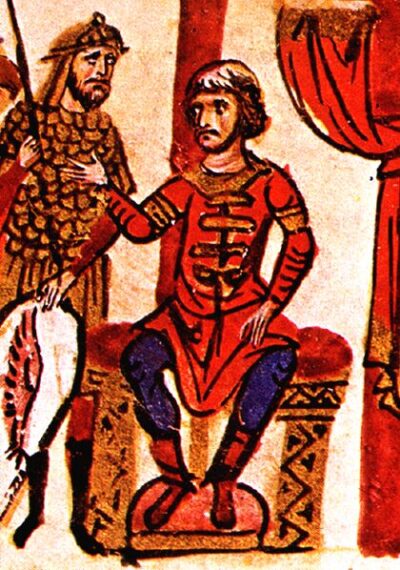
Omurtag of Bulgaria
Omurtag of Bulgaria was a Bulgarian ruler. Died 831. Positions held include knyaz and Bulgarian Khan.
Facts
9 facts · 0 confirmed by two sources · 4 cited · 5 from one source
Where this comes from
Papalocal keeps its own record. It started from these sources; what each one said is kept here as it was copied, so a change on their side never changes this page by itself. Tap one to read its version.
What Wikidata says · copied November 16, 2026 · revision 2521372154
- Described as
- Bulgarian ruler
- Died
- 831 · 1 reference
- Citizen of
- Bulgaria
- Occupation
- sovereign
- Positions held
- knyaz; Bulgarian Khan
- Children
- Zvinitsa · 1 reference; Enravota · 1 reference; Malamir of Bulgaria · 1 reference
- Father
- Krum · 1 reference
- Wikipedias with a page
- 39
Wikidata item Q276527 (wikidata.org/wiki/Q276527), public domain (CC0). Copied November 16, 2026.
What Wikipedia says · copied November 16, 2026 · revision 1378647220
Omurtag, or Omortag (died 831), also known as Murtag or Murtagon (Bulgarian: Омуртаг; Greek: Μορτάγων and Ομουρτάγ), was Khan (Kanasubigi) of Bulgaria from 814 to 831. He is known as "the Builder".
In the very beginning of his reign he signed a 30-year peace treaty with the neighboring Byzantine Empire which remained in force to the end of his life. Omurtag successfully coped with the aggressive policy of the Frankish Empire to take Bulgaria's north-western lands and suppressed the unrest among several Slavic tribes. He made administrative reforms which increased the power and the authority of the central government. His reign was marked with a strong development of Bulgarian architecture with a number of significant construction projects.
From the Wikipedia article “Omurtag of Bulgaria” (en.wikipedia.org/wiki/Omurtag_of_Bulgaria), by its contributors, under CC BY-SA 4.0 (creativecommons.org/licenses/by-sa/4.0/). Copied November 16, 2026; not changed.
Confirmed Two sources agree. Cited One source, and it names where it got it. One source One source, without a reference of its own. Sources disagree The sources disagree. We show the best-supported value and keep theirs below.
