
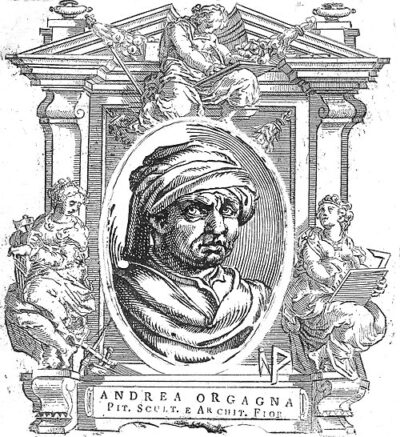
Orcagna
Orcagna was an Italian painter. Born 1308, in Florence. Died 1368, in Florence. Known for Triptych with the Virgin and Child, and Saints Mary Magdalene and Ansanus and Fragments of frescos from the Basilica of Santa Croce (Florence).
Facts
15 facts · 2 confirmed by two sources · 10 cited · 3 from one source
What’s different
- Born: we show 1308 (Confirmed). Wikidata also lists 1315 and 1320
Where this comes from
Papalocal keeps its own record. It started from these sources; what each one said is kept here as it was copied, so a change on their side never changes this page by itself. Tap one to read its version.
What Wikidata says · copied November 16, 2026 · revision 2570374762
- Described as
- Italian painter
- Other names
- Andrea di Cione Orcagna, Andrea di Cione Orgagna, Andrea Di Cione Orgagna, Orgagna, Andrea Di Cione Arcagnuolo, Andrea Di Cione Orcagna, Arcagnuoulo, Andrea di Cione Arcagnuolo, Andrea Orcagna, Andrea di Cione, Andrea Orgagna, Andrea di Cione Arcagnolo
- Born
- 1315 · 1 reference; 1320 · 1 reference; 1308 · 3 references
- Died
- 1368 · 5 references
- Born in
- Florence · 2 references
- Died in
- Florence · 2 references
- Citizen of
- Italy · 1 reference
- Occupation
- painter · 1 reference; sculptor · 1 reference; architect · 2 references; poet · 1 reference
- Known for
- Triptych with the Virgin and Child, and Saints Mary Magdalene and Ansanus; Fragments of frescos from the Basilica of Santa Croce (Florence) · 1 reference
- Field
- visual arts · 1 reference
- Siblings
- Jacopo di Cione · 1 reference; Nardo di Cione · 1 reference; Matteo di Cione
- Wikipedias with a page
- 33
Wikidata item Q366499 (wikidata.org/wiki/Q366499), public domain (CC0). Copied November 16, 2026.
What Wikipedia says · copied November 16, 2026 · revision 1377314624
Andrea di Cione di Arcangelo (c. 1308 – 25 August 1368), better known as Orcagna, was an Italian painter, sculptor, and architect active in Florence. He worked as a consultant at the Florence Cathedral and supervised the construction of the façade at the Orvieto Cathedral. His monumental marble tabernacle (1352–1359), commissioned by the confraternity of Orsanmichele to protect the Maestà by Bernardo Daddi (1347) at Orsanmichele, was immediately praised. The tabernacle, executed according to his design with the assistance of a team of selected sculptors and masons, included 117 figural sculptures or reliefs as part of a domed structure.
His Strozzi Altarpiece (1354–1357) is noted as defining a new role for Christ as a source of Catholic doctrine and papal authority, as central figure enthroned actively handing out the (Dominican, or generally the Mendicant theology to Thomas Aquinas, and the keys of the church to St. Peter.
- Born, in its opening lines
- c. 1308
- Died, in its opening lines
- August 25, 1368
From the Wikipedia article “Orcagna” (en.wikipedia.org/wiki/Orcagna), by its contributors, under CC BY-SA 4.0 (creativecommons.org/licenses/by-sa/4.0/). Copied November 16, 2026; not changed.
Confirmed Two sources agree. Cited One source, and it names where it got it. One source One source, without a reference of its own. Sources disagree The sources disagree. We show the best-supported value and keep theirs below.
