
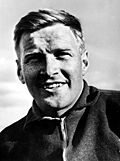
Orvar Bergmark
Orvar Bergmark was a Swedish footballer. Born November 16, 1930, in Bureå parish. Died May 10, 2004, in Örebro. Teams include Örebro SK (3 times) (1948–1965), AIK Fotboll (1955) and AS Roma (1962–1964). Awards include Guldbollen.
Facts
19 facts · 2 confirmed by two sources · 6 cited · 11 from one source
Where this comes from
Papalocal keeps its own record. It started from these sources; what each one said is kept here as it was copied, so a change on their side never changes this page by itself. Tap one to read its version.
What Wikidata says · copied November 17, 2026 · revision 2555186392
- Described as
- Swedish footballer (1930-2004)
- Born
- November 16, 1930 · 3 references
- Died
- May 10, 2004 · 2 references
- Born in
- Bureå parish · 1 reference
- Died in
- Örebro · 1 reference
- Buried in
- Almby Cemetery · 1 reference
- Citizen of
- Sweden
- Occupation
- association football player · 1 reference; bandy player; association football coach
- Teams
- Örebro SK (3 times) (1948–1965); AIK Fotboll (1955); AS Roma (1962–1964); Sweden men's national football team (1951–1965) · 1 reference; Sweden men's national football B team (1952–1956) · 1 reference; Örebro SK Bandy; Sweden national bandy team
- Sport
- association football; bandy
- Awards
- Guldbollen (1958)
- Wikipedias with a page
- 24
Wikidata item Q721360 (wikidata.org/wiki/Q721360), public domain (CC0). Copied November 17, 2026.
What Wikipedia says · copied November 17, 2026 · revision 1382490678
Orvar Bergmark (16 November 1930 – 10 May 2004) was a Swedish football defender, manager and bandy player. He was the second manager of the Sweden national team, and was manager when the Sweden national team qualified for the FIFA World Cup in Mexico 1970, after having beaten France (among others) in the qualifications. The 1970 World Cup was the first one for Sweden in 12 years, and it was also the first time in 20 years that Sweden had qualified for a World Cup. Sweden hosted the 1958 FIFA World Cup, and hence did not need to qualify. (Bergmark was a player for Sweden that year.) Sweden did not qualify for the World Cups in 1954, 1962 and 1966]. In 1952 he took part in the Olympic Bandy tournament.
In Mexico, Sweden had to face the becoming runners-up, Italy, in their first game, and lost 0–1. The Italian squad included Roberto Boninsegna, Gianni Rivera, Luigi Riva, Giacinto Facchetti and Dino Zoff. In the second game, Israel did not seem too difficult to beat. But Sweden managed only a 1–1 draw. Then Sweden needed to beat Uruguay in the last group game by at least two goals. Orvar Bergmark's squad only scored a single goal (in the last minute), and it all was over. Some of Orvar Bergmark's key players were Ove Grahn, Ove Kindvall, Hasse Selander, Tommy Svensson (who would 24 years later, as manager, lead Sweden to a surprising bronze medal in the 1994 World Cup in the United States), Bosse Larsson and Roland Grip.
During the tournament, Sweden had a goal-keeping problem. Bergmark used the young Ronnie Hellström in the opening game against Italy, and was displeased with Hellström's performance when Italy scored. The little less talented, but far more experienced Sven-Gunnar Larsson guarded the Swedish goal during the last two matches instead.
Orvar Bergmark left his office soon after the World Cup and was replaced by Georg "Åby" Ericson.
Bergmark won a silver medal and was elected to the All-Star team at the 1958 FIFA World Cup. He was also an international bandy player, and won silver medals at that sport's World Cup also. He played his bandy for Örebro SK.
In 1980, he organized the first international tournament for women's bandy. In Örebro, Sweden met Finland, Norway and the Netherlands, and took the first prize.
Bergmark contracted Parkinson's disease around 1980, and died from it in 2004.
- Born, in its opening lines
- November 16, 1930
- Died, in its opening lines
- May 10, 2004
From the Wikipedia article “Orvar Bergmark” (en.wikipedia.org/wiki/Orvar_Bergmark), by its contributors, under CC BY-SA 4.0 (creativecommons.org/licenses/by-sa/4.0/). Copied November 17, 2026; not changed.
Confirmed Two sources agree. Cited One source, and it names where it got it. One source One source, without a reference of its own. Sources disagree The sources disagree. We show the best-supported value and keep theirs below.
