
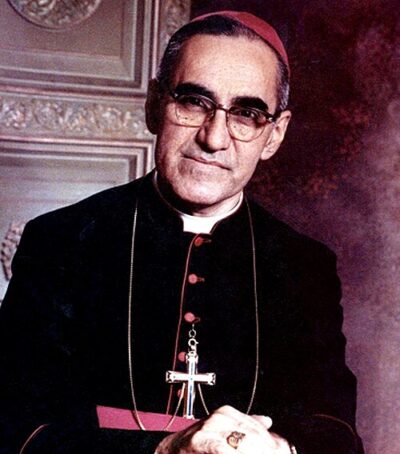
Óscar Romero
Óscar Romero was a Salvadoran Catholic archbishop and saint. Born August 15, 1917, in Ciudad Barrios. Died March 24, 1980, in San Salvador. Positions held include Roman Catholic Archbishop of San Salvador (1977–1980), titular bishop (1970–1974) and Roman Catholic Bishop of Santiago de María (1974–1977). Educated at Pontifical Gregorian University. Awards include Honorary doctor of the Catholic University of Louvain.
Facts
16 facts · 2 confirmed by two sources · 6 cited · 7 from one source · 1 where the sources disagree
What’s different
- Cause of death: we show gunshot wound (Sources disagree). Wikidata also lists assassination and terrorism
Where this comes from
Papalocal keeps its own record. It started from these sources; what each one said is kept here as it was copied, so a change on their side never changes this page by itself. Tap one to read its version.
What Wikidata says · copied November 16, 2026 · revision 2567484809
- Described as
- Salvadoran Catholic archbishop and saint (1917–1980)
- Other names
- Oscar Arnulfo Romero, Óscar Arnulfo Romero, Óscar Arnulfo Romero y Galdámez, Oscar Arnulfo Romero y Galdamez, Galdámez, Arzobispo oscar romero, Arzobispo Óscar Romero, Monseñor romero, Obispo romero, Arzobispo romero, Saint Óscar Romero, Galdamez
- Born
- August 15, 1917 · 12 references
- Died
- March 24, 1980 · 12 references
- Born in
- Ciudad Barrios · 1 reference
- Died in
- San Salvador · 1 reference
- Cause of death
- gunshot wound · 1 reference; assassination · 1 reference; terrorism
- Name at birth
- Óscar Arnulfo Romero Galdámez · 4 references
- Citizen of
- El Salvador
- Occupation
- Latin Catholic priest (1942–) · 1 reference; Catholic bishop
- Positions held
- Roman Catholic Archbishop of San Salvador (1977–1980); titular bishop (1970–1974) · 1 reference; Roman Catholic Bishop of Santiago de María (1974–1977) · 2 references; auxiliary bishop (1970–1974) · 1 reference
- Education
- Pontifical Gregorian University · 1 reference
- Awards
- Honorary doctor of the Catholic University of Louvain
- Religion
- Catholicism · 1 reference
- Wikipedias with a page
- 61
Wikidata item Q293455 (wikidata.org/wiki/Q293455), public domain (CC0). Copied November 16, 2026.
What Wikipedia says · copied November 16, 2026 · revision 1384896571
Óscar Arnulfo Romero y Galdámez (15 August 1917 – 24 March 1980) was a prelate of the Catholic Church in El Salvador; he served as Auxiliary Bishop of the Archdiocese of San Salvador, the Titular Bishop of Tambeae, as Bishop of Santiago de María, and finally as the fourth Archbishop of San Salvador. As archbishop, Romero spoke out against social injustice and violence amid the escalating conflict between the military government and left-wing insurgents that led to the Salvadoran Civil War. In 1980, Romero was fatally shot by an assassin while celebrating Mass. Though no one was ever convicted for the crime, investigations by the UN-created Truth Commission for El Salvador concluded that Major Roberto D'Aubuisson, a death squad leader and later founder of the right-wing Nationalist Republican Alliance (ARENA) political party, had ordered the killing.
In 1997, Pope John Paul II bestowed upon Romero the title of Servant of God, and a cause for his beatification was opened by the church. The cause stalled but was reopened by Pope Benedict XVI in 2012. Romero was declared a martyr by Pope Francis on 3 February 2015, paving the way for his beatification on 23 May 2015. During Romero's beatification, Pope Francis declared that his "ministry was distinguished by his particular attention to the most poor and marginalized." Pope Francis canonized Romero on 14 October 2018.
Initially seen as a social conservative at the time of his appointment as archbishop in 1977, Romero was deeply affected by the murder of his friend and fellow priest Rutilio Grande and thereafter became an outspoken critic of the military government of El Salvador. Hailed by supporters of liberation theology, Romero's relationship with this theology was debated and initially led to impediments in his beatification process, with both denials and affirmations of Romero adhering to it. According to his biographer Michael E. Lee, since Romero's theological thought and homilies extensively utilized the theme of liberation, and Romero borrowed numerous controversial elements of liberation theology, he "can be seen as an exemplar of liberation theology". Similarly, Peter McLaren also argued that "Archbishop Oscar Arnulfo Romero adopted an outspoken stance in favor of 'liberation theology'".
In 2010, the United Nations General Assembly proclaimed 24 March as the "International Day for the Right to the Truth Concerning Gross Human Rights Violations and for the Dignity of Victims" in recognition of Romero's role in the defence of human rights. Romero actively denounced violations of the human rights of the most vulnerable people and defended the principles of protecting lives, promoting human dignity and opposing all forms of violence. Archbishop José Luis Escobar Alas, one of Romero's successors as Archbishop of San Salvador, asked Pope Francis to proclaim Romero a Doctor of the Church, which is an acknowledgement from the church that his religious teachings were orthodox and had a significant impact on its philosophy and theology.
Latin American church groups often proclaim Romero an unofficial patron saint of the Americas and El Salvador; Catholics in El Salvador often refer to him as San Romero, as well as Monseñor Romero. Outside of Catholicism, Romero is honoured by other Christian denominations, including the Church of England and Anglican Communion, through the Calendar in Common Worship, as well as in at least one Lutheran liturgical calendar. Romero is also one of the ten 20th-century martyrs depicted in statues above the Great West Door of Westminster Abbey in London.
- Born, in its opening lines
- August 15, 1917
- Died, in its opening lines
- March 24, 1980
From the Wikipedia article “Óscar Romero” (en.wikipedia.org/wiki/Óscar_Romero), by its contributors, under CC BY-SA 4.0 (creativecommons.org/licenses/by-sa/4.0/). Copied November 16, 2026; not changed.
Confirmed Two sources agree. Cited One source, and it names where it got it. One source One source, without a reference of its own. Sources disagree The sources disagree. We show the best-supported value and keep theirs below.
