
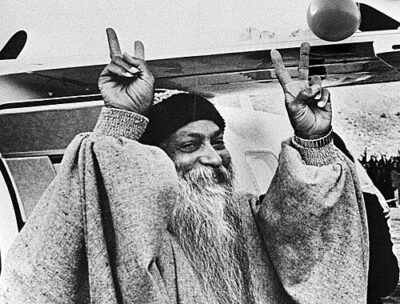
Osho
Osho was an Indian guru and leader of the Rajneesh movement. Born December 11, 1931, in Udaipura. Died January 19, 1990, in Pune. Educated at Dr. Hari Singh Gour University.
Facts
24 facts · 2 confirmed by two sources · 3 cited · 18 from one source · 1 where the sources disagree
What’s different
- Name at birth: we show चन्द्र मोहन जैन (Sources disagree). Wikidata also lists Chandra Mohan Jain
Where this comes from
Papalocal keeps its own record. It started from these sources; what each one said is kept here as it was copied, so a change on their side never changes this page by itself. Tap one to read its version.
What Wikidata says · copied November 16, 2026 · revision 2563961667
- Described as
- Indian guru and leader of the Rajneesh movement (1931–1990)
- Other names
- Rajneesh Chandra Mohan, Acharya Rajneesh, Osho Rajneesh, Chandra Mohan Jain, Shree Rajneesh, Bhagwan, Rajneesh, Bhagwan Shree Rajneesh, Bhagwam Shree Rajneesh
- Born
- December 11, 1931 · 7 references
- Died
- January 19, 1990 · 8 references
- Born in
- Udaipura
- Died in
- Pune · 1 reference
- Cause of death
- heart failure
- Name at birth
- चन्द्र मोहन जैन; Chandra Mohan Jain
- Citizen of
- India (1950–) · 1 reference; British Raj (–1947); Dominion of India
- Occupation
- writer; autobiographer; guru; mystic; religious leader · 1 reference; teacher
- Worked for
- Rani Durgavati University, Jabalpur (1958–1966)
- Education
- Dr. Hari Singh Gour University (–1957)
- Religion
- mysticism
- Lived in
- Raisen district; Gadarwara; Jabalpur; Mumbai (1970–1974); Koregaon Park (2 times) (1974–1990)
- Website
- https://www.osho.com
- Wikipedias with a page
- 98
Wikidata item Q148285 (wikidata.org/wiki/Q148285), public domain (CC0). Copied November 16, 2026.
What Wikipedia says · copied November 16, 2026 · revision 1371940951
Osho (pronounced [ˈoːʃoː] ; born Chandra Mohan Jain; 11 December 1931 – 19 January 1990), also known as Bhagwan Shree Rajneesh, Acharya Rajneesh, and simply Rajneesh, was an Indian godman, and founder of the new religious movement, the Rajneesh movement. He rejected institutional religions, insisting that spiritual experience could not be organized into any one system of religious dogma. As a guru, he advocated meditation and taught a unique form called dynamic meditation. Rejecting traditional ascetic practices, he encouraged his followers to embrace life fully while remaining unattached to worldly desires.
Osho said he experienced a spiritual awakening in 1953 at the age of 21. Following several years in academia, in 1966 Osho resigned his post at the University of Jabalpur as a lecturer in philosophy, and began traveling throughout India, becoming known for his criticism of the orthodoxy of mainstream religions, as well as of mainstream political ideologies and of Mahatma Gandhi. In 1970, Osho spent time in Mumbai initiating followers referred to as "neo-sannyasins". During this period, he expanded his spiritual teachings and commented extensively in discourses on the writings of religious traditions, mystics, bhakti poets, and philosophers from around the world. In 1974, Osho relocated to Pune, where an ashram was established and a variety of therapies, incorporating methods first developed by the Human Potential Movement, were offered to a growing Western following. By the late 1970s, the tension between the ruling Janata Party government of Morarji Desai and the movement led to a curbing of the ashram's development and a back tax claim estimated at $5 million.
In 1981, the Rajneesh movement shifted its focus to the United States, where Osho established a commune called Rajneeshpuram in Wasco County, Oregon. The movement ran into conflict with county residents and the state government, and a succession of legal battles concerning the ashram's construction and continued development curtailed its success. In 1985, Osho publicly asked local authorities to investigate his personal secretary Ma Anand Sheela and her close supporters for a number of crimes, including a 1984 mass food-poisoning attack intended to influence county elections, an aborted assassination plot on U.S. attorney Charles H. Turner, the attempted murder of Osho's personal physician, and the bugging of his own living quarters; authorities later convicted several members of the ashram, including Sheela. That year, Osho was deported from the United States on separate immigration-related charges in accordance with an Alford plea. After his deportation, 21 countries denied him entry.
Osho returned to Mumbai in 1986 and, after a period of public discourse, moved back to Pune in January 1987 to revive his ashram, where he died in 1990. Osho's ashram, now known as the Osho International Meditation Resort, and all associated intellectual property, is managed by the registered Osho International Foundation (formerly Rajneesh International Foundation). Osho's teachings have had an impact on Western New Age thought, and their popularity increased after his death.
- Born, in its opening lines
- December 11, 1931
- Died, in its opening lines
- January 19, 1990
From the Wikipedia article “Osho” (en.wikipedia.org/wiki/Osho), by its contributors, under CC BY-SA 4.0 (creativecommons.org/licenses/by-sa/4.0/). Copied November 16, 2026; not changed.
Confirmed Two sources agree. Cited One source, and it names where it got it. One source One source, without a reference of its own. Sources disagree The sources disagree. We show the best-supported value and keep theirs below.
