
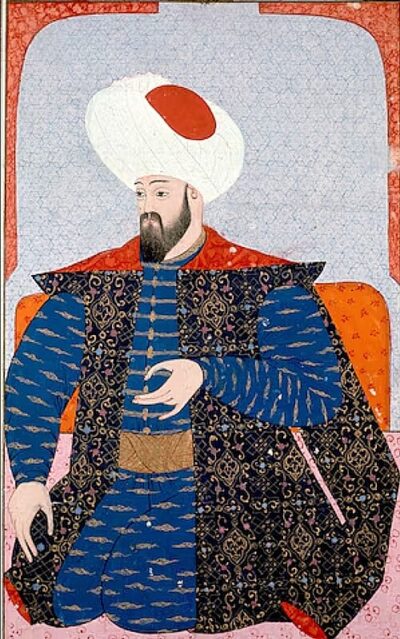
Osman I
Osman I was a founder of the Ottoman Empire (died 1323/4). Born August 23, 1258, in Söğüt. Died August 1, 1326, in Söğüt. Positions held include sultan of the Ottoman Empire (1299–1324).
Facts
22 facts · 0 confirmed by two sources · 4 cited · 18 from one source
Where this comes from
Papalocal keeps its own record. It started from these sources; what each one said is kept here as it was copied, so a change on their side never changes this page by itself. Tap one to read its version.
What Wikidata says · copied November 16, 2026 · revision 2565542681
- Described as
- founder of the Ottoman Empire (died 1323/4)
- Other names
- Othman I, Osman Ghazi, I. Osman
- Born
- August 23, 1258
- Died
- August 1, 1326 · 1 reference
- Born in
- Söğüt
- Died in
- Söğüt · 1 reference
- Buried in
- Bursa
- Occupation
- governor; sultan · 1 reference
- Positions held
- sultan of the Ottoman Empire (1299–1324) · 1 reference
- Spouse
- Rabia Bala Mal Hatun; Malhun Hatun · 1 reference
- Children
- Orhan · 1 reference; Alaeddin Pasha; Fatma Hatun; Çobanbey; Pazarlı Bey; Hamid Bey; Melik Bey; Savcı Bey
- Father
- Ertuğrul
- Mother
- Halime Hatun
- Siblings
- Gündüz Bey
- Religion
- Islam
- Wikipedias with a page
- 103
Wikidata item Q83100 (wikidata.org/wiki/Q83100), public domain (CC0). Copied November 16, 2026.
What Wikipedia says · copied November 16, 2026 · revision 1384191914
Osman I or Osman Ghazi (Ottoman Turkish: عثمان غازى, romanized: ʿOsmān Ġāzī; Turkish: I. Osman or Osman Gazi; died 1323/4) was the eponymous founder of the Ottoman Empire (first known as a beylik or emirate). While initially a small Turkoman principality during Osman's lifetime, his beylik transformed into a vast empire in the centuries after his death. It existed until 1922, shortly after the end of World War I, when the sultanate was abolished.
Owing to the scarcity of historical sources dating from his lifetime, very little factual information about Osman has survived. Not a single written source survives from Osman's reign, and the Ottomans did not record the history of his life until the fifteenth century, more than a hundred years after his death. Because of this, historians find it very challenging to differentiate between fact and myth in the many stories told about him. One historian has even gone so far as to declare it impossible, describing the period of Osman's life as a "black hole".
According to later Ottoman tradition, Osman's ancestors were descendants of the Kayı tribe of Oghuz Turks. However, many scholars of the early Ottomans regard it as a later fabrication meant to reinforce dynastic legitimacy.
The Ottoman principality was one of many Anatolian beyliks that emerged in the second half of the thirteenth century. Situated in the region of Bithynia in the north of Asia Minor, Osman's principality found itself particularly well placed to launch attacks on the vulnerable Byzantine Empire, which his descendants would eventually go on to conquer.
From the Wikipedia article “Osman I” (en.wikipedia.org/wiki/Osman_I), by its contributors, under CC BY-SA 4.0 (creativecommons.org/licenses/by-sa/4.0/). Copied November 16, 2026; not changed.
Confirmed Two sources agree. Cited One source, and it names where it got it. One source One source, without a reference of its own. Sources disagree The sources disagree. We show the best-supported value and keep theirs below.
