
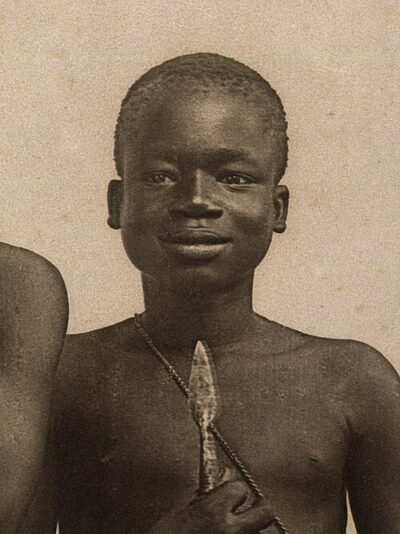
Ota Benga
Ota Benga was a Mbuti pygmy featured in an anthropology exhibit in 1904. Born 1883, in Ituri rainforest. Died March 20, 1916, in Lynchburg.
Facts
7 facts · 2 confirmed by two sources · 1 cited · 3 from one source · 1 where the sources disagree
What’s different
- Born in: we show Ituri rainforest (Sources disagree). Wikidata also lists Kasai River
Where this comes from
Papalocal keeps its own record. It started from these sources; what each one said is kept here as it was copied, so a change on their side never changes this page by itself. Tap one to read its version.
What Wikidata says · copied November 16, 2026 · revision 2561310775
- Described as
- Mbuti pygmy featured in an anthropology exhibit in 1904
- Other names
- Mbye Otabenga
- Born
- 1883 · 1 reference
- Died
- March 20, 1916 · 2 references
- Born in
- Kasai River; Ituri rainforest · 1 reference
- Died in
- Lynchburg · 2 references
- Buried in
- Lynchburg
- Cause of death
- gunshot wound
- Height
- 1.50 m (4 ft 11 in)
- Wikipedias with a page
- 31
Wikidata item Q557565 (wikidata.org/wiki/Q557565), public domain (CC0). Copied November 16, 2026.
What Wikipedia says · copied November 16, 2026 · revision 1380242462
Ota Benga (c. 1883 – March 20, 1916) was a Mbuti (Congo pygmy) former slave and performer at an exhibit at the 1904 Louisiana Purchase Exposition in St. Louis, Missouri, and as a human zoo exhibit in 1906 at the Bronx Zoo. Benga had been purchased from native African slave traders by Samuel Phillips Verner, a businessman searching for African people for the exhibition, who brought him to the United States and hired him for stagework. While at the Bronx Zoo, Benga was allowed to walk the grounds before and after he was exhibited in the zoo's Monkey House. Benga was placed in a cage with an orangutan, regarded as both an offense to his humanity and a promotion of social Darwinism.
To enhance the primitive image and presumably protect himself if need be from the ape, he was given a functional bow and arrow. He used this instead to shoot at visitors who mocked him and partially as a result of this the exhibition was ended. Except for a brief visit to Africa with Verner after the close of the St. Louis fair, Benga lived in the United States, mostly in Virginia, for the rest of his life.
African-American newspapers around the nation published editorials strongly opposing Benga's treatment. Robert Stuart MacArthur, spokesman for a delegation of black churches, petitioned New York City mayor George B. McClellan Jr. for his release from the Bronx Zoo. In late 1906, the mayor released Benga to the custody of James H. Gordon, who supervised the Howard Colored Orphan Asylum in Brooklyn.
In 1910, Gordon arranged for Benga to be cared for in Lynchburg, Virginia, where he paid for his clothes and to have his sharpened teeth capped. This would enable Benga to be more readily accepted in local society. Benga was tutored in English and began to work at a Lynchburg tobacco factory.
He tried to return to Africa, but the outbreak of World War I in 1914 stopped all passenger ship travel. Benga developed depression and died by suicide in 1916.
- Born, in its opening lines
- c. 1883
- Died, in its opening lines
- March 20, 1916
From the Wikipedia article “Ota Benga” (en.wikipedia.org/wiki/Ota_Benga), by its contributors, under CC BY-SA 4.0 (creativecommons.org/licenses/by-sa/4.0/). Copied November 16, 2026; not changed.
Confirmed Two sources agree. Cited One source, and it names where it got it. One source One source, without a reference of its own. Sources disagree The sources disagree. We show the best-supported value and keep theirs below.
