
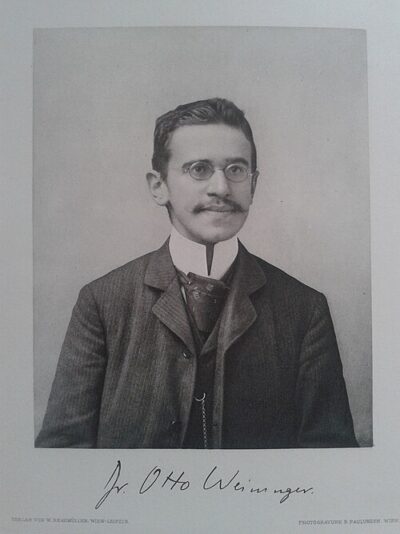
Otto Weininger
Otto Weininger was an Austrian philosopher and writer. Born April 3, 1880, in Vienna. Died October 4, 1903, in Vienna. Known for Sex and Character. Educated at University of Vienna.
Facts
17 facts · 2 confirmed by two sources · 6 cited · 9 from one source
Where this comes from
Papalocal keeps its own record. It started from these sources; what each one said is kept here as it was copied, so a change on their side never changes this page by itself. Tap one to read its version.
What Wikidata says · copied November 16, 2026 · revision 2569140120
- Described as
- Austrian philosopher and writer (1880-1903)
- Born
- April 3, 1880 · 9 references
- Died
- October 4, 1903 · 9 references
- Born in
- Vienna · 3 references
- Died in
- Vienna · 3 references
- Buried in
- Matzleinsdorf Protestant Cemetery
- Cause of death
- gunshot wound · 1 reference
- Citizen of
- Cisleithania · 1 reference
- Occupation
- philosopher · 2 references; writer · 1 reference; psychologist · 2 references
- Education
- University of Vienna
- Known for
- Sex and Character · 1 reference
- Field
- philosophy; gender studies; psychology · 1 reference
- Siblings
- Richard Weininger · 1 reference
- Religion
- Lutheranism · 1 reference
- Wikipedias with a page
- 58
Wikidata item Q78513 (wikidata.org/wiki/Q78513), public domain (CC0). Copied November 16, 2026.
What Wikipedia says · copied November 16, 2026 · revision 1380699150
Otto Weininger (German: [ˈvaɪnɪŋɐ]; 3 April 1880 – 4 October 1903) was an Austrian philosopher who in 1903 published the book Geschlecht und Charakter (Sex and Character), which gained popularity after his suicide at the age of 23. Weininger had a strong influence on Ludwig Wittgenstein, August Strindberg, and, via his lesser-known work Über die letzten Dinge, on James Joyce.
- Born, in its opening lines
- April 3, 1880
- Died, in its opening lines
- October 4, 1903
From the Wikipedia article “Otto Weininger” (en.wikipedia.org/wiki/Otto_Weininger), by its contributors, under CC BY-SA 4.0 (creativecommons.org/licenses/by-sa/4.0/). Copied November 16, 2026; not changed.
Confirmed Two sources agree. Cited One source, and it names where it got it. One source One source, without a reference of its own. Sources disagree The sources disagree. We show the best-supported value and keep theirs below.
